Calorimetry Problems and Intro to Enthalpy
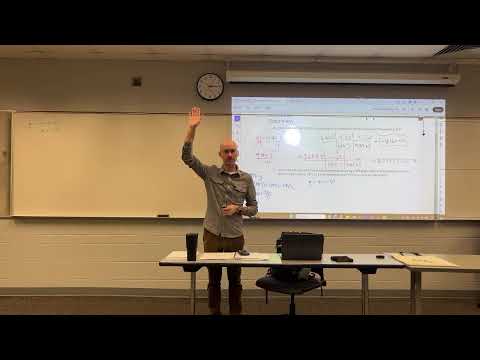
Overview
John Flood develops calorimetry problem-solving from heat capacity and specific heat through energy conservation between a reacting system, its solution, and a bomb calorimeter. He then introduces enthalpy as the heat transferred at constant pressure, explaining its units per mole of reaction, sign, phase dependence, extensive nature, and the lattice enthalpy trends predicted by ionic charge and distance.
Key takeaways
- Heat capacity and specific heat differ by sample size: C = m c, so an 876 g sample with c = 2.15 cal/(g·°C) has C = 188 cal/°C.
- In a two-substance calorimetry problem, energy conservation requires equal and opposite heat changes; the metal’s negative ΔT and water’s positive ΔT produce a positive specific heat.
- A bomb-calorimeter reaction transfers heat to both the liquid and the bomb: Qreaction = −(m c + Cbomb)ΔT, with the liquid’s mass and heat capacity defined consistently.
- A reaction enthalpy such as −82.8 kJ/mol must be scaled to the actual quantity reacted; 8.32 g CaCl₂ corresponds to far less than one mole and about −6.2 kJ, not −82.8 kJ.
- At constant pressure, ΔH = q; reaction enthalpy is reported per mole of the specified reaction, and its value depends on the balanced equation and physical phases.
- Enthalpy is extensive: halving the coefficients in hydrogen combustion halves the enthalpy from −572 to −286 kJ per mole of reaction, while ionic charge and ion separation govern lattice enthalpy.
Chapters
- Introduces calorimetry problem-solving through heat transfer and temperature change.
- The central relationship used in the worked examples is Q = m c ΔT, where mass and specific heat determine heat flow.
- For an 876 g sample with specific heat 2.15 cal/(g·°C), John Flood derives heat capacity as C = Q/ΔT = m c.
- The temperature-change terms cancel, leaving 876 × 2.15 = 188 cal/°C to three significant figures.
- The answer uses calories because the given specific heat is in calories, not joules.
- For the 876 g sample, the cooling calculation uses Q = m c ΔT with c = 0.215 cal/(g·°C).
- The resulting heat is about −82,100 cal, or −82.1 food Calories, to three significant figures.
- The negative sign indicates heat leaves the sample; using the heat capacity instead is also valid if C and ΔT are known.
- A 345.0 g metal sample cools from 325.0°C to 93.6°C while 250.0 g of water warms from 25.0°C to 93.6°C.
- At thermal equilibrium, the metal and water exchange equal and opposite heat, so their m c ΔT expressions can be equated.
- Using water’s specific heat of 4.184 J/(g·°C), the metal’s specific heat is about 0.899 J/(g·°C).
- The negative temperature change for the metal and positive change for water cancel in the energy balance, yielding a physically positive specific heat.
- Question 8 asks for a final temperature, which requires rearranging the heat-balance equation rather than directly substituting into Q = m c ΔT.
- John Flood prefers doing the algebra with symbols before inserting numerical values and units.
- The example combines calcium chloride, water, and a bomb calorimeter.
- The example uses 8.32 g CaCl₂ mixed with 150 g of water initially at 24.8°C.
- The bomb calorimeter has heat capacity 92.7 J/°C, and the solution is assigned a specific heat of 4.00 J/(g·°C).
- The reaction enthalpy is given as −82.8 kJ/mol, requiring conversion from a per-mole value to the heat released by the actual sample.
- The reaction’s heat is distributed between the solution and the bomb, so the energy balance must include both heat terms.
- Because the solution and bomb undergo the same temperature change, ΔT can be factored from their combined heat capacity.
- The resulting balance is Qreaction = −(m csolution + Cbomb)ΔT.
- Solving the combined heat balance gives ΔT = −Qreaction/(m csolution + Cbomb).
- Since ΔT = Tfinal − Tinitial, the final temperature is the initial temperature plus the calculated temperature change.
- This derivation makes clear why the bomb’s heat capacity must be added to the solution’s effective heat capacity.
- The 8.32 g CaCl₂ sample is not one mole; using an approximate molar mass of 111 g/mol gives substantially less than a mole.
- Dimensional analysis converts grams of CaCl₂ to moles, applies −82.8 kJ per mole of reaction, and converts kilojoules to joules.
- The example obtains about −6,206 J for the actual sample, rather than applying −82.8 kJ to an amount smaller than one mole.
- The initial calculation combines the sample’s reaction heat with a total heat-capacity denominator to estimate a final temperature near 33.3°C.
- The arithmetic checks that joules cancel and the temperature change is in degrees Celsius.
- John Flood later flags a possible setup error: he likely included the CaCl₂ mass in the solution mass when the reference approach uses the water mass, so the numerical result should be treated cautiously.
- John Flood outlines the remaining lecture schedule, including Module 21 on enthalpy and later coverage of Units 9 and 10.
- The Unit 6 to 8 test is expected to remain open through Thanksgiving break, with the Canvas due date to determine whether it closes November 29 or December 1.
- The final-week ACS standardized exam is 50 minutes; for face-to-face students, a low unit test can be dropped and replaced if the ACS score is higher.
- The bomb-calorimeter relation is Qbomb = Cbomb ΔT, and the reaction’s heat is absorbed by both the water or solution and the bomb.
- John Flood acknowledges that the earlier example’s data and solution path may be faulty, including whether the CaCl₂ mass belongs in the solution mass.
- Using the water’s mass rather than the combined salt-and-water mass changes the denominator and therefore the predicted final temperature.
- Enthalpy is represented by H, but chemistry problems generally measure changes in enthalpy, ΔH, rather than absolute H.
- The defining relationship is H = E + PV, combining internal energy with pressure-volume energy.
- The lesson connects enthalpy changes to heat flow in common constant-pressure processes.
- The change in enthalpy is ΔH = ΔE + PΔV when pressure is constant.
- Using ΔE = q + w and pressure-volume work w = −PΔV cancels the work terms, leaving ΔH = q at constant pressure.
- Calorimetry relationships such as Q = m c ΔT can therefore be used to determine ΔH for constant-pressure processes.
- Reaction enthalpy is expressed in J/mol or kJ/mol, not merely as an unqualified energy amount.
- For hydrogen combustion, 2 H₂(g) + O₂(g) → 2 H₂O(g) is associated with −572 kJ per mole of reaction.
- A mole of reaction means the stated chemical equation occurs 6.022 × 10²³ times, with its coefficients defining the reacting amounts.
- Hydrogen combustion producing liquid water releases about 572 kJ per mole of reaction, while producing water vapor releases about 484 kJ per mole.
- The different values reflect the product phase, so enthalpy data must specify whether water is liquid or gas.
- Bond breaking and bond formation contribute to reaction energy, but reactions can either release energy or require energy.
- A positive ΔH identifies an endothermic process that absorbs heat.
- A negative ΔH identifies an exothermic process that releases heat.
- The sign communicates whether energy enters or leaves the system, so it must be preserved through calorimetry calculations.
- Enthalpy is an extensive property, so its value changes with the amount of material reacting.
- Halving hydrogen combustion from 2 mol H₂ to 1 mol H₂ halves the reaction enthalpy from −572 kJ to −286 kJ per mole of reaction.
- Fractional coefficients are acceptable when an enthalpy definition specifies a particular amount, such as one mole of hydrogen.
- Lattice enthalpy is defined here as the energy required to separate one mole of an ionic solid into gaseous ions.
- For NaCl(s) → Na⁺(g) + Cl⁻(g), the lattice enthalpy is +769 kJ/mol.
- The positive sign reflects the energy required to overcome the strong attraction between oppositely charged ions.
- Lattice enthalpy depends on ionic charges and the distance between ions, consistent with a Coulomb-style relationship proportional to charge product and inversely related to separation.
- Higher ionic charges produce much larger lattice enthalpies: LiF is about 1,023 kJ/mol, while MgO is about 3,900 kJ/mol.
- For magnesium salts, the smaller F⁻ ion gives MgF₂ a higher lattice enthalpy, about 2,957 kJ/mol, than the larger I⁻ ion gives MgI₂, about 2,327 kJ/mol.
- Upcoming enthalpy topics include bond dissociation energy, heat of reaction, heat of combustion, and enthalpy of formation.
- Many definitions specify producing or burning exactly one mole of a substance, which can require fractional coefficients for other reactants or products.
- For hydrogen combustion defined per mole of H₂, the balanced enthalpy equation uses ½ O₂ rather than requiring all coefficients to be whole numbers.
Transcript excerpt
1:41 I >> Do we? We might.
24:37 This is what we're interested in in in question A. We're interested in big C being Q divided by delta T. And this is the information that is given us. Do I know delta T? Sure. But do I know Q? No. Could I solve for Q? Sure. Q equals MCat. But look at what MCat requires. MC and delta T. I have all of those. But I feel like there's an easier way to do this. The long way is to solve for Q and then plug it back in. There's actually a shorter way to do this. Nick, you had a a thought?
25:23 A question? >> solve for Q but >> We could solve for Q. Cat. Kate. Sorry. >> Sorry. >> I No, I I think I see what you're saying. Instead of solving for Q, substitute for Q. Since Q equals MCat, we can plug this in directly, which means big C equals MCat over delta T. Oh.
26:11 Delta T cancels. And all I'm really doing to solve this problem is taking the mass times the specific heat. But of course, that's the difference. The difference between heat and specific heat is how much you have. So, we plug this in. I've got 876 grams times a specific heat of 2.15 calories per gram degree C. Notice how grams cancels out and I'll be left with calories per degree C. That is heat capacity. What do we get?
26:59 >> 188.34 >> I believe you. 188 point 34 units on that, Kaden? >> Um calories over degree C. >> Calories per degree C. Now, if we want to limit this to sig figs >> 188 >> 188 I've got three sig figs in my mass, three sig figs in my specific heat.
This is the start of the transcript. Save this video free for the whole transcript, searchable and time-coded.
In this course
Related notes
Summary, takeaways, and chapters were generated by AI from the video's transcript and may contain errors. The video belongs to its creator, John Flood Chemistry.