Pathology Introduction 1of2
 Watch on YouTube →
Overview
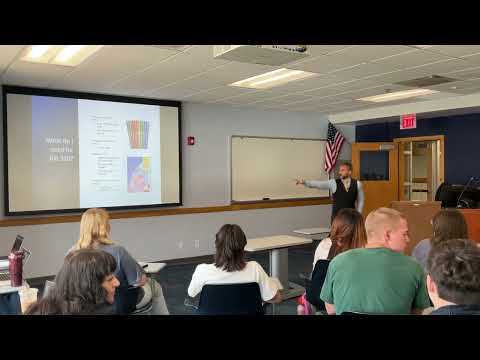
Robert Kellar, Ph.D., introduces NAU’s hybrid BIO320 General Pathology course, outlining its Canvas resources, study expectations, assessment schedule, and standards for professional conduct. He encourages students to prepare before lectures, form study groups, and use AI as a reference rather than a substitute for learning, then begins defining pathology as the study of disease or suffering and epidemiology as the study of illness across populations.
Key takeaways
- BIO320 requires no textbook purchase: students can access the 10th-edition PDF on Canvas or use a physical 8th- or 9th-edition copy.
- The course’s 300 exam points come from three 100-point exams; 12 pre-quizzes and 12 post-quizzes provide additional practice, with the lowest score in each quiz set dropped.
- Online exams are open-resource but time-limited: the first exam has 50 questions in 60 minutes, so students need to know most answers before looking them up.
- Kellar permits AI use on quizzes and exams but stresses that students need foundational pathology knowledge to judge AI answers and prepare for clinical work.
- Pathology means the study of disease or suffering, while epidemiology focuses on illness across populations, including spread and infection rates.
- Marfan syndrome can affect multiple systems, but cardiovascular complications involving the heart or aorta are especially important; Kellar encountered this in work on aortic stent grafts at W. L. Gore & Associates.
Chapters
- Robert Kellar welcomes students to BIO320 General Pathology and explains that the in-person and online sections cover essentially the same course.
- The opening activities use dad jokes and a visual-number puzzle to help students meet nearby classmates.
- Kellar recommends forming study groups, introducing collaboration as part of the course’s learning approach.
- Students can use a PDF of the 10th-edition textbook on Canvas or find a used 8th- or 9th-edition print copy; no textbook purchase is required.
- Quizzes and exams are delivered through Canvas, while recorded lectures are posted on YouTube.
- Kellar explains that the in-person section responds to student requests for live lectures after the course expanded successfully online during COVID.
- Kellar advises students to schedule enough independent study time, emphasizing that the amount varies by person rather than prescribing a fixed weekly number.
- In-person students already spend about 2.5 hours each week in lecture, so he urges them not to forfeit that scheduled exposure to course material.
- Students should silence phones and other notifications during the 75-minute class; missed lectures are generally posted to YouTube within 24 to 48 hours.
- The course has Tuesday and Thursday quizzes due by 11:59 p.m., with pre-quizzes and post-quizzes supporting work before and after lecture.
- Kellar recommends reading the assigned material and reviewing Canvas lecture slides before class, then bringing written questions to the lecture.
- Study groups can help students explain difficult material in different ways, while recorded lectures offer a repeatable review resource.
- Kellar describes AI as a lasting technology and useful study tool, but warns that using it to supply quiz answers does not build the knowledge students need for future work.
- He compares AI’s emergence with the early internet, arguing that students should learn responsible, informed use rather than avoid the technology.
- Clinicians can use medical AI tools more safely when they already have enough foundational knowledge to assess whether an answer is accurate.
- Kellar earned his undergraduate, master’s, and Ph.D. degrees at the University of Arizona, completing a Ph.D. in physiology with research involving bioengineering.
- After working for a San Diego startup, he moved to Flagstaff in 2003 and spent five years at W. L. Gore & Associates, a medical-device company.
- He began teaching part-time around 2008 and later combined teaching with campus research, consulting, and biotech startup work.
- Regular office hours are Mondays from 2 to 3 p.m. in the Weta room 211, with Zoom appointments available for students whose schedules conflict.
- Kellar says weekly Canvas announcements explain the work due and help keep the in-person and online sections aligned.
- The syllabus provides the Tuesday and Thursday class schedule, YouTube lecture links, optional materials, and course grading information.
- The course has three 100-point exams, for 300 exam points total; each exam is cumulative, though most questions cover newly taught material.
- There are 12 pre-quizzes and 12 post-quizzes, and Kellar drops each student’s lowest quiz score in recognition of illness or technical problems.
- The grading scale is fixed from the start: 89.5% rounds to an A, while 89.4999% rounds down to a B.
- Students may challenge an exam question by presenting evidence and discussing it professionally with Kellar before the semester ends.
- Kellar expects complete-sentence emails and respectful communication, framing disagreement as practice for clinical and workplace collaboration.
- AI is permitted on open-resource quizzes and exams, but Kellar cautions that depending on it can undermine learning and connects academic honesty with professional integrity.
- The first exam is scheduled for September 30 and is taken online, with 50 questions and a 60-minute time limit.
- Students can take exams at home, in a dorm, or in the library, but a reliable internet connection matters because the exam clock continues after a disconnection.
- The final is scheduled for December 9 and can be taken between 7 a.m. and 11:59 p.m.; a few lectures will be online when Kellar is away.
- Cumulative material is expected to make up roughly 5 to 10% of an exam, or at most about five questions on a 50-question test.
- Kellar presents cumulative review as practice for retaining information in future careers, while noting that open-book resources reflect real-world access to reference materials.
- Students pursuing honors can arrange a term paper with Kellar, developing a topic, outline, draft, and final paper through scheduled feedback.
- Kellar defines pathology as the study of disease, or literally the study of suffering, rather than limiting it to pathogens or disease mechanisms.
- Epidemiology examines illness across populations, including how diseases spread and measures such as infection and death rates, illustrated by COVID-19 dashboards.
- Students practice naming diseases and linking them to affected organ systems: COVID-19 is associated primarily with the respiratory system, while Marfan syndrome can seriously affect the cardiovascular system and aorta.
- Kellar connects Marfan syndrome to his medical-device experience at W. L. Gore & Associates, where the company built aortic stent grafts for patients.
Transcript excerpt
0:01 So, welcome. You should be in general pathology. So, this is bio320. And looks like we have one seat available right here, the coveted seat. It's kind of interesting. It's like um probably some physical law, the opposite of diffusion, which is where students with their seats move will migrate as far away from possible from the professor. You guys see that? You're all like clustered back there. [snorts] Um so there's a seat here. Is anybody trying to add this class? Okay. All right. Good. Everyone's enrolled. Okay. Perfect. Everyone's enrolled in
0:47 the in-person session. Okay. So, we have an in-person and we have an online uh course and they're going to be basically the same class. The difference is you're coming to lecture in person. Clearly, I'm recording the lectures and that's what I do. Uh we use that as a study tool. I also use it a tool to to build exams. Uh so today we're going to get into a little content, but we're going to kind of walk through mostly like this organization of the class, how it's structured, uh tips and tricks on how to be successful. Okay, I'll tell a little bit about myself. I want to hear a little bit about you. It's it's actually maybe this doesn't seem like it, but this is a pretty small classroom for me. Like I really like this. I can see all of you.
1:36 Um it's it's a little tight, I think, from a you know, stuffiness standpoint. So, we'll try to keep the doors open. I do have a fan here that I haven't tried to use yet, so we can kind of blow some air if we need. All right. Um, [clears throat] so first up, years ago, and those of you I see some
This is the start of the transcript. Save this video free for the whole transcript, searchable and time-coded.
Related notes
Summary, takeaways, and chapters were generated by AI from the video's transcript and may contain errors. The video belongs to its creator, Robert Kellar, Ph.D..