Pathology Introduction 2of2
 Watch on YouTube →
Overview
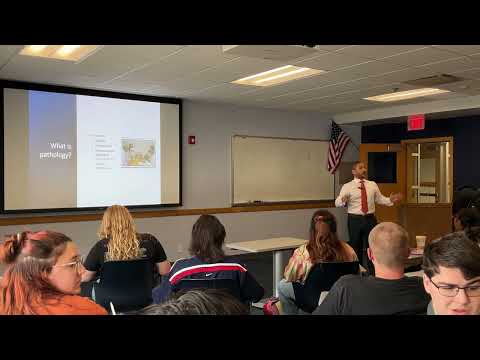
Robert Kellar introduces a framework for analyzing disease through etiology, pathogenesis, morphology, and clinical significance, then applies it to Barrett esophagus. Chronic GERD can injure the esophagus and prompt a metaplastic shift from protective squamous epithelium to goblet-cell-containing columnar epithelium; persistent damage can progress toward dysplasia and esophageal adenocarcinoma. Kellar also connects the pathology concepts to medical-device development, describing Merit Medical’s RAPSODY stent graft, Nitinol deployment, and the long, costly clinical-approval process.
Key takeaways
- GERD results when the lower esophageal sphincter permits hydrochloric acid to reflux into the esophagus, causing chronic injury in tissue not designed to tolerate stomach acid.
- Barrett esophagus is a metaplastic adaptation: protective stratified squamous epithelium is replaced by mucus-producing, goblet-cell-containing columnar epithelium.
- Metaplasia can be reversible when the damaging stimulus is removed, but persistent injury can alter regenerative cells and contribute to dysplasia and esophageal adenocarcinoma.
- Kellar identifies Barrett mucosa longer than 3 cm as a higher-risk finding, associated in the lecture with 30- to 40-fold greater risk of esophageal adenocarcinoma.
- Pathology analysis combines four questions: what caused the disease, how it progresses, what structural changes occur, and what those changes mean for diagnosis, treatment, and prognosis.
- Medical-device costs reflect more than manufacturing: Kellar describes clinical-trial phases costing $20 million to $60 million and a roughly 15-year path to FDA approval for the RAPSODY stent graft.
Chapters
- Kellar describes designing stent grafts for vessels including the aorta, and passes around examples made for Merit Medical in Sandy, Utah.
- The RAPSODY device uses Nitinol, a shape-memory alloy that compresses into a catheter and expands to reline a vessel from the inside.
- He estimates clinical-trial phases at $20 million to $60 million each and explains that testing, manufacturing, and regulatory requirements make devices costly.
- Kellar says he worked on the project for five years and that roughly 15 years passed before FDA approval.
- Etiology identifies a disease’s origin or cause, while pathogenesis describes how the disease develops or progresses.
- Morphology examines changes in tissue shape and architecture, both grossly and microscopically.
- Gross observations are visible to the unaided eye; microscopic observations rely on tools such as light or electron microscopy.
- Clinical significance includes diagnosis, treatment options, prognosis, severity, and whether a condition is manageable or life-threatening.
- Barrett esophagus is named for Norman Rupert Barrett, an Australian-born esophageal surgeon who published on the condition in 1957.
- Kellar says about 10% of people with GERD develop Barrett esophagus, while most do not.
- GERD occurs when a weakened lower esophageal sphincter allows stomach hydrochloric acid to reflux into the esophagus, whose lining is not adapted to acid exposure.
- Repeated, often untreated reflux creates chronic injury; metaplasia may develop after many years of exposure.
- The esophagus normally has stratified squamous epithelium, which protects against abrasion during swallowing.
- Barrett metaplasia replaces that lining with columnar epithelium containing goblet cells, which produce protective mucus.
- Endoscopic images can show loss of the normal pale, glistening squamous surface; biopsy with hematoxylin and eosin staining can identify goblet cells.
- Persistent inflammation and injury can advance toward esophageal adenocarcinoma, a lesion that may grow into and obstruct the esophageal lumen.
- Adult stem cells in the esophageal basal layer renew tissue after damage, much as the skin’s stratum basale supports epithelial turnover.
- Metaplasia is a change from one differentiated cell type to another and can be reversible if the acid injury is removed.
- Kellar distinguishes embryonic stem cells, described as totipotent, from adult stem cells, which have more limited pluripotency.
- He explains that continued injury can mutate the regenerative cell population and contribute to a less reversible cancerous state; induced pluripotent stem cells are introduced as adult cells reprogrammed with transcription factors.
- Kellar identifies middle-aged white men as the most prevalent demographic group, while noting that Barrett esophagus can affect people of other sexes and ethnicities.
- Barrett mucosa extending more than 3 cm is associated in the lecture with a 30- to 40-fold higher risk of esophageal adenocarcinoma.
- Dysplasia means abnormal tissue development or growth and represents progression beyond metaplasia, though it is not the same as metastatic cancer.
- The distinction is exam-relevant: metaplasia describes a cellular change, while dysplasia describes abnormal growth at the tissue level.
- Kellar contrasts esophageal reflux injury with damage near the stomach-duodenum interface, where ulcers can disrupt normal epithelial and connective-tissue structure.
- He discusses immune-cell-rich Peyer’s patches and inflammatory tissue changes in the context of intestinal pathology.
- The course will repeatedly organize disease study around etiology, pathogenesis, clinical significance, and gross and microscopic morphology.
- He recommends reviewing anatomy and physiology prerequisites, reading slides ahead, and using office hours or earlier course lectures to refresh foundational material.
Transcript excerpt
0:03 Okay, folks. Uh, a couple of things. So, just reminder to silence your phones if you don't mind. I just did mine. Um, [clears throat] so again, we don't have any assignments this week. It's all lecture kind of getting organized and oriented to the way the class works. Um, we're gonna we're going to kind of start back with this from from Tuesday because it's going to set this tone for the first disease that we're going to look at. Uh, but before I go there, uh, what did baby corn say to mama? No. No ideas. Where's Where's popcorn?
0:53 Nicely done. What's the best thing about Switzerland? >> The flag is a big plus. I asked my dog, "What's 2 minus two?" Guess what he said? Nothing. Okay. If you don't get it, turn to your neighbor. The other one that Joseph asked for was some relevant real world experience. So this is a [clears throat] company you can look them up. They're in uh Salt Lake City. So after I left Gore, I started it's kind of like a mercenary for hire. I just get hired by companies to do projects. We call it a consultant, but mercenary for hire sounds more cool.
1:42 It sounds like I was like in battle or something. Uh but really I was just a biomedical consultant. So we would make stent graphs. So, this is a stent graph that I talked about that we made like for the aorta. And I think I might have gotten the numbers wrong or the units wrong. I think I told you that your aorta is probably about two uh centimeters or 20 millimeters. And as you age into your 50s and 60s, it can double in size. Okay. So this is um uh these are stent graphs
This is the start of the transcript. Save this video free for the whole transcript, searchable and time-coded.
Related notes
Summary, takeaways, and chapters were generated by AI from the video's transcript and may contain errors. The video belongs to its creator, Robert Kellar, Ph.D..