Nucleophlic Substitution and Elimination: Summary and Flowchart
Overview
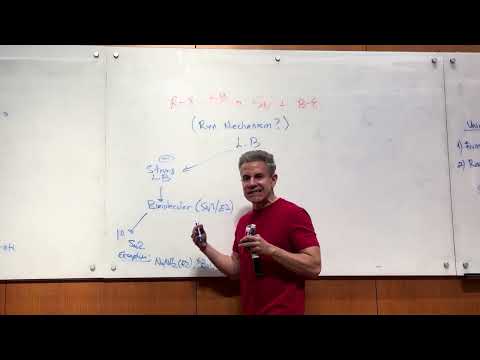
The chapter’s decision process begins by identifying whether a haloalkane reacts with a strong or weak Lewis base, then uses substrate structure and base properties to distinguish SN2, E2, SN1, and E1. It connects each mechanism to product prediction, including SN2 inversion, E2 anti-periplanar geometry and alkene regioselectivity, and carbocation rearrangements and product mixtures in unimolecular pathways.
Key takeaways
- A negatively charged Lewis base directs the initial decision toward SN2 or E2, while a weak Lewis base points to carbocation-forming SN1 or E1 pathways.
- For primary haloalkanes, strong bases typically produce SN2, except sodium amide, which favors elimination, and bulky potassium tert-butoxide, which obstructs backside attack.
- SN2 is a one-step backside attack that inverts configuration at a reacting chiral center; steric hindrance controls its rate.
- E2 requires anti-periplanar alignment, or a trans-diaxial arrangement in cyclohexanes, and that geometry controls the alkene’s stereochemistry.
- In E2, regular bases tend to favor more substituted alkenes and bulky bases less substituted alkenes; for secondary substrates, conjugate-acid pKa above 12 indicates E2 and below 12 indicates SN2.
- SN1 and E1 share a carbocation intermediate, so rearrangements can occur before either product forms; SN1 can yield racemic products, while E1 favors the most stable alkene.
Chapters
- Haloalkanes undergo substitution or elimination because the polarized carbon-halogen bond makes the halogen a good leaving group.
- A negatively charged Lewis base is treated as strong, leading to bimolecular SN2 or E2 pathways.
- With a primary haloalkane, strong bases generally favor SN2; sodium amide favors elimination, while bulky potassium tert-butoxide disfavors backside attack.
- A tertiary haloalkane with a strong base favors E2 because steric hindrance prevents SN2.
- SN2 occurs in one step by backside attack; steric hindrance affects its rate, and reaction at a chiral center gives inversion of configuration.
- E2 requires an anti-periplanar beta hydrogen and leaving group; cyclohexane substrates require a trans-diaxial arrangement.
- E2 stereochemistry depends on the reactive conformation, making the reaction stereospecific and determining the alkene geometry.
- A regular base generally favors the more substituted, more stable alkene, while a bulky base favors the less substituted alkene; for secondary substrates, conjugate-acid pKa above 12 points to E2 and below 12 to SN2.
- A weak Lewis base leads to a unimolecular pathway: form a carbocation first, then check for rearrangement before drawing products.
- SN1 and E1 products can coexist because they share the carbocation pathway; SN1 formation of a chiral center gives a racemic mixture.
- E1 favors the most stable alkene, and distinct beta-hydrogens on the carbocation can produce multiple E1 alkenes.
- The recommended study sequence is to summarize each mechanism, draw its steps and products, explain it to someone else, and only then practice problems.
Transcript excerpt
0:00 because you will need it. Uh it may be highly useful, hopefully. So, what I'm going to do right now is to summarize the chapter. And I'm going to emphasize this because this is what you should be doing at home when you study for this class. And one of the things that I noticed is that a lot of you need help on how to study better for the exams of organic chemistry. So, I want to use this specific chapter to showcase how exactly you have to study for organic chemistry and for the exams, right? Okay, so in this chapter, uh you must be So, we have been learning about uh haloalkanes reacting with Lewis bases, and we know that that leads to nucleophilic substitution and elimination. And we know that these are two competing
0:50 reactions. So, that's that's that's a given, and the reason for that is because halogens are uh electronegative, right? So, we have a bond polarized uh in between the the alpha carbon and the halogen, and halogens are very good leaving groups. So, that's what That's actually what makes the haloalkanes great substrates for substitution and elimination. So, to write a product of uh an again, I'm presenting this summary in a generic way, which is it doesn't matter which haloalkane, it doesn't matter which Lewis base. I need to know how to deal with any reaction that I'm given. Okay, that's the point of how to study for this class. So, when I see a reaction between a Lewis base and a haloalkane, the number one thing that I'm going to do before writing anything is to identify what's the reaction
1:39 mechanism. So, that's the number one question that you guys must be asking yourself. What is the dominant mechanism in these specific reaction
This is the start of the transcript. Save this video free for the whole transcript, searchable and time-coded.
In this course
Related notes
Summary, takeaways, and chapters were generated by AI from the video's transcript and may contain errors. The video belongs to its creator, Organic Chemistry by Prof Gerona-Navarro.