Hydration of a Substituted Cycloalkene: H20/H+ vs. Oxymercuration–Reduction vs. BH3/THF–Oxidation
Overview
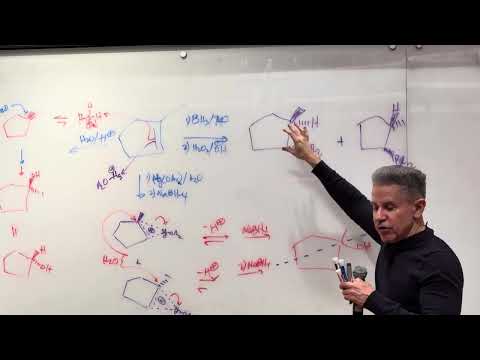
The worked example compares three ways to hydrate a substituted cycloalkene: acid-catalyzed hydration, oxymercuration-reduction, and hydroboration-oxidation. Their mechanisms explain the different outcomes: acid and oxymercuration place OH on the more substituted alkene carbon, while hydroboration places OH on the less substituted carbon and gives syn addition of H and OH; avoiding a free carbocation also avoids rearrangements.
Key takeaways
- Acid-catalyzed hydration with H2O and acid gives Markovnikov regiochemistry because water attacks the more substituted carbocation formed after alkene protonation.
- Oxymercuration uses Hg(OAc)2 and H2O to form a bridged mercurinium ion; anti attack by water gives Markovnikov hydration without a free carbocation or expected rearrangements.
- Hydroboration-oxidation with BH3·THF followed by H2O2 and NaOH gives an anti-Markovnikov alcohol because boron initially bonds to the less substituted alkene carbon.
- Hydroboration adds H and boron syn, and oxidation replaces boron with OH without changing that stereochemistry, so H and OH remain on the same face of the ring.
- Mechanism-based reasoning predicts regiochemistry, stereochemistry, and rearrangement risk more reliably than memorizing reagent-product rules.
Chapters
- With H2O and acid, protonation of the alkene produces the more stable carbocation, placing positive charge at the more substituted carbon.
- Water attacks the carbocation and deprotonation yields an alcohol with OH on the more substituted alkene carbon.
- Check possible carbocation rearrangements by considering shifts from adjacent carbons; none are favored for the substrate shown.
- The carbocation is planar, so water can approach either face; the depicted substrate gives equivalent outcomes from those attacks.
- Hg(OAc)2 and H2O form a bridged mercurinium ion across the alkene rather than a free carbocation.
- Water attacks the more substituted carbon of the bridge, opening it by anti addition, then deprotonation gives the alcohol intermediate.
- NaBH4 replaces the carbon-mercury bond with hydrogen, producing the Markovnikov alcohol with OH on the more substituted carbon.
- Because the pathway uses a bridged intermediate instead of a free carbocation, rearrangement products are not expected.
- BH3·THF adds across the alkene in a concerted four-centered transition state, placing boron on the less substituted carbon and hydrogen on the other carbon.
- The H and boron add to the same face; H2O2 and NaOH then replace boron with OH while preserving the stereochemical relationship.
- The product has OH on the less substituted carbon, with H and OH syn; the methyl group and OH are trans in the ring, and addition from either face gives an enantiomeric pair.
- The closing exercise asks students to draw products in line-angle notation; the class also reviews upcoming quiz coverage and the next alkene topics.
Transcript excerpt
0:00 And again I'm doing this as that's how you should actually spell it for the class again. Uh so when you have reactions to complete the common thing that I'm doing over and over again is to first look into the reaction mechanism. Okay you guys should never memorize reactions. It's really a bad idea because first of all the big question in the exams about specific mechanisms. So throw the mechanism for this reaction. That's the type of portions that you should expect in the exams. And secondly, if you don't know the reaction mechanism, it's extremely difficult for you to come up with the right hearts considering everything else. So it is important to research everything that we are doing in this class and and and part of that is just following the reaction may
0:49 >> uh when you write the bacterate is going to be OC2. >> Mhm. Yes. >> Okay. So let's look into step one acid catalyze hydration. So when we look into acid catalyze hydration who is the electrophile here once again. >> Who is the electrophile here? >> Hyalon right? So electrofile is hyonic ion. So the nucleophile is attacking the electrophile and and that is forming what what's formed after the nucleophile
1:35 attacks the electrophile >> a caroc regio selectively meaning that only the most stable carocatine is formed. In this case, it's already that they're shared carboation. I have to think every single time when I see a carocation about a rearrangement. So clearly migration from any of the carbons bonded to a carocation will lead to a least stable carboation. It doesn't make any sense in this case. No rearrange rearrange is expected here. And now the carboation who is the nucleophile in this case who is reacting with the carocation
This is the start of the transcript. Save this video free for the whole transcript, searchable and time-coded.
In this course
Related notes
Summary, takeaways, and chapters were generated by AI from the video's transcript and may contain errors. The video belongs to its creator, Organic Chemistry by Prof Gerona-Navarro.