Acid-Catalyzed Hydration vs. Oxymercuration–Reduction: Example with a Substrate That Rearranges
Overview
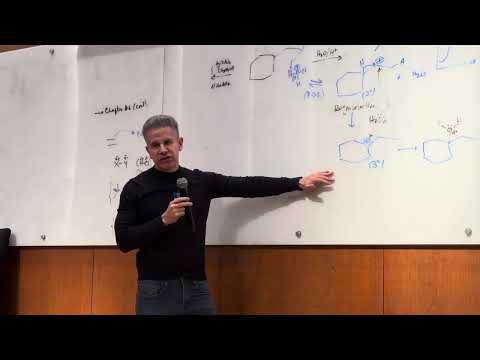
Acid-catalyzed hydration forms a free carbocation that rearranges by a 1,2-hydride shift from a secondary to a more stable tertiary carbocation before nucleophilic attack, while oxymercuration proceeds through a bridged mercurinium ion and avoids rearrangement. Both pathways favor attack at the more substituted alkene carbon and can produce racemic products when a chiral center forms; in the worked oxymercuration example, ethanol is the nucleophile, so the product is an ether, while water would give an alcohol.
Key takeaways
- Acid-catalyzed hydration passes through a free carbocation, allowing a 1,2-hydride shift from a secondary to a tertiary carbocation before water captures it.
- Oxymercuration forms a bridged mercurinium ion instead of a free carbocation, preventing the rearrangement possible during acid-catalyzed hydration.
- In oxymercuration, the nucleophile attacks the more substituted carbon of the mercurinium bridge, and attack occurs anti to the mercury bridge.
- NaBH4 reduces the carbon-mercury bond, replacing mercury with hydrogen in the final product.
- Oxymercuration's product functional group depends on its nucleophile: water gives an alcohol, ethanol gives an ether, and a carboxylic acid can give an ester.
Chapters
- The lesson reviews electrophiles including protonated water, carbocations with incomplete octets, boron compounds, and halogen molecules.
- In acid-catalyzed hydration, the alkene acts as a nucleophile and attacks hydronium, producing a carbocation and water.
- Carbocation formation is the rate-determining step; forming the more stable carbocation is favored and determines regioselectivity.
- The initially formed secondary carbocation undergoes a 1,2-hydride shift to create a more stable tertiary carbocation.
- Water attacks the rearranged carbocation, then deprotonation by another water molecule yields the rearranged product.
- Attack on a planar carbocation can occur from either face, producing a racemic mixture when the product contains a chiral center.
- The first step uses mercury acetate in ethanol; the alkene pi bond attacks electrophilic mercury.
- A mercurinium bridge forms across the former double bond rather than a free carbocation, so the intermediate cannot undergo carbocation rearrangements.
- The alkene can form the bridge from either face, giving two stereochemical pathways.
- Ethanol acts as the nucleophile and attacks the more substituted carbon of the mercurinium ion, where the transcript describes a greater fraction of positive charge.
- The mercury bridge blocks one face, so nucleophilic attack occurs from the opposite face and gives anti stereochemistry.
- Deprotonation of the oxonium intermediate by ethanol gives the oxymercuration addition product.
- Sodium borohydride, NaBH4, reduces the carbon-mercury portion of the intermediate, replacing mercury with hydrogen.
- Oxymercuration avoids rearrangement, unlike acid-catalyzed hydration; both pathways can give racemic products when a chiral center forms.
- The worked reaction uses ethanol as solvent and nucleophile, so its product is an ether; using water instead would produce an alcohol, while a carboxylic acid could yield an ester.
Transcript excerpt
0:04 Hey so last course we started discussing about alkynes. So those one can see how uh react as nucleophiles or Lewis bases and electron sources [clears throat] and because of this we were expecting to react alkynes with D5 electrophiles. So I discussed in the three general structural features that could to understand what is an electrophile. The first group was when you got a poor two arms and one of them is a good leaving group. A classic example of this is all the halides.
0:53 Example like so makes it making the higher electron deficient and the halides being very So that's a classic example of so we saw the halides we talk about water in acid media and and we talk about once anyone remembers why water is not a good electrophile? >> Is it hydroxide? >> Those hydroxide leaving group right? So you do have here certainly there is so that so they are electrophilic a hydrogen there so hydrogen that is electron deficient but hydroxide is a really bad leaving group. So once again we are organic chemists
1:40 too if you want to transform water into a good electrophile just add a drop of acid to uh and from hydronium and then now hydronium is a good electrophile because again we have the electron deficient oxygens and now the leaving group is Okay? So that's something that we uh during the last class. So that's the first group we talked about once again, uh uh hiding halides and So those were the three examples of electrophiles that could be uh including that group. The second group of electrophiles and animation in the last class was uh those uh
2:28 could read this having an atom with an incomplete octet. Classic sample of carbocation. So the carbocation, the carbon has six
This is the start of the transcript. Save this video free for the whole transcript, searchable and time-coded.
In this course
Related notes
Summary, takeaways, and chapters were generated by AI from the video's transcript and may contain errors. The video belongs to its creator, Organic Chemistry by Prof Gerona-Navarro.