Hydroboration–Oxidation of Alkenes: Concerted Mechanism, Regioselectivity, Syn Addition
Overview
Hydroboration–oxidation converts alkenes to alcohols using BH₃·THF followed by H₂O₂/NaOH, placing OH on the less substituted alkene carbon. The hydroboration step is concerted and syn, proceeds through a four-centered transition state without a free carbocation, and avoids rearrangements; steric and electronic effects explain its regioselectivity.
Key takeaways
- BH₃·THF followed by H₂O₂/NaOH transforms an alkene into an alcohol with OH on the less substituted carbon.
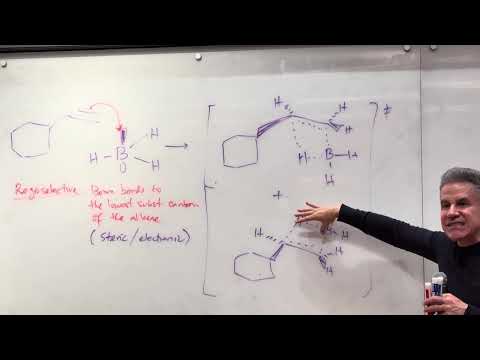
- Hydroboration is concerted: the C–B and C–H bonds form together through a four-centered transition state, so no free carbocation or rearrangement occurs.
- Boron attaches to the less substituted carbon because it is less sterically hindered, while transition-state charge stabilization favors hydrogen delivery to the more substituted carbon.
- Hydrogen and boron add syn from the same face of the alkene, and oxidation replaces boron with OH with retention of configuration.
- One BH₃ molecule can hydroborate three alkene molecules, forming a trialkylborane before the oxidation step.
- Hydroboration–oxidation and oxymercuration–reduction both make alcohols without rearrangements, but they differ in regioselectivity and stereochemistry: anti-Markovnikov and syn versus Markovnikov and anti.
Chapters
- The reaction uses BH₃ in THF for step one, followed by a separate oxidation step.
- Boron is electrophilic because it has only six valence electrons; THF coordinates through its oxygen lone pair and stabilizes BH₃.
- Each BH₃ can react with three alkene molecules, replacing its three B–H bonds to produce a trialkylborane.
- Hydroboration occurs in one concerted step, forming C–B and C–H bonds together rather than generating a free carbocation.
- Boron bonds to the less substituted alkene carbon, while hydrogen bonds to the more substituted carbon.
- The four-centered transition state places partial positive charge on the more substituted carbon, where it is better stabilized.
- Steric access also favors boron bonding to the less hindered carbon; B and H add from the same alkene face, giving syn addition.
- BH₃ reacts sequentially with three alkene molecules because its three B–H bonds can each deliver hydrogen during hydroboration.
- The product of these additions is a trialkylborane with boron attached to the less substituted carbon of each former double bond.
- H₂O₂ and NaOH oxidize the trialkylborane, replacing its carbon–boron bonds with carbon–oxygen bonds.
- The net result is an alcohol on the less substituted carbon, making hydroboration–oxidation an anti-Markovnikov hydration of an alkene.
- Oxidation replaces boron with OH with retention of configuration, preserving the syn relationship established during hydroboration.
- Unlike acid-catalyzed hydration, hydroboration–oxidation avoids free carbocations and therefore avoids carbocation rearrangements.
- Compared with oxymercuration–reduction, hydroboration–oxidation puts OH on the less substituted carbon and has syn rather than anti stereochemistry.
Transcript excerpt
0:39 Okay, so that's uh the the substrate this reaction is an alkene. Same thing. So we have two steps here. Step one using BH3 borane / THF. So when you see this as I said before, two step reaction. Step one, so you add the reagents, wait for step one to finish and then you go to step two and then add the reagents for step two. So in step one, we have BH3 / THF. So acid is used to write the solvent of the reaction. So THF is the solvent and that's that's hydrofuran which looks like this.
1:32 So that's the solvent of the reaction. And we are using here borane uh as I just explained at the beginning of the lecture. Borane is a very strong electrophile because boron has an incomplete octet. Six Six electrons in the shell. So it's missing two to have eight, a full valence shell. Uh and boring is so electrophilic, but it's actually bought us a solution in THF that so you buy the reagent as not just boring by itself. It's just
2:19 boring the solvent THF. The reason for that this is a reaction that we learned in chapter four. Boring is uh so reactive you have THF has oxygen with lone pairs. This is a ether. So we we can have a acid base reaction here where THF is forming a complex with boring and and that's a way to stabilize boring a little bit cuz so reactive, so electrophilic you can just have uh boring by itself. So you buy it as a solution of THF uh which you form with this complex. Again this is an equilibrium reaction, right? So you still have free boring there. Uh it doesn't really limit the electrophilicity of boring. It just
This is the start of the transcript. Save this video free for the whole transcript, searchable and time-coded.
In this course
Related notes
Summary, takeaways, and chapters were generated by AI from the video's transcript and may contain errors. The video belongs to its creator, Organic Chemistry by Prof Gerona-Navarro.