1H-NMR: Lecture 3
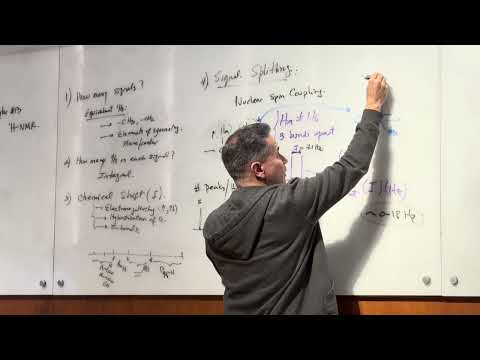 Watch on YouTube →
Overview
The lecture develops a practical method for reading and predicting proton NMR spectra using four features: signal count, integration, chemical shift, and splitting. It explains symmetry and the n + 1 rule, shows how matching coupling constants (J values) identify coupled protons, distinguishes overlapping multiplets from doublets of doublets, and applies these ideas to aromatic substitution patterns and an unknown C3H7Br structure.
Key takeaways
- A proton NMR assignment is strongest when signal count, integration, chemical shift, and multiplicity all agree; a mismatch in any feature signals that the proposed structure needs revision.
- Under the basic n + 1 rule, a triplet indicates one set of two equivalent neighboring protons, while a quartet indicates one set of three; these patterns often reveal CH2 and CH3 groups, respectively.
- Coupled proton signals share the same J value, so matching line spacing can identify which signals belong to neighboring groups even when their chemical shifts differ.
- A doublet of doublets and a quartet can both have four lines, but a doublet of doublets arises from two distinct coupling relationships, while a quartet comes from one set of three equivalent neighboring protons.
- Aromatic integration and splitting work together: the illustrated para-disubstituted benzene gives two 2H doublets, while the meta example produces four distinct aromatic environments with more varied splitting.
- The C3H7Br example demonstrates a full structure-solving check: a 3H triplet near 1 ppm, a deshielded 2H triplet near 3 ppm, and a middle CH2 multiplet support BrCH2CH2CH3.
Chapters
0:00
Four Proton NMR Clues: Signals, Integration, Shift, and Splitting
- Each distinct proton environment produces a signal; the number of signals does not by itself reveal how many hydrogens are in each set.
- Integration measures the relative number of protons contributing to each signal.
- Chemical shifts reflect local environment, especially electronegativity, carbon hybridization, and nearby pi bonds.
- Symmetry can make proton sets equivalent, while splitting provides information about neighboring non-equivalent protons.
5:30
Three-Bond Spin Coupling and the Meaning of J
- In the introductory examples, splitting occurs when non-equivalent protons couple across three bonds.
- A neighboring proton's nuclear spin changes the resonance frequency slightly, producing multiple peaks.
- A doublet has a 1:1 intensity ratio; a triplet has 1:2:1; and a quartet has 1:3:3:1.
- The spacing between neighboring lines is the coupling constant J, measured in hertz and commonly ranging from near 0 to about 18 Hz.
13:55
Use Matching J Values to Identify Coupled Signals
- Coupling is reciprocal: if proton set A splits set B, B shows the same J value when it splits A.
- Matching J spacings across separate signals can connect those signals to neighboring proton sets.
- The n + 1 rule predicts the number of peaks from n equivalent, non-equivalent-to-the-observed-set neighboring protons.
- Equivalent neighbors are counted as one set for the simple splitting analysis, with their number of hydrogens determining n.
19:00
Read Doublets and Triplets Backward to Infer Neighboring Groups
- A triplet usually indicates one neighboring set containing two equivalent hydrogens, as 2 + 1 = 3.
- A doublet usually indicates one neighboring set containing one hydrogen, as 1 + 1 = 2.
- For a signal integrating to 1H that is a triplet, the neighboring group is typically a CH2; the observed proton cannot have additional neighboring hydrogens in that simple pattern.
- Integration describes the protons producing the signal, while multiplicity describes their coupling to nearby protons.
23:35
Quartets and Triplets Reveal Methyl and Methylene Neighbors
- A quartet commonly means one neighboring set of three equivalent protons, identifying a nearby CH3 group.
- A triplet commonly means one neighboring set of two equivalent protons, identifying a nearby CH2 group.
- A CH3-CH2 pair therefore often gives a triplet for the methyl signal and a quartet for the methylene signal.
- The two signals should share the same J value because each set couples to the other.
28:00
Predict All Four NMR Features for a Simple Molecule
- Practice begins by counting distinct proton environments, then assigning one signal to each non-equivalent set.
- Integrations follow the number of hydrogens in each set, such as 3H for a methyl group and 2H for a methylene group.
- A methyl group next to a carbonyl is estimated near 2.1 ppm, while a less deshielded aliphatic methyl may appear near 1.3 ppm.
- Neighbor counts determine patterns such as a methyl triplet next to CH2 and a methylene quartet next to CH3.
33:00
Symmetry Combines Equivalent Proton Sets and Integrations
- A plane of symmetry relating two methyl groups makes them chemically equivalent and combines them into one signal.
- In the worked symmetric example, the signals integrate to 6H for the equivalent methyl groups and 4H for the equivalent methylene groups.
- The 6H methyl signal is a triplet when it neighbors one set of two equivalent hydrogens.
- The 4H methylene signal is a quartet when it neighbors one set of three equivalent hydrogens.
38:00
Isopropyl Splitting: A 6H Doublet and 1H Septet
- Two equivalent methyl groups can form a single 6H signal when symmetry relates them.
- Each methyl group is split by the neighboring methine proton, giving the combined methyl signal a doublet.
- The methine proton is split by six equivalent methyl protons, producing a septet under the n + 1 rule.
- The example illustrates why neighboring hydrogens must be counted across the whole equivalent set, not just on one side of a structure.
42:00
Distinguish a Doublet of Doublets from a Quartet
- A proton coupled to two different one-proton sets can form a doublet of doublets, with up to four peaks.
- When the two coupling constants differ, the four lines of a doublet of doublets are generally not equally spaced.
- A quartet from three equivalent neighboring protons has four lines with the characteristic 1:3:3:1 intensity ratio.
- If two distinct J values are equal or very similar, lines can overlap and make a doublet of doublets appear as fewer peaks.
47:30
Multiple Neighbor Sets Create More Complex Multiplets
- A proton coupled to one neighboring set of one proton and another set of two protons can produce a doublet of triplets, with up to six peaks.
- The maximum number of lines assumes the coupling constants are distinct and the lines do not overlap.
- Similar J values can collapse visible lines, so the observed number of peaks may be lower than the theoretical maximum.
- The worked examples compare the splitting of each proton set separately rather than treating all neighboring hydrogens as one group.
52:30
Electronegative Substituents Shift Proton Signals Downfield
- In a molecule with two different halogens, the lack of symmetry produces three distinct proton signals.
- The proton environment most affected by an electronegative substituent is expected at the highest chemical shift.
- The lecture ranks the example environments by deshielding and uses both connectivity and electronegativity to predict their relative positions.
- Splitting still depends on neighboring proton sets, independently of the chemical-shift order.
56:30
Vinylic Protons: Restricted Rotation and Geminal Coupling
- Vinylic protons typically appear around 5 ppm because they are attached to sp2 carbons near a pi bond.
- A carbon-carbon double bond prevents free rotation, so two hydrogens that might average in a rotating system can remain non-equivalent.
- Vinylic hydrogens can couple across the double bond and geminally to a non-equivalent hydrogen on the same carbon.
- For the discussed alkene example, trans coupling is largest, cis coupling is smaller, and geminal coupling is very small; relative J spacing helps assign peaks.
1:00:00
Aromatic Integration and the Four-Proton Disubstituted Ring
- Aromatic protons commonly appear around 7 to 8.5 ppm, making that range a clue for a benzene ring.
- If an aromatic signal set integrates to 4H rather than benzene's 6H, the ring has two substituents.
- A para-disubstituted ring with symmetry produces two aromatic signals, each integrating to 2H.
- Two aromatic doublets with the same J value are a characteristic pattern for the illustrated 1,4-substitution arrangement.
1:04:30
Use Aromatic Multiplets to Separate Meta from Para Substitution
- A 1,3-disubstituted example with different substituents lacks the symmetry that simplifies the para pattern, producing four distinct aromatic proton environments.
- The worked meta pattern includes a singlet, a doublet, and a doublet of doublets, in contrast to the clean pair of doublets in the para example.
- Integration first establishes how many aromatic hydrogens remain; splitting then helps distinguish 1,2-, 1,3-, and 1,4-substitution.
- Overlapping aromatic peaks can obscure the ideal patterns, so signal count, integration, and coupling must be considered together.
1:09:30
Solve C3H7Br by Matching Integration, Splitting, and Chemical Shift
- The spectrum shows three proton signals with integrations corresponding to CH3, CH2, and CH2 groups.
- The methyl signal near 1 ppm is a triplet, indicating a neighboring CH2; the signal near 3 ppm is also a triplet, indicating another neighboring CH2.
- With three carbons total, the groups form a CH3-CH2-CH2 chain, and bromine attaches to the deshielded terminal CH2 to satisfy C3H7Br.
- The proposed structure is checked against all three constraints: integration, splitting, and chemical shifts; the middle CH2 is expected to appear as a six-line multiplet from coupling to three plus two neighboring hydrogens.
Summary, takeaways, and chapters were generated by AI from the video's transcript and may contain errors. The video belongs to its creator, Organic Chemistry by Prof Gerona-Navarro.