NDSU ECE 211 Lecture 20
 Watch on YouTube →
Overview
ECE 211 Lecture 20 introduces ideal inductors through the voltage-current law v(t) = L di(t)/dt, its integral form, and parallels with capacitors. Worked examples show how a 2 H inductor responds to a 10 V step, how a 0.1 H inductor produces 20 V for a 2 A rise over 10 ms, and how a 2 mH inductor integrates a piecewise voltage waveform; the lecture also covers energy storage, DC behavior, and why inductors resist instantaneous current changes.
Key takeaways
- The ideal inductor law v(t) = L di(t)/dt means voltage depends on how quickly current changes, not on the current’s absolute value.
- For a 0.1 H inductor, raising current by 2 A in 10 ms requires 20 V; reducing the rise time to 1 microsecond requires 200,000 V.
- An ideal inductor’s current is continuous because an instantaneous current change would demand infinite voltage.
- At DC steady state, an ideal inductor acts as a short and an ideal capacitor acts as an open, simplifying the circuit to a resistive network.
- Inductor energy is stored in the magnetic field and, under zero initial conditions, is calculated as 1/2 L i².
Chapters
- Inductors are commonly made by wrapping insulated wire around a core, which may be metal or another material.
- Current through the coil creates a magnetic field, which induces a voltage across the two-terminal element.
- The inductor’s inductance is denoted L and measured in henries.
- The ideal inductor law is v(t) = L di(t)/dt, swapping the roles of current and voltage in the capacitor law i(t) = C dv(t)/dt.
- One henry equals volt-seconds per amp, matching the units required by the voltage-current equation.
- An inductor develops voltage when its current changes, while a constant current produces zero voltage.
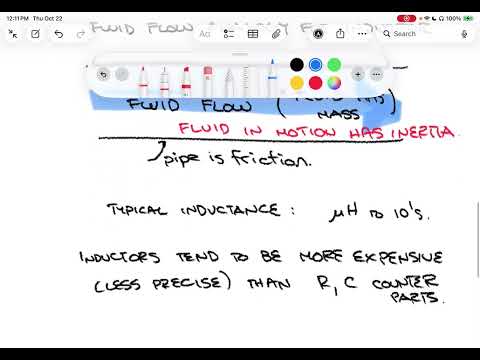
- A frictionless pipe carrying fluid with mass illustrates current inertia: flow resists changes, much as an inductor’s current resists changing.
- Typical inductances range from microhenries to tens of henries.
- Compared with capacitors, inductors tend to be more expensive or less precise for a given cost, contributing to capacitor preference in many circuits.
- Rearranging v(t) = L di(t)/dt and integrating gives i(t) = (1/L)∫ from t₀ to t of v(τ)dτ + i(t₀).
- A 10 V source switched onto a 2 H inductor at t = 0 produces i(t) = 5t A for t ≥ 0, with zero current before the switch closes.
- The constant voltage accumulates over time, so the ideal inductor current rises linearly without bound in this example.
- With the passive reference convention, instantaneous inductor power is p(t) = v(t)i(t).
- Energy accumulated from power is W(t) = ∫ p(t)dt; under the lecture’s stated zero-initial-condition assumptions, stored energy is 1/2 L i²(t).
- Ideal inductors and capacitors store or release energy rather than dissipating it.
- For a current ramp from 0 A to 2 A over 10 ms, a 0.1 H inductor has a constant 20 V across it during the ramp.
- Before the ramp and after current settles at 2 A, di/dt is zero, so the inductor voltage is zero.
- Compressing the same 2 A rise to 1 ms raises the voltage to 200 V; completing it in 1 microsecond raises it to 200,000 V.
- Quickly closing a valve on flowing water can make pipes rattle because moving fluid resists an abrupt flow change.
- The electrical counterpart is a large inductor voltage when current changes rapidly, as shown by v = L di/dt.
- An ideal inductor’s current cannot change instantaneously, because doing so would require infinite voltage.
- At DC steady state, an inductor’s constant current gives di/dt = 0 and therefore zero voltage, so it behaves like a short circuit.
- A capacitor at constant DC voltage has zero current, so it behaves like an open circuit.
- Replacing inductors with shorts and capacitors with opens reduces DC steady-state circuits to resistive networks that can be solved algebraically.
- The example applies a voltage that ramps from 0 to 10 V over 0.5 s, stays at 10 V until 1 s, then returns to zero; initial inductor current is zero.
- For 0 ≤ t < 0.5 s, v(t) = 20t and L = 2 mH, giving i(t) = 5,000t² A.
- For 0.5 ≤ t < 1 s, accumulating both voltage intervals gives i(t) = 5,000t − 1,250 A.
- After t = 1 s the applied voltage is zero, so current remains constant at the accumulated value of 3,750 A.
- The current expressions meet at t = 0.5 s with 1,250 A and at t = 1 s with 3,750 A, providing checks for integration errors.
- The resulting waveform is quadratic during the voltage ramp, linear during the constant-voltage interval, and flat after the voltage returns to zero.
Transcript excerpt
0:01 Welcome to the issue ECE 211. This is lecture 20. Last time we continued our discussion of capacitors including the integral form of the ideal capacitor's current-voltage relationship. That relationship made it easier to get voltage if you had a known current through capacitor. We also talked about a capacitor's power and energy, talked about capacitors in series and parallel, and wrapped up with a few loose ends on capacitors. Today, we're going to introduce another circuit element that behaves in kind of a similar fashion to what we saw with capacitors, and this is one called inductors. So, we are going to take a look at inductors. And associated with inductors is the idea of inductance. Just like capacitors have capacitance,
0:49 inductors as an element have inductance. Um when we look at an inductor, I would say that usually usually inductors are made and so they're made by coiling wrapping insulated wire insulated wire around some core a core. That core could be metal, it could be a variety of materials. Um the current through the coil, the current through the wire you might say, the current
1:35 through the wire creates a magnetic field. It's a little bit of a magnetic field. Maybe a little more detail than we need for a circuits class, but just give an idea. And that magnetic field in turn, so that magnetic um the magnetic field magnetic field induces induces a voltage across the coil. We have a wire and it's wrapped around some core. Well, it's like a coil of wire and you run current through that and that current in causes a
2:23 corresponding magnetic field and that magnetic field induces a voltage across it. So, we'll have a two-terminal element and it's going to have a current and a voltage, um just like a capacitor
This is the start of the transcript. Save this video free for the whole transcript, searchable and time-coded.
Related notes
Summary, takeaways, and chapters were generated by AI from the video's transcript and may contain errors. The video belongs to its creator, Roger Green.