NDSU ECE 211 Lecture 18
 Watch on YouTube →
Overview
Roger Green introduces capacitors as passive components that store energy, explains their plate-and-dielectric construction, and derives the ideal relationships Q = CV and i = C dv/dt. A 2 μF capacitor ramped from 0 to 12 V over 1 ms draws 24 mA; the examples show that faster voltage changes require proportionally greater current and that an ideal capacitor cannot change voltage instantaneously.
Key takeaways
- An ideal capacitor obeys Q = CV: its stored charge is proportional to the voltage across its conducting plates.
- The capacitor current law is i = C dv/dt, so current depends on both capacitance and how quickly voltage changes.
- A constant voltage across an ideal capacitor produces zero current after the transient, making it equivalent to an open circuit at steady state.
- A 2 μF capacitor ramped from 0 to 12 V in 1 ms draws 24 mA; completing the same ramp in 0.5 ms doubles the current to 48 mA.
- An instantaneous voltage change would require infinite current in the ideal capacitor model, so capacitor voltage cannot change instantaneously.
Chapters
- Resistors, capacitors, and inductors are passive elements: unlike voltage and current sources, they cannot generate their own energy.
- Resistors dissipate energy, while capacitors and inductors can store it, enabling circuit behavior beyond resistor-only networks.
- Roger Green focuses this lecture on capacitors, denoted by C, and postpones most discussion of inductors, denoted by L.
- A capacitor consists of two conducting plates separated by an insulating dielectric material.
- Air, Mylar, mica, and polyester are examples of dielectric materials; the dielectric prevents current from freely crossing between the plates.
- A capacitor is a two-terminal component, with a lead connected to each plate.
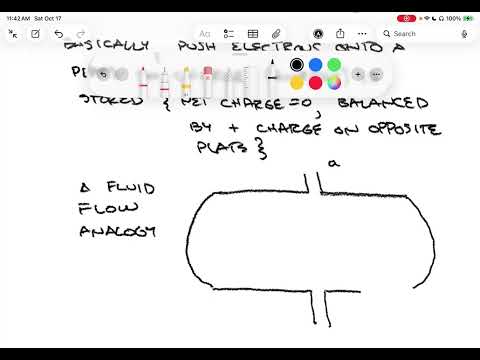
- Current supplied to one plate moves charge onto it, while an equal and opposite charge accumulates on the other plate, keeping the capacitor's net charge balanced.
- The dielectric supports energy storage through polarization, while the separated plate charges create the capacitor's stored electrical energy.
- Green compares charging to pushing water into a reservoir divided by a flexible membrane: the membrane deforms and stores energy, then pushes back when the applied pressure is removed.
- For an ideal capacitor, stored charge is proportional to voltage: Q = CV, where C is capacitance.
- Capacitance is measured in farads, equivalent to coulombs per volt; one farad is unusually large for many ordinary circuit applications.
- Common capacitance scales include picofarads (10⁻¹² F), nanofarads (10⁻⁹ F), microfarads (10⁻⁶ F), and, less commonly, millifarads (10⁻³ F).
- The capacitor circuit symbol resembles two plates; diagrams may curve one plate to indicate the lower-potential side.
- Current is the time derivative of charge, so differentiating Q = CV for constant C gives i(t) = C dv(t)/dt.
- The equation i = C dv/dt is the capacitor's current-voltage relationship, analogous in circuit analysis to Ohm's law for resistors.
- Using capacitors in KCL and KVL circuit equations introduces derivatives and differential equations, rather than only the algebraic equations used with resistors.
- When capacitor voltage is constant, dv/dt = 0, so i = C dv/dt gives zero current.
- After a capacitor reaches steady state under a constant applied voltage, it behaves like an open circuit.
- A changing voltage can produce current; the zero-current conclusion applies to a constant voltage after any transient has settled.
- Green applies a piecewise voltage waveform to a 2 μF capacitor: 0 V before t = 0, a linear rise to 12 V over 1 ms, then a constant 12 V.
- For t < 0, the voltage slope is zero, so the capacitor current is zero.
- During the 1 ms ramp, dv/dt = 12 V / 1 ms = 12,000 V/s; multiplying by 2 μF gives a constant current of 24 mA.
- After the ramp, the voltage is constant at 12 V, so the current returns to zero.
- The current waveform is piecewise: zero before the ramp, 24 mA during the 0-to-1 ms rise, and zero while holding 12 V.
- During the ramp, constant current means charge accumulates at a constant rate on the capacitor plates.
- Holding the voltage maintains the stored charge without ongoing current; changing the voltage again can produce current.
- Raising the same 2 μF capacitor to 12 V in 0.5 ms doubles the ramp slope and current, from 24 mA to 48 mA.
- Compressing the ramp to 0.01 ms, one hundredth of the original 1 ms interval, requires 2.4 A while delivering the same total charge.
- Because i = C dv/dt, an instantaneous voltage step would require infinite current in the ideal model; practical capacitors therefore cannot change voltage instantaneously.
Transcript excerpt
0:01 Welcome to NDSU ECE211. This is lecture 18. Last time we finished our discussion of op amps, including a discussion of comparators and schmid triggers. Today um we're going to introduce two new circuit elements um two elements that will complement uh the resistors that we had talked about before. And those two elements are something called a capacitor uh which we're going to designate with the letter C and inductors which will mostly be talked about in a later lecture which will designate with the letter L. So let's go ahead and think uh a little bit about some characteristics of these of these two devices. I'd say that um like resistors resistors capacitors [clears throat]
0:48 and inductors so the season and L's are what are called passive elements. Passive elements. Um a resistor just basically sits there. It absorbs uh absorbs energy. It dissipates energy when you apply a voltage and a current goes through it. Um, capacitors and inductors are passive elements as well. And and one way that we might think about passive elements is that they're unpowered. They are unpowered devices. They are unpowered and they can't they can't generate generate their own their own energy. If you think of something like a voltage source, it can
1:34 generate its own energy. It's not passive element. A current source is the same way. Resistors, inductors, and capacitors, um, they're nonpowered and they can't generate their own energy. Unlike resistors, though, so unlike resistors, capacitors and inductors can store energy. So, while they can't generate it on their own, they can store it. And it's this energy storage cap capability of inductors and capacitors that really make them so interesting. It really enhances or or changes in fundamental ways the kinds of things that we can uh
This is the start of the transcript. Save this video free for the whole transcript, searchable and time-coded.
Related notes
Summary, takeaways, and chapters were generated by AI from the video's transcript and may contain errors. The video belongs to its creator, Roger Green.