Monitor Lizard: The Most Intelligent Lizard In The World | WILD ASIA | Real Wild
 Watch on YouTube →
Overview
Island isolation and time reshape Southeast Asia’s wildlife, from Java’s leopard-dominated forests to Sulawesi’s predator-poor ecosystems and the volcanic island of Anak Krakatau. Fig trees connect these communities through fruit and seed dispersal, while monitor lizards show how adaptable colonizers can become island rulers, including the giant Komodo dragon and the vegetarian emerald tree monitor.
Key takeaways
- Java’s leopard limits the monitor lizard’s role on the mainland, but on Anak Krakatau, which erupted in 1930, a monitor arrived within six years and became the top predator.
- The fig tree sustains island ecosystems through short fruiting periods, while animals such as macaques, fruit bats, and Sulawesi hornbills spread its seeds.
- Sulawesi’s long isolation and repeated Ice Age separations helped produce seven macaque species, with traits spreading quickly in small populations.
- Sulawesi’s red-knobbed hornbill depends on figs for food and disperses their seeds; the female seals herself in a tree cavity for about 13 weeks while raising a chick.
- Island conditions can produce opposite body-size extremes: Sulawesi has both the world’s largest cuscus and the smallest cuscus, as well as the world’s smallest buffalo, the anoa.
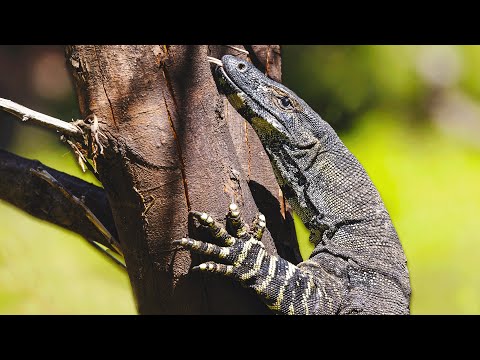
- Monitor lizards illustrate island-driven ecological change, ranging from the arboreal emerald tree monitor to the giant Komodo dragon, the world’s largest lizard.
Chapters
- Java separated from mainland Asia about 10,000 years ago as post-Ice Age seas rose.
- The leopard is Java’s top predator, while monitor lizards are smaller hunters and scavengers.
- Island banteng cattle became smaller than mainland relatives, but remain large enough to resist leopard attacks.
- Fig trees fruit for roughly seven or eight days at a time, drawing animals from across the forest.
- Long-tailed macaques travel between fruiting trees, while ebony leaf monkeys and Javan gibbons use different feeding strategies.
- Monitor lizards eat varied prey, including crabs, bird eggs, and small animals, and may need to feed only about once a month.
- Leopards exploit the gathering around fruiting trees, preying on animals such as wild piglets.
- Monitor lizards avoid competition with leopards by hunting along rivers, where they move readily between water and land.
- Fewer than 70 Javan rhinoceroses remain, and their large size, slow reproduction, and need for space make them vulnerable to shrinking forests.
- Unlike the rhino, a monitor lizard can swim away from difficult conditions and potentially reach another island.
- Anak Krakatau rose from the sea after a volcanic eruption in 1930, about 40 kilometres off Java’s west coast.
- Fruit bats can travel 70 kilometres or more in a night, carrying fig seeds to new islands.
- Fig trees established on Anak Krakatau helped create forest cover, but successful fruit production depended on the arrival of tiny pollinating fig wasps.
- A female fig wasp enters a fig through a narrow passage, pollinates its flowers, lays eggs, and dies inside.
- A monitor lizard reached Anak Krakatau within six years of the 1930 eruption, likely arriving by sea.
- Without Java’s leopard, the monitor became the island’s top predator and ate both living prey and carrion.
- The young forest’s fruit-eating animals attracted the monitor, linking the new predator to the fig-based food web.
- The island’s changing community illustrates how colonization, isolation, and time can produce new ecological roles.
- Sulawesi has been isolated for about 30 million years and is home to more than 100 species found nowhere else.
- Macaques that arrived from mainland Asia diversified as small populations became separated by changing sea levels during Ice Ages.
- The transcript describes seven macaque species arising through repeated isolation, with traits such as albinism spreading more readily in small groups.
- With no big cats on the island, Sulawesi macaques face less pressure from predators and more competition from other macaque troops.
- The red-knobbed hornbill is found only on Sulawesi and carries figs across the forest, dispersing seeds.
- A nesting female hornbill seals herself inside a tree cavity with fig-sticky material, leaving a slit through which the male passes fruit.
- After about 13 weeks, the female leaves the nest and both parents feed their chick, which grows largely on figs.
- Strangler fig seeds can bribe ants with fatty packages; the ants carry seeds into the canopy, where the fig can grow above competing plants.
- A Sulawesi fig species bears fruit along its branches that tastes like young leaves, attracting the tree-climbing bear cuscus.
- The bear cuscus evolved as a large leaf-eating marsupial, while another cuscus species is the world’s smallest.
- The anoa is the world’s smallest buffalo and feeds on figs close to the ground.
- Babirusas also forage on low-growing figs; their dramatic tusks are used by males in displays rather than serving as dangerous weapons.
- Spectral tarsiers are among the world’s smallest primates and hunt insects at night.
- Their huge eyes, sensitive hearing, and swivelling heads help them detect and target prey such as leaf-mimicking insects.
- Tarsier family members hunt separately but use long-distance calls to reunite before returning to a shared home inside a strangler fig.
- The emerald tree monitor is a small, camouflaged lizard that climbs slender branches and uses its tail for balance and gripping.
- On Komodo, isolation and time produced the Komodo dragon, the world’s largest lizard and a predator capable of killing much larger animals.
- Komodo dragons also scavenge and can survive for months when food is scarce.
- The contrast between the gentle, tree-dwelling monitor and the island-ruling Komodo dragon shows how island conditions can drive radically different forms.
Transcript excerpt
0:01 [Music] [Applause] [Music] [Music] look into the eyes of some of the most
0:48 extraordinary creatures on Earth they were all Cast Away on Islands in Southeastern Asia they've now been transformed into new species this is the remarkable story of how some of Asia's animals came under the powerful spell of Island magic Southeast Asia shatters into archipelagos of thousands of islands some are ancient others are very
1:36 recent the island of java became separated from Mainland Asia just 10,000 years [Music] ago in its isolated forests the top predator and most feared animal is the leopard nothing escapes its Keen Eye other must somehow avoid predation or die on Java it is the Undisputed top of the food [Music] chain the monitor lizard is another Predator but it's a small time killer and scavenger
2:25 nevertheless on other Islands in Southeast Asia the monitor lizard can be king Java was created at the end of the last ice age as ice caps melted and sea levels Rose the land bridges to the mainland disappeared and many animals were marooned on this new island in the 10,000 years that bantang cattle have been stranded on Java they have changed from their Mainland relatives on an island where land is limited the size of animals becomes crucial on Java the bantang cattle have adapted by becoming significantly smaller but bul remains
3:18 important particularly for the Bulls the younger Bull on the right has successfully challenged his old arrival for control of the her but the loser keeps returning refusing to accept his defeat soon the loser will give up his attempts to regain the females his role in shaping the genetic future of this herd is over he is frustrated at his loss the loss of size of these Island cattle is limited on Java they must be big
This is the start of the transcript. Save this video free for the whole transcript, searchable and time-coded.
Related notes
Summary, takeaways, and chapters were generated by AI from the video's transcript and may contain errors. The video belongs to its creator, Real Wild.