03. Speciation and Phylogeny - Evolutionary Anthropology Fall 2026
 Watch on YouTube →
Overview
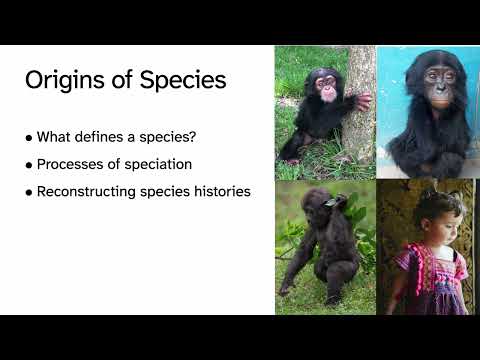
Richard McElreath explains how species form through varied processes, then shows how evolutionary relationships are inferred from anatomy, genetic data, and fossils. Examples including Darwin’s finches, apple maggot flies, ring species, and ape genomes illustrate why species boundaries and phylogenetic trees are useful but imperfect models: gene flow, convergent evolution, incomplete lineage sorting, and hybridization complicate both.
Key takeaways
- Species boundaries have multiple causes: geographic isolation, mating behavior, hybrid viability, and ecological specialization can all reduce gene flow.
- Darwin’s finches demonstrate that hybrids can be disadvantaged and that competition can produce character displacement in beak sizes, reinforcing differences between populations.
- Apple maggot flies illustrate sympatric divergence: apple and hawthorn fruit mature at different times, separating mating seasons without separating populations geographically.
- Phylogenetic inference is strongest when it distinguishes ancestral traits from shared derived traits; outgroups, fossils, embryology, and detailed anatomy help make that distinction.
- Molecular clocks depend on fossil calibration and assumptions about mutation rates; estimates for human and chimpanzee divergence range from about 5 to 10 million years.
- A species tree does not capture every gene history: incomplete lineage sorting means some human genomic regions can be more closely related to gorillas than to chimpanzees.
Chapters
- Human traits can reflect historical events hundreds of millions of years old, not only recent adaptations.
- Five digits in terrestrial vertebrates are explained as inherited history from an ancestral fish, rather than an optimal design.
- McElreath frames speciation and phylogeny as tools for applying evolutionary theory to questions such as when humans and chimpanzees diverged.
- Barnacles and terrestrial isopods are both crustaceans, making them closer relatives than either is to a cockroach despite superficial resemblance.
- Arctic gull populations interbreed around most of a geographic ring but not where forms meet in Europe, challenging a clean species boundary.
- California salamanders show a similar ring pattern around the Central Valley, while dog breeds vary enormously yet remain largely able to interbreed.
- Folk taxonomies across cultures commonly recognize species-like natural kinds, but biological species do not arise from one universal process.
- McElreath contrasts the biological species concept, centered on reproductive isolation, with the ecological species concept, which emphasizes natural selection.
- Species boundaries are emergent results of long-term evolutionary forces, not necessarily intrinsic, perfectly discrete units.
- The biological species concept treats populations that exchange alleles through mating as a species, with reduced gene flow allowing populations to diverge.
- Geographic barriers, mating behavior, and offspring viability can all limit gene flow.
- Horses have 64 chromosomes and donkeys 62; their mule offspring typically have 63, a chromosome mismatch that disrupts viable gamete production.
- Medium and large ground finches can interbreed about 10% of the time and remain recognizably distinct species.
- Asexual bdelloid rotifers and bacteria cannot be classified through mating compatibility, though biologists still recognize distinct types.
- Rapidly mutating viruses such as rhinovirus form clouds of related genotypes called mutational quasispecies rather than straightforward gene trees.
- Checkerspot butterfly populations can remain morphologically similar despite millions of years of reproductive isolation.
- The ecological species concept emphasizes selection favoring specialized phenotypes in different environments.
- Hybrids may be less effective than either specialist, much like a Swiss Army knife performs each task less well than a dedicated tool.
- Speciation is difficult to observe directly: it may take too long for researchers to witness but appear instantaneous in geological strata.
- Allopatric speciation begins with geographic separation, while peripatric speciation allows some mixing that selection can overcome.
- Sympatric speciation can occur without spatial separation when other ecological or life-cycle differences reduce interbreeding.
- A storm can move finches to a cactus-covered island, where selection favors larger beaks suited to dry-island seeds.
- If the specialized population returns, competition can push the original population toward a different beak-size range, a pattern called character displacement.
- On islands with both small and medium ground finches, beak-size distributions diverge; on islands with only one type, beak sizes are closer to intermediate.
- Learned song preferences in Darwin’s finches and species-specific firefly flash patterns can help individuals choose mates of their own type.
- Some North American apple maggot flies shifted from hawthorn fruit to introduced apples, which mature months earlier.
- The different fruiting schedules separate fly mating times even in the same geographic area, and populations developed different odor preferences for apples and haws.
- An individual-based simulation begins with a normally distributed population investing little in a specialized trait.
- Investment rises as specialists outcompete less specialized individuals, then the population splits when low-investment and high-investment strategies each gain an advantage.
- The model illustrates how specialization can produce polymorphism without geographic separation; bacterial social traits provide a possible experimental analogue.
- Carl Linnaeus developed a hierarchical classification system in the 18th century while believing species were specially created and immutable.
- Shared traits allow organisms to be grouped into nested categories such as birds, mammals, vertebrates, animals, and eukaryotes.
- Taxonomy concerns names and classification, whereas phylogeny concerns population history and evolutionary relationships.
- Phylogenies help test evolutionary hypotheses and support the comparative method for studying morphology and behavior.
- Birds are living dinosaurs; detailed digit and hip-bone anatomy links birds to bipedal dinosaurs more strongly than superficial appearance does.
- Sharks, dolphins, and extinct ichthyosaurs independently evolved streamlined aquatic predator forms, demonstrating convergence rather than recent shared ancestry.
- Dugongs, bats, moles, flying squirrels, and zebras have very different forelimb functions but share a conserved underlying arrangement of bones.
- Ancestral traits, such as egg-laying inherited from distant ancestors, do not reliably identify a close relationship; shared derived traits are more informative.
- In the human, chicken, and platypus comparison, lactation points to the mammal relationship, while egg-laying and bipedalism can mislead.
- Comparing humans, chickens, and platypuses with an outgroup such as a fish helps identify egg-laying as an ancestral trait.
- Pigeons independently produce nutrient-rich crop milk using prolactin, showing that similar functions can evolve through different anatomical structures.
- Embryonic development, fossil timing, and outgroup comparisons are useful heuristics, but each can fail and should be checked against the others.
- Modern phylogenies often compare genetic sequences and infer closer relationships from fewer sequence differences.
- Genome alignment can be difficult when chromosome structure differs, as it does between humans and chimpanzees, and is especially challenging in many plants.
- Whole-genome distance methods can work well while overlooking whether shared sequences are ancestral or derived and structural changes that could improve inference.
- Genetic distance first gives relative branch lengths; converting those lengths into years requires an estimated mutation rate and assumptions about rate variation.
- Well-dated fossils calibrate molecular clocks by anchoring a divergence to a known time, allowing dates to be estimated elsewhere on the tree.
- Human and chimpanzee divergence estimates span roughly 5 to 10 million years, in part because the relevant tropical ape fossil record is sparse.
- Species trees summarize population histories, but individual genes can have different genealogies because ancestral populations contain genetic variation.
- Rapid ape divergences contribute to incomplete lineage sorting; some human genomic regions are more closely related to gorillas than to chimpanzees.
- A species tree can mislead analyses of specific traits, so researchers need to account for variation among gene trees.
- Arctic gull ring species form a connected interbreeding gradient, making a branching tree only an abstraction of the population history.
- Balkan languages such as Romanian, Bulgarian, Greek, Turkish, and Albanian share grammatical features through prolonged contact despite belonging to different language families.
- Trees remain useful models, but evolutionary histories can include gene flow and cultural exchange that require network-like or gradient representations.
Transcript excerpt
0:00 All right, welcome back. This is lecture three. Um I'm excited about this lecture, perhaps uncharacteristically, because this is not what I study. Uh but maybe that's why. Uh no, I'm excited about it because it's this one of these interesting pivot points in the course where you've learned some evolutionary theory, and now we get to apply it, to extrapolate it, draw out implications from it to learn very difficult things about the evolution of life on Earth. Uh and that's nice. It's satisfying. You've already made intellectual progress, and so now we can build up from basic biological facts to things like figuring out when humans and chimpanzees diverged. Right? Uh uh which we'll talk about today. Um and it's also a pivot point in the course because uh starting next week we're going to switch to
0:47 focusing on primates uh because it is a course in human evolution, and the narcissism comes. Yeah, it just builds towards the end. It gets more and more narcissistic. Species narcissism, right? Not personal narcissism. You know what I mean. Uh but we're going to pivot to primates, and we need this material to study primate diversity, which is what we're going to begin doing next week. Okay? Um so that this is a artistic tree of life that I've got up on the up on the slide, and I just want to use it to to sort of problematize when you study human evolution, there's no uh sort of limit to how far back in time relevant facts lay. All right, so that's the other thing about this material in the first part of the course here. I haven't talked about human evolution in the specific very much yet. We're in lecture three, uh but all of this is relevant. Obviously, you
This is the start of the transcript. Save this video free for the whole transcript, searchable and time-coded.
Related notes
Summary, takeaways, and chapters were generated by AI from the video's transcript and may contain errors. The video belongs to its creator, Richard McElreath.