Math317Fa26 Lec16 BaseballMultiObjFixedPoints
 Watch on YouTube →
Overview
Steven Miller connects practical modeling to mathematical optimization, showing how Bill James’s baseball winning-percentage formula can be adjusted for opponent strength and why AI-generated analyses require precise definitions and data checks. He then develops weighted multi-objective linear programming and fixed-point methods, including the intermediate value argument, Newton’s iteration for √3, and the contraction principle that turns fixed-point existence into a way to compute one.
Key takeaways
- Bill James’s Pythagorean expectation estimates baseball winning percentage from runs scored and allowed, with exponents around 1.8 to 1.9 typically used instead of the original 2.
- Opponent-adjusting runs scored by opponents’ runs allowed relative to the league average can improve head-to-head comparisons and preserve a .500 league-wide average winning percentage.
- AI-generated statistical tables need explicit definitions and independent checks: the playoff analysis was initially wrong because AI confused a higher seed with a stronger team.
- A multi-objective linear program can combine competing costs as a weighted sum with nonnegative weights totaling 1, but solution sensitivity to those weights should be tested.
- The equation f(x) = a can be converted into a fixed-point problem by defining g(x) = f(x) + x − a, so a fixed point of g solves the original equation.
- For a contraction with factor c < 1, repeated application converges to a fixed point; Newton’s iteration for √3 demonstrates how fixed-point methods can yield accurate numerical answers quickly.
Chapters
- For time-limited work, specify the available time, expected deliverable, and time for iteration when asking an AI tool for help.
- Define terms and include relevant possibilities so collaborators do not solve different interpretations of the same problem.
- Assess interactions, not just individual effects: new Spring Street restaurants might add customers or cannibalize existing demand, just as similar movies can compete for the same audience.
- Bill James’s formula estimates winning percentage as runs scored raised to γ divided by the sum of that quantity and runs allowed raised to γ.
- The original exponent was 2; values around 1.8 to 1.9 are now commonly used, and the formula can estimate a season’s wins to within about four games.
- The basic formula estimates average performance but does not account for who a team played; Miller and former Williams students adjust runs scored using opponents’ runs allowed relative to the league average.
- A league-wide adjustment is designed to preserve an average winning percentage of .500 across teams, unlike the original formula.
- The analysis examined MLB playoffs from 2001 through 2019, stopping before COVID-era changes, and estimated home-team game and series win probabilities.
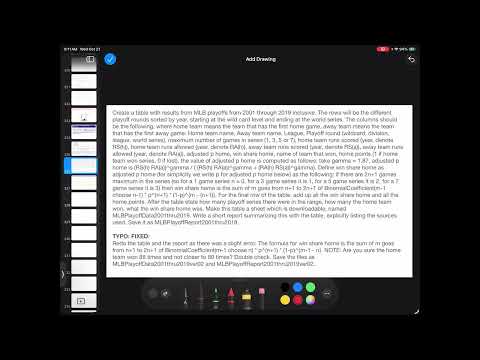
- A long AI prompt requested a table covering year, teams, league, round, series length, runs, adjusted home win probability, series probability, and actual winner.
- AI initially miscounted home-team wins because it treated the higher seed as the better team; MLB division winners can receive home-field advantage over stronger wild-card teams.
- Miller recommends verifying assumptions and statistics, correcting formula errors, using clear filenames, and retaining prompts and earlier versions for an auditable workflow.
- Standard linear programming minimizes one objective, such as cᵀx, subject to Ax = b and x ≥ 0, while real choices such as buying a house involve location, quality, size, and school district.
- Lagrange multipliers provide an analogy: with multiple constraints, the gradient of the objective is a linear combination of constraint gradients.
- When several objectives cannot all be minimized simultaneously, combine them as a weighted sum of costs cᵢᵀx.
- Choose nonnegative weights that sum to 1; a zero weight means an objective is being ignored, and normalization does not change the relative weighting.
- The main modeling challenge is choosing weights, such as how much house location matters relative to price or school district.
- Test multiple weight choices and study whether small changes produce large changes in the selected solution; this sensitivity analysis was missing from many class projects.
- In the secretary problem, candidates arrive in random order and each must be accepted or rejected immediately; a strategy can select the best candidate with probability 1/e, about 37%.
- Real decisions also include the cost of delay or a bad choice, as in hiring or buying a house, so those costs should inform the objective weights.
- A fixed point of a function f is an input x satisfying f(x) = x; fixed-point theorems support existence results such as those used in Nash equilibrium.
- To solve f(x) = a using a fixed-point method, define g(x) = f(x) + x − a; any fixed point of g satisfies f(x) = a.
- The transformation resembles simplex phase one: modify a problem to create the input conditions required by a method, then use that method on the original task.
- Fixed-point iteration also appears in differential equations, including Picard iteration, and Miller emphasizes the value of constructive proofs that show how to find a solution.
- For continuous f mapping [0, 1] into [0, 1], an endpoint that is already fixed solves the problem immediately.
- If neither endpoint is fixed, then f(0) > 0 and f(1) < 1; define g(x) = f(x) − x.
- These endpoint conditions give g(0) > 0 and g(1) < 0, so the intermediate value theorem guarantees a c in [0, 1] with g(c) = 0.
- That zero satisfies f(c) = c, proving a fixed point exists even when the theorem does not directly calculate its location.
- For x² − 3 = 0, Newton’s method gives xₙ₊₁ = ½(xₙ + 3/xₙ), with √3 as a fixed point.
- Starting at x₀ = 2 gives x₁ = 7/4 and x₂ = 97/56, approximately 1.73214285, already close to √3 ≈ 1.732050807.
- Each iteration approximately doubles the number of correct decimal digits, far faster than repeatedly halving an interval in a bisection search.
- The update comes from finding where the tangent line to x² − 3 at the current estimate meets the x-axis; replacing 3 with another positive number targets its square root.
- A contraction satisfies |f(x) − f(y)| ≤ c|x − y| for a fixed constant c with 0 < c < 1, shrinking distances by a uniform factor.
- If |f′(x)| ≤ c < 1 throughout the domain, the mean value theorem shows that f is a contraction.
- Starting from any x₀ and iterating xₙ₊₁ = f(xₙ) converges to a fixed point under the contraction result; the proof was assigned for further thought.
- Unlike an existence-only argument, contraction iteration gives a constructive procedure for approximating the fixed point.
Transcript excerpt
0:00 Welcome to math 317 operations research. So, what I want to do today is hopefully click on this There you go. Is talk a little bit about uh applications of trying to do stuff like this in practice. You know, for the most part, I think you guys did really well on the 50-minute challenge. You know, you're not supposed to get it perfectly the first time. One of the big things is a little bit more forethought, I think, in some of the prompts that you're doing. Actually tell AI, "I only have this amount of time. You know, I've got to get the best product I can. I need to make sure I have enough time to maybe iterate what you're giving me." So, you can work for something for this amount of time, and then I need to do it. Make sure you have everything clearly defined. A lot of times, there's confusion because different people define things differently, and you might be solving what you think is the problem, but maybe
0:47 it's not quite uh what somebody else's. Make sure you include all the possibilities, all the things you might want to think about. So, different people came up with good items for the Spring Street challenge. You know, some people thought about what kind of parking issues would there be. Other people thought about if you have uh new restaurants bringing in more people, are they actually bringing in more people, or are they just cannibalizing existing demand? And so, it's not so much, you know, what is that going to do by itself, but what is it going to do in conjunction with everything else? This is similar to the movie project I told you, where if you're introducing two movies that have very similar uh I'm going to let him in
This is the start of the transcript. Save this video free for the whole transcript, searchable and time-coded.
In this course
Related notes
Summary, takeaways, and chapters were generated by AI from the video's transcript and may contain errors. The video belongs to its creator, Steven Miller.