Math317Fa26 Lec14 IntProgFreeFlow
 Watch on YouTube →
Overview
Steven Miller develops an integer-programming formulation for Flow Free-style bridge puzzles, emphasizing that good variable choices and constraints matter more than brute-force enumeration. He models cell colors with binary variables, uses neighbor-count constraints and a black-cell objective to discourage unnecessary paths, then connects the formulation’s computational limits to real-world operations research examples including the Berlin Airlift.
Key takeaways
- For n variables each ranging from 0 to b - 1, a single loop over 0 through b^n - 1 enumerates every n-tuple through the base-b digits of the counter.
- A puzzle-specific encoding can simplify a condition: assigning queens 1, kings 10, and all other cards 0 turns the five-card requirement into a sum of 22, 23, or 32.
- Flow Free can be modeled with binary color indicators Xᵢⱼc and a constraint requiring each interior path cell to have exactly two orthogonal neighbors of its color.
- Maximizing cells assigned black, represented by color 0, discourages unnecessary colored loops because removing them improves the objective.
- A 10-by-10, 12-color model with about 1,176 binary variables already has approximately 10^352 possible assignments, demonstrating why a formulation needs an effective solver rather than exhaustive search.
- In integer programming, the value of an approximate answer depends on the objective: a near-optimal profit may be useful, but a puzzle requiring a valid path is an exact yes-or-no problem.
Chapters
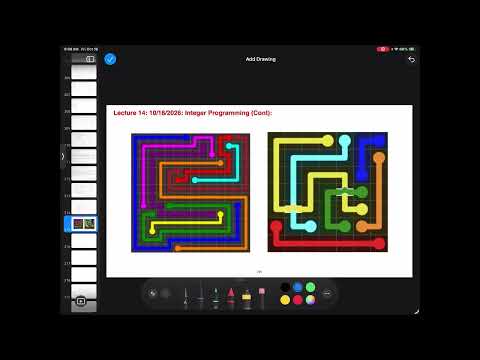
- The puzzle connects matching colored dots without crossings, with every board square required to be filled in the standard version.
- Bridge squares add directional constraints: yellow must continue vertically, while green must continue horizontally.
- Steven Miller frames the class around comparing possible solution methods rather than treating one technique as mandatory.
- To simulate n nested loops, count k from 0 to b^n - 1 and write each k in base b.
- The n base-b digits each range from 0 to b - 1, producing every required n-tuple.
- This approach is most direct when all loops share the same range; differing ranges may require extra checks or exits.
- For a five-card hand requiring at least two queens and two kings, Miller compares representing all 52 cards with a task-specific encoding.
- Assigning queens value 1, kings value 10, and other cards 0 reduces the condition to checking whether the sum is 22, 23, or 32.
- A specialized encoding makes one test easier but is less adaptable if requirements change, such as adding a red-card condition.
- Miller first proposes a cell variable Xᵢⱼ whose value identifies one of the puzzle’s colors.
- A richer encoding can combine color and outgoing direction, or use binary variables Xᵢⱼcd for location, color, and direction.
- Each color pair can be divided into a start set and an end set, but the formulation must ensure each path actually connects them.
- Local flow rules can permit disconnected colored components or cycles that do not connect a start to its matching end.
- If unused cells are allowed, introduce black as color 0 and maximize the number of black cells.
- An unnecessary loop can then be removed to increase the black-cell count, so it cannot remain in an optimal solution.
- For an interior path cell that is neither a start nor an end, require exactly two orthogonally adjacent cells of the same color.
- The degree-two rule prevents branches with three or more same-color neighbors, while a loop disconnected from the endpoints can be excluded by the black-cell objective.
- Boundary conditions can be simplified by expanding the grid with an outer border fixed to color 0.
- Define Xᵢⱼc as 1 when cell (i,j) has color c and 0 otherwise.
- For a middle cell assigned color c, sum Xᵢ′ⱼ′c over its adjacent cells and require the sum to equal 2.
- The adjacency sum considers north, south, east, and west, not diagonal cells; the proposed model maximizes the sum of Xᵢⱼ0.
- A 10-by-10 board with 12 colors and four direction choices can produce roughly 4,800 binary variables before fixing the given dots.
- Even the direction-free color model has about 1,176 binary variables, yielding roughly 2^1176, or 10^352, possible assignments.
- Miller distinguishes formulating a problem from solving it efficiently: an exact yes-or-no puzzle offers no useful partial result, unlike profit optimization where a near-best answer may suffice.
- After the Allies lost land access to West Berlin when the Soviet Union closed routes through East Germany, supplies had to arrive by air.
- Standardizing aircraft let any pilot fly any plane and let mechanics share one set of replacement parts.
- Miller presents the airlift as an example of practical operations research, where logistics and resource allocation shape the solution.
- A uniform fleet carries systemic risk: a design flaw could ground every aircraft, and one aircraft size may not match demand across routes or times.
- Southwest is cited as an airline that initially used a common aircraft type, while variable-capacity planes can better match passenger demand and fuel costs.
- Miller asks students to work in groups on a real-time operations research challenge, focusing on quick analysis, iteration, and a polished report or presentation.
Transcript excerpt
0:00 Welcome to Math 317 Operations Research. What I want to do today is show how certain types of problems can be solved using certain techniques. This does not mean that you should solve them using these techniques. It just means this is a way to do it. I want to try to get some things on your radar as to this is doable. And then if there are multiple ways that you can solve the problem, then you can start to see which one is going to be fastest. For so many things, does it really matter if it takes the computer 1 trillionth of a second or 1 millionth of a second or 1 second? No. For many things we're doing, even though there's a tremendous orders of magnitudes of difference, for most of us, we can't really notice the difference between 1 millionth and 1
0:47 billion. So, that's absolutely fine. What I'm going to show you today is a very inelegant way to solve these bridge problems. So, the way it works is you have a bunch of colored dots in pairs, and you have to connect from one to the other without crossing another line. Every square on the board has to be filled. Uh in the one on the right, you can see that there's two bridges. So, for the bridge, the bridge can be traversed in two directions. But so, the yellow, if it's going through it, uh it has to keep going up. And the green has to keep going left right. Okay. So, that makes it a little bit more interesting when you have something like that. It's easy to put in additional constraints like that. We'll look at the simple one of how do you handle this? You could, of course, say,
This is the start of the transcript. Save this video free for the whole transcript, searchable and time-coded.
In this course
Related notes
Summary, takeaways, and chapters were generated by AI from the video's transcript and may contain errors. The video belongs to its creator, Steven Miller.