Lecture 8: Bosonic parton theory of Z2 spin liquid
 Watch on YouTube →
Overview
Subir Sachdev introduces bosonic partons as a way to describe spin liquids whose excitations carry fractional quantum numbers, and explains why an emergent gauge field accompanies that fractionalization. He constructs a Schwinger-boson mean-field theory for antiferromagnets, derives gapped spin-½ spinons, and sets up the path-integral analysis needed to test their stability and expose the gauge redundancy.
Key takeaways
- A spin liquid can fractionalize a spin-1 excitation into separated spin-½ spinons; local physical operators create only gauge-invariant combinations, not an isolated spinon.
- The minimal gapped Z₂ spin liquid has four anyon sectors—vacuum, spinon, vison, and spinon-vison bound state—closely related to the toric code and surface-code error correction.
- In the Schwinger-boson representation, exactly one boson per site both recovers the physical spin-½ Hilbert space and produces a local U(1) gauge redundancy.
- A symmetry-preserving singlet-bond mean-field decoupling yields gapped spinons when the bosonic dispersion stays positive; boson condensation instead signals magnetic order.
- Mean-field spinons are not proof of a stable spin liquid: gauge fluctuations can confine partons, so the effective action and competing saddle points must also be examined.
Chapters
0:00
Why Spin Liquids Go Beyond Landau Symmetry Breaking
- Sachdev contrasts the familiar Landau picture—phases classified by broken symmetry—with spin liquids that need a different organizing principle.
- In conventional magnets and superfluids, gapless modes arise from broken continuous symmetries; spin liquids can host gapless excitations without that mechanism.
- The central concepts for the lecture are fractionalization and emergent gauge fields.
4:19
RVB States, Fractionalized Spinons, and Emergent Gauge Fields
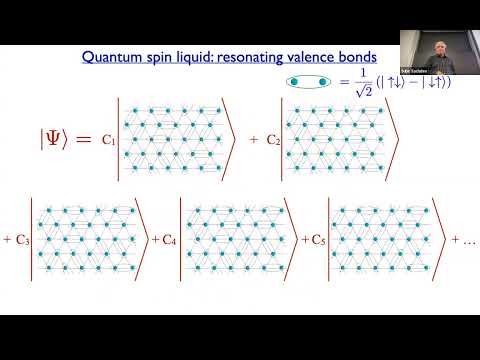
- A resonating valence bond (RVB) state superposes an exponentially large number of singlet coverings rather than just two macroscopically distinct states.
- A local perturbation creates integer-spin excitations, but a spin liquid can separate the two halves of a broken singlet into spin-½ spinons.
- A spinon cannot be created by a local physical operator alone; the gauge-invariant creation process produces a pair joined by a gauge-field string, analogous to a Wilson line.
8:37
Anyons and Superselection Sectors in a Z₂ Spin Liquid
- Spinons occupy a superselection sector with half-integer spin, disconnected from the integer-spin sector by local operations.
- The simplest gapped Z₂ spin liquid has four sectors: the vacuum, spinon (e), vison (m), and their bound state (ε).
- Sachdev connects these sectors to the toric code and notes their relevance to surface-code quantum error correction.
13:52
Visons, Branch Cuts, and the Four Anyon Sectors
- A vison can be represented by choosing a point and drawing a branch cut to infinity; RVB configuration amplitudes change sign according to the dimers crossing that cut.
- The branch cut is a nonlocal construction, reflecting why a vison cannot be created by a local operator.
- Combining a vison with a spinon gives the fourth anyon sector, completing the minimal Z₂ structure.
20:19
Rydberg Atoms and the Kagome Rydberg-Blockade Liquid
- A Harvard experiment places Rydberg atoms on kagome-lattice links and uses laser light to couple ground states to large excited states.
- Rydberg blockade prevents neighboring atoms from becoming excited simultaneously, imposing a local exclusion rule.
- Many allowed blockade configurations can form a coherent superposition, providing an experimental route toward a Z₂ spin-liquid-like state.
24:55
Schwinger Bosons Encode Spin-½ Directly
- The parton method introduces two bosons on each site, b↑ and b↓, so the elementary fields already carry spin ½.
- The physical up and down states each contain exactly one boson, unlike the zero-or-one occupancy condition used for ordinary hard-core bosons.
- Sachdev presents bosonic partons as a convenient choice for triangular and kagome-lattice spin liquids, while noting that fermionic partons are another option.
27:03
The One-Boson Constraint Generates U(1) Gauge Redundancy
- The spin operator is represented as Sᵃᵢ = ½ b†ᵢα σᵃαβ bᵢβ, which reproduces spin-½ operator actions within the one-boson Hilbert space.
- A site-dependent phase rotation of both boson flavors leaves every physical spin operator unchanged, giving the representation a local U(1) gauge redundancy.
- The exact boson-number constraint acts like a Gauss-law constraint; the spinons carry gauge charge even though physical observables are gauge invariant.
33:28
From the Heisenberg Exchange to Singlet-Bond Fields
- Sachdev applies the bosonic representation to a nearest-neighbor antiferromagnetic Heisenberg Hamiltonian on square and triangular lattices.
- A Lagrange multiplier λᵢ enforces one boson per site, while rewriting exchange in the singlet channel highlights the RVB bond amplitude.
- The singlet operator εαβ bᵢα bⱼβ measures bond pairing and provides the natural field for a symmetry-preserving mean-field treatment.
36:02
Symmetry-Preserving Mean-Field Decoupling
- Sachdev factorizes the four-boson exchange interaction into a quadratic Hamiltonian using the singlet bond expectation value Qᵢⱼ.
- Unlike mean-field treatments of ordered magnets, this decoupling is chosen to preserve lattice and spin symmetries.
- The self-consistent saddle point determines both Qᵢⱼ and λᵢ; the resulting theory can be diagonalized with a bosonic Bogoliubov transformation.
41:19
Bond Orientations, Gauge Choices, and Lattice Ansätze
- The bond field Qᵢⱼ changes sign when its orientation is reversed, so a calculation requires a consistent orientation convention.
- On the square lattice, a uniform choice of horizontal and vertical bond amplitudes can preserve physical symmetries because Qᵢⱼ itself is gauge dependent.
- Triangular and kagome lattices allow more intricate ansätze, and some choices are not gauge-equivalent and can have different energies.
45:11
Self-Consistent Spinon Dispersions and Magnetic Instability
- Fourier transforming the quadratic boson Hamiltonian gives spinon energies ωₖ, with λ̄ and Q̄ fixed by self-consistency.
- When ωₖ remains positive throughout the Brillouin zone, the mean-field state has gapped, charge-neutral spin-½ spinons.
- If a boson mode becomes unstable and condenses, spin rotation symmetry breaks, producing conventional order such as 120-degree order on the triangular lattice or Néel order on the square lattice.
51:30
Testing Whether Mean-Field Spinons Survive Gauge Fluctuations
- A gapped mean-field spinon spectrum does not by itself establish a stable spin liquid because the partons are coupled to an emergent gauge field.
- Sachdev compares the question to quarks in quantum chromodynamics: strong gauge fluctuations can confine fractional fields into physical bound states.
- The stability analysis must check both small fluctuations around the saddle point and competing saddle points elsewhere in the field space.
58:27
Path Integrals for Bond and Constraint-Field Fluctuations
- The exact path integral includes boson fields and time-dependent Lagrange multipliers; integrating over the multipliers enforces the one-boson constraint.
- A Hubbard–Stratonovich transformation introduces the bond field Qᵢⱼ and reduces the boson action to a quadratic form.
- Integrating out gapped bosons produces an effective action S[Q, λ], whose saddle-point equations reproduce the earlier mean-field self-consistency conditions.
1:03:23
Local Gauge Transformations Constrain the Effective Action
- Fluctuations of Qᵢⱼ and λᵢ must respect an exact local transformation that leaves the action invariant.
- The transformation acts on the bond field and constraint field together with the bosons, revealing that the mean-field saddle is not an arbitrary point but a gauge-related family.
- Sachdev closes by identifying this redundancy as the link between unobservable spinons and the emergent gauge structure to be analyzed in subsequent lectures.
Summary, takeaways, and chapters were generated by AI from the video's transcript and may contain errors. The video belongs to its creator, Subir Sachdev.