Lec9 Chp3 M2001 Summer26 Symplifying Log, Solvinig Log Equations and Application
 Watch on YouTube →
Overview
Shahera Jannah teaches logarithm properties, including product, quotient, power, change-of-base, inverse, and one-to-one rules, then applies them to expanding and condensing expressions and solving logarithmic equations. The lesson emphasizes checking that every log argument is positive, using a scientific calculator for change of base and numerical solutions, and modeling a village population with P(t) = 34 ln(t) + 520.
Key takeaways
- For real logarithms, every argument must be greater than zero; checking each argument rejects extraneous roots such as -2 in log_4(x) + log_4(x - 6) = 2.
- Logarithm rules translate structure: multiplication inside an argument becomes addition between logs, division becomes subtraction, and an argument exponent becomes a coefficient.
- Combining logs requires matching bases; after combining, convert a single logarithm to exponential form or use the one-to-one property when matching single logs appear on both sides.
- Change of base evaluates log_b(a) as log(a) / log(b), and using ln(a) / ln(b) gives the same result, making either form suitable for a scientific calculator.
- The natural logarithm and exponential base e are inverse operations, while common logarithms pair with base 10; log and ln are not interchangeable as individual functions.
- The population model P(t) = 34 ln(t) + 520 reaches 550 at t = e^(30/34), or about 2.42 years after the village is founded.
Chapters
- Shahera Jannah begins Chapter 3 on logarithms and asks students to copy the properties before reviewing them.
- She says the class may finish logarithms and begin trigonometry, with exam papers to be returned during class.
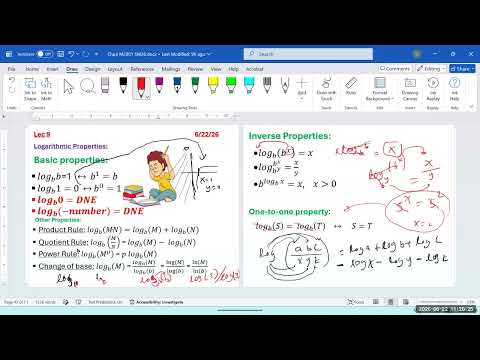
- A logarithm whose base matches its argument evaluates to 1, while log_b(1) = 0.
- Logarithms of zero and negative numbers are undefined over the real numbers, consistent with the logarithm graph's vertical asymptote at x = 0.
- The product rule turns multiplication inside an argument into addition between logs; the quotient rule turns division into subtraction.
- The power rule brings an argument's exponent down as a coefficient, and change of base rewrites log_b(a) as log(a) / log(b).
- To simplify log_10(100), rewrite 100 as 10^2, then cancel the matching base and argument to get 2.
- The key strategy is to express the argument as a power of the logarithm's base so the exponent becomes the answer.
- Shahera Jannah presents simplification as removing the logarithm and finding the resulting numerical value.
- The example log_3(1/81) becomes log_3(3^-4), so its value is -4.
- An alternate solution uses the quotient rule: log_3(1) - log_3(81) = 0 - 4.
- A matching exponential and logarithm, such as 3^(log_3(4x)), cancel to leave 4x.
- To explain 3^(log_3(4x)), Shahera Jannah sets the expression equal to y and applies log base 3 to both sides.
- The power rule brings log_3(4x) down, while log_3(3) evaluates to 1.
- The resulting equal single logarithms imply 4x = y by the one-to-one property.
- Students simplify log(1/1000) by rewriting 1/1000 as 10^-3, giving -3.
- The natural-log example ln(e^(1/5)) simplifies to 1/5 because ln and base e are inverses.
- Shahera Jannah identifies product, quotient, power, and change-of-base rules as likely exam material.
- Expanding reverses the combining rules: numerator factors produce added logarithms and denominator factors produce subtracted logarithms.
- For log_2(2x/(3y^2)), the factors become separate base-2 logs, with the denominator terms carrying minus signs.
- The power rule then turns log_2(y^2) into 2 log_2(y), and log_2(2) simplifies to 1.
- A square root is rewritten as an exponent of 1/2 before applying the power rule.
- The class expands expressions involving factors such as 4, w, x^3, y^2, and z^(1/2), assigning signs according to numerator or denominator position.
- A combined exponent over a product is distributed to each factor before its powers are brought down as coefficients.
- An expression containing ln(e) is simplified using ln(e) = 1.
- Shahera Jannah reminds students to simplify fully after expanding, rather than leaving evaluable terms such as ln(e).
- The lesson transitions from expanding one log into many terms to combining many terms into one log.
- Before combining, coefficients such as 3 or 2 are moved into the corresponding logarithm arguments as exponents.
- Positive log terms go into the numerator, while negative log terms go into the denominator.
- The example combines log(x^3) - log(y) + log(z^2) - log(7) into log(x^3 z^2 / 7y).
- Because many scientific calculators provide log and ln but not arbitrary bases, log_b(a) can be evaluated as log(a) / log(b).
- The same change-of-base calculation can use either common logarithms or natural logarithms.
- When entering a quotient such as log(361) / log(3), students must close the calculator's right parenthesis.
- Students calculate change-of-base examples and round answers to the nearest hundredth, including values around 3.83 and 5.36.
- Shahera Jannah demonstrates that ln(361) / ln(3) and log(361) / log(3) give the same result.
- Although log and ln produce different individual values, their ratios in the change-of-base formula agree.
- The natural logarithm is inverse to base e, while the common logarithm is inverse to base 10; e and log do not cancel.
- A log equation can be converted to exponential form, for example ln(x) = 5 becomes x = e^5.
- Every candidate solution must be checked because a logarithm's argument must be strictly positive.
- When a single logarithm equals a number, convert it to exponential form using the cycle base^power = argument.
- For an equation involving ln((2x - 3)/2) = 6, the conversion gives an exponential expression that can be solved with ordinary algebra.
- Shahera Jannah reviews rounding to the nearest tenth and identifies the first digit after the decimal as the tenths place.
- A base-2 equation is converted to 2x = 8^5, then solved by dividing by 2.
- A common-log equation with argument 1/(x + 1) is rewritten using 10^-1 and solved for x.
- The proposed answer is checked by substituting it back into the argument and confirming the result is positive.
- For log_4(x) + log_4(x - 6) = 2, the plus sign combines the arguments by multiplication.
- The single-log equation converts to x(x - 6) = 4^2, producing the quadratic x^2 - 6x - 16 = 0.
- Factoring gives candidate values 8 and -2, but -2 is rejected because log_4(-2) is undefined.
- Logarithms can be combined only when their bases match; the example uses two base-2 logarithms.
- A subtraction between logs becomes division of their arguments, while addition becomes multiplication.
- The combined single logarithm is then converted to exponential form and solved as an algebraic equation.
- A coefficient outside one logarithm is moved into its argument as an exponent before using the one-to-one property.
- The example becomes equal single logarithms with arguments -2x and (x + 1)^2, so the arguments are set equal.
- Expanding produces a quadratic equation that requires a method such as completing the square when factoring is not straightforward.
- For x^2 + 4x + 1 = 0, completing the square rewrites the expression as (x + 2)^2 - 3 = 0.
- Solving gives x = -2 ± √3, after which each candidate must be checked in the original log arguments.
- Only x = -2 + √3 is accepted because the other candidate makes the argument x + 1 negative.
- For log_2(x) + log_2(x - 3) = 4, the left side combines to log_2(x(x - 3)).
- The equation yields x^2 - 3x - 4 = 0, with candidates 4 and -1.
- Only x = 4 is valid because x and x - 3 must both be positive.
- Shahera Jannah pauses the logarithm lesson to return and discuss students' exams.
- The transcript contains an extended low-content interval from approximately 98:04 to 111:13, with little recoverable instructional material.
- Shahera Jannah tells students to report any scoring discrepancies and to show reasoning even on multiple-choice questions.
- She discusses a Thursday quiz, a following-week exam, and a final exam scheduled for the subsequent Thursday.
- Chapter 1 and 2 homework is due that night, Chapter 3 work is also assigned, and the final homework submission deadline is identified as Monday before the final-exam review period.
- For log(x) + log(x + 3) = log(40), students combine the left side into log(x(x + 3)).
- The one-to-one property gives x^2 + 3x = 40, which factors to candidates -8 and 5.
- The class rejects -8 because it makes a logarithm argument negative and accepts x = 5.
- The population model is P(t) = 34 ln(t) + 520, where t is years since the village was founded and t ≥ 1.
- Setting the population to 550 gives 34 ln(t) = 30, then ln(t) = 30/34.
- Converting to exponential form yields t = e^(30/34), approximately 2.42 years to the nearest hundredth.
- Shahera Jannah declares Chapter 3 complete after the logarithm application and identifies trigonometry as the next topic.
- She describes trigonometry as the next major portion of the course after Chapters 1, 2, and 3.
- The closing conversation shifts away from logarithms to testing signs on intervals of a number line.
- The discussion mentions alternating signs for factors with odd multiplicity and checking whether function values are zero or negative.
- Students review interval endpoints such as -4, 3, 5, and 7, including whether endpoints are included.
Transcript excerpt
0:09 Why are you guys here everyone? I want to say something. Come on. But anyway, thank you guys for being here on time. We are going to start log today. And most likely you will be able to finish it today and start trig. I didn't post the trig uh notes yet because I'm still making them. Once I'm done making them, then I'll post the trig notes. And I graded your exam your exam I will give them back um somewhere in the middle. Once you're done writing these and when more people come. So for now, you can write down all these
1:00 properties for log and then I'll discuss them uh one by one. >> I think I'll stop recording for now.
2:23 Well, log has some properties. You have to remember all this stuff like this because uh that equation is based on this. So, the first property says when you have the base and the argument same number, they cancel out the log, so we get uh the result to be one. Second property says when you x value is one, the argument, then your y value is zero. And it's true because if you look at the log graph, it goes through the x value one. So, x intercept for log graph, you see the shape. So, when x is one, our y is zero. This is what it says here. When x value is one, our y value is zero.
3:11 I mean here. And then, log zero doesn't exist because when x is zero, we have a vertical asymptote here. So, there is no y value. The next one says log negative number doesn't exist. Log of the negative number doesn't exist because you see on the left side of the log function, there is no y value.
This is the start of the transcript. Save this video free for the whole transcript, searchable and time-coded.
Related notes
Summary, takeaways, and chapters were generated by AI from the video's transcript and may contain errors. The video belongs to its creator, Shahera Jannah's Math World! 😁😎.