Lec10 Chp4 M2001 Summer26 Trig Reference-Coterminal angle,
 Watch on YouTube →
Overview
Shahera Jannah reviews Chapter 4 trigonometry, moving from angle conventions, reference and coterminal angles, and degree-radian conversions to the six trig functions, the unit circle, and exact values. She demonstrates practical methods including SOHCAHTOA, reciprocal identities, a finger trick and value table for the first-quadrant unit circle, special triangles, and quadrant signs; course logistics include a July 6 homework deadline and July 9 final exam.
Key takeaways
- Reference-angle formulas depend on the quadrant: use θ in Quadrant I, 180° - θ in Quadrant II, θ - 180° in Quadrant III, and 360° - θ in Quadrant IV.
- Coterminal angles differ by full rotations: add or subtract 360° in degree measure or 2π in radian measure.
- Degree-to-radian conversion multiplies by π/180, while radian-to-degree conversion multiplies by 180/π; for example, 135° = 3π/4.
- On the unit circle, a terminal point (x, y) gives cos θ = x and sin θ = y, while tan θ = y/x when x is nonzero.
- The first-quadrant values for 0°, 30°, 45°, 60°, and 90° generate the other quadrants by changing coordinate signs, and reciprocal identities provide csc, sec, and cot.
- The 30-60-90 side ratio 1:√3:2 and the 45-45-90 ratio 1:1:√2 support exact trig calculations; quadrant signs must be applied to coordinate-based side values.
Chapters
- The class has completed Chapters 1 through 3 and is beginning Chapter 4, followed by two sections of Chapter 5.
- Homework and online assignments are due Monday, July 6, at midnight; Shahera Jannah says she will not reopen work after that date.
- The final exam is scheduled for July 9, with one or two review days planned beforehand.
- Online answer systems can be sensitive to formatting, so an answer may be mathematically correct but rejected if entered in an unexpected form.
- Shahera Jannah says she does not receive question notifications automatically and will check messages when she logs in.
- Students can email her when they need help with a homework issue.
- Trigonometry derives from Greek roots meaning measurement of triangles and originally described relationships among triangle sides and angles.
- Its historical applications include astronomy, navigation, and surveying.
- Treating trigonometric relationships as functions of real numbers expanded applications to sound waves, planetary orbits, vibrating strings, and pendulums.
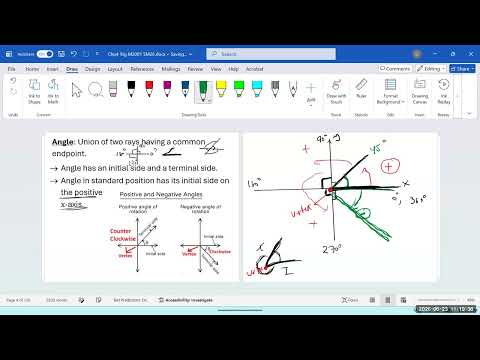
- An angle is formed by two rays that share an endpoint.
- The shared endpoint is the vertex, and the two rays form the angle's sides.
- Two intersecting lines create multiple angles around their intersection.
- The initial side is where an angle's rotation begins; the terminal side marks where it ends.
- In standard position, the vertex is at the origin and the initial side lies along the positive x-axis.
- The coordinate axes mark the familiar rotations 0°, 90°, 180°, 270°, and 360°.
- Counterclockwise rotation from the positive x-axis gives a positive angle.
- Clockwise rotation gives a negative angle; for example, a terminal side 45° below the positive x-axis represents -45°.
- Angle sign depends on rotation direction, not on whether the terminal side is above or below the x-axis alone.
- A reference angle is the positive acute angle between an angle's terminal side and the x-axis.
- It shares the original angle's terminal side, uses either the positive or negative x-axis, and is less than 90°.
- Reference angles are always positive, including when the original angle is negative.
- In Quadrant I, an angle is already acute, so its reference angle equals the original angle.
- In Quadrant II, measure from the negative x-axis; for 150°, the reference angle is 180° - 150° = 30°.
- The reference angle is the smaller angle between the terminal side and the nearest x-axis direction.
- For a Quadrant III angle such as 250°, subtract 180° to get a 70° reference angle.
- For a Quadrant IV angle such as 290°, subtract the angle from 360° to get a 70° reference angle.
- The formulas are θ - 180° in Quadrant III and 360° - θ in Quadrant IV.
- Degrees and radians measure the same rotation using different units.
- The conversion equivalence is 180° = π radians, so degree-to-radian conversion uses π/180.
- Radian-to-degree conversion uses 180/π to cancel the radian unit.
- Convert 30° by multiplying by π/180°, giving π/6 radians.
- Convert 135° the same way and simplify 135π/180 to 3π/4 radians.
- For a non-special angle such as 29°, the exact radian form is 29π/180, approximately 0.51 radians to two decimal places.
- Multiply a radian measure by 180°/π so the π and radian factors cancel.
- π/3 radians converts to 60°.
- -5π/3 radians converts to -300°, while 5π/9 radians converts to 100°.
- Quadrantal angles have terminal sides on the x- or y-axis: 0°, 90°, 180°, 270°, and 360°.
- Their radian equivalents are 0, π/2, π, 3π/2, and 2π.
- Each quarter-turn adds 90° or π/2 radians.
- Coterminal angles in standard position have the same initial side and the same terminal side.
- They can differ by one or more full rotations in either direction.
- The number of revolutions does not matter as long as the terminal side matches.
- Degree measures become coterminal by adding or subtracting multiples of 360°; radian measures use multiples of 2π.
- For -30°, adding 360° gives the positive coterminal angle 330°.
- For 410°, subtracting 360° gives 50°; subtracting another 360° gives the coterminal angle -310°.
- For the diagram's angle A, angles B and C qualify because each ends on A's terminal side.
- Angle D does not qualify because its terminal side differs, even though its initial side matches.
- A visual check of both initial and terminal sides distinguishes coterminal angles.
- The six functions are sine, cosine, tangent, cosecant, secant, and cotangent, commonly abbreviated sin, cos, tan, csc, sec, and cot.
- Sine and cosecant are reciprocals, cosine and secant are reciprocals, and tangent and cotangent are reciprocals.
- Knowing sin, cos, and tan allows the reciprocal functions to be found by taking reciprocals.
- For an acute angle in a right triangle, sine is opposite over hypotenuse, cosine is adjacent over hypotenuse, and tangent is opposite over adjacent.
- The hypotenuse is the longest side and lies opposite the right angle.
- SOHCAHTOA is a mnemonic for the three primary ratios: sine, cosine, and tangent.
- A unit circle has radius 1, and each point on it corresponds to an angle in standard position.
- For an angle's terminal point (x, y), cosine is the x-coordinate and sine is the y-coordinate.
- For 30°, the unit-circle coordinates are (√3/2, 1/2), so cos 30° = √3/2 and sin 30° = 1/2.
- The first-quadrant reference values repeat in the other quadrants, with signs determined by the coordinates.
- Quadrant II has negative x and positive y; Quadrant III has negative x and negative y; Quadrant IV has positive x and negative y.
- The axis points have coordinates (1, 0), (0, 1), (-1, 0), and (0, -1) at 0°, 90°, 180°, and 270°.
- Use one hand with fingers corresponding in order to 0°, 30°, 45°, 60°, and 90°.
- For a selected angle, count fingers to its left and below: the square roots of those counts over 2 give the x- and y-coordinates, respectively.
- For 60°, the method gives x = √1/2 = 1/2 and y = √3/2.
- Read the y-coordinate from the finger rule for sine and the x-coordinate for cosine.
- For 45°, both coordinates are √2/2, so sin 45° = cos 45° = √2/2.
- The axis cases give sin 0° = 0 and cos 90° = 0.
- Students are given time to copy the unit-circle notes and fill in a table of special-angle values.
- The break and note-taking interval runs until the lesson resumes at approximately 104:42.
- The upcoming table uses sine and cosine values to derive tangent and the reciprocal functions.
- The table covers 0°, 30°, 45°, 60°, and 90° and uses sine and cosine as the starting rows.
- Cosecant, secant, and cotangent are found by taking the reciprocals of sine, cosine, and tangent.
- Tangent is computed as sine divided by cosine, and division by zero makes tan 90° undefined.
- The 30-60-90 triangle has side lengths 1, √3, and 2, opposite 30°, 60°, and 90° respectively.
- The 45-45-90 triangle has side lengths 1, 1, and √2.
- These triangles provide exact side ratios for deriving special-angle trig values without recalling the full unit circle.
- SOHCAHTOA applied to a 30-60-90 triangle gives values such as cos 60° = 1/2 and sin 60° = √3/2.
- Reciprocal ratios include csc 60° = 2/√3 and sec 30° = 2/√3; denominators can be rationalized when required.
- For 45°, sin and cos both equal 1/√2, equivalent to √2/2.
- Since cosine corresponds to x and sine corresponds to y, positive sine and positive cosine place an angle in Quadrant I.
- Cosecant has the sign of sine, while tangent has the sign of y/x; these relationships can reveal coordinate signs indirectly.
- For example, positive cosecant and negative tangent imply y is positive and x is negative, locating the angle in Quadrant II.
- Given tan θ < 0 and cos θ > 0, the angle must be in Quadrant IV.
- With adjacent side 21 and hypotenuse 29, the Pythagorean theorem gives the opposite-side length √(29² - 21²) = 20; its signed y-coordinate is -20.
- The six values are sin θ = -20/29, cos θ = 21/29, tan θ = -20/21, csc θ = -29/20, sec θ = 29/21, and cot θ = -21/20.
Transcript excerpt
0:06 Hello everyone. Welcome to our trigonometry. I love trigonometry. The easy stuff, not the harder stuff. So we are done with chapter one, two, three, and we have chapter four. The entire chapter four and then only two sections of chapter five. So hopefully we will be able to finish everything. We have three days, two weeks, right? Three days and one more week or two weeks. I forgot. I even lost count of all the days. >> So >> exactly. >> Wow. Great. Okay, then you'll be able to finish our syllabus in no times and
0:54 you'll be uh ready for the final exam hopefully. But remember uh the last Monday. So we have how many more Monday? Two more Mondays. Chapter one, chapter two. Yeah, we have two more Mondays, right? And then so 29 is one Monday. So you have four Mondays. So the last Monday July 6 is uh all the homework like whatever you have you know on website everything you you must do by mon Monday midnight. Okay. So before that if you miss any any chapter any section or
1:42 anything I don't mind opening them but after July 5th 6th after July 6th I'm not going to open anything no matter how much you be me okay I'm warning you guys so whatever you do make sure you complete all the homework by Monday July 6 midnight our final exam will be July 9th and I'm planning to spend at least two days on reviewing. If not possible, then at least one day on reviewing. And we have one, two, three, four, five, six, seven. Seven classes including today before your next exam, right? Yeah.
2:30 Great actually time wise. Wonderful. Okay. So, we are going to touch the Any questions, comments, concerns, question
This is the start of the transcript. Save this video free for the whole transcript, searchable and time-coded.
Related notes
Summary, takeaways, and chapters were generated by AI from the video's transcript and may contain errors. The video belongs to its creator, Shahera Jannah's Math World! 😁😎.