Lec12 Chp4 M2001 Summer26 Angle of Elevation & Depression, Graphs of Sine & Cosine
 Watch on YouTube →
Overview
Shahera Jannah reviews quadrant-based trigonometric ratios, function composition, and right-triangle applications before developing sine and cosine graphing. Examples include a 240-foot building viewed from 75 feet away, a Ferris wheel height equation, and transformed graphs analyzed through amplitude, period, phase shift, and midline; she also outlines the upcoming Chapter 3 quiz and exam schedule.
Key takeaways
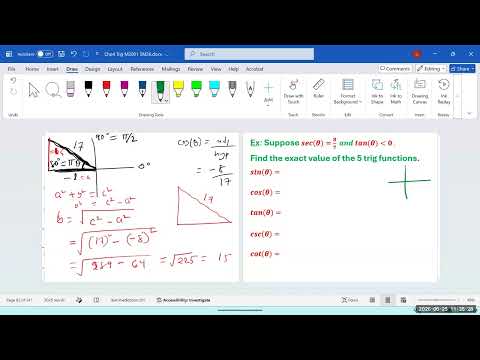
- For cos θ = -8/17 with θ between 0 and π, the angle must be in Quadrant II, making the missing y-coordinate +15 and determining the signs of all six trigonometric ratios.
- For an elevation angle with known opposite and adjacent sides, use tangent; the 240-foot building viewed from 75 feet away gives arctan(240/75) ≈ 72.65°.
- A sine or cosine model can be solved by isolating the trig function and applying inverse trig; in the Ferris wheel example, h(t) = -18 cos(t) + 22 reaches 13 feet when cos(t) = 1/2.
- For a temperature model T(h) = C + 6 sin(πh/12), substituting h = 14 and T = 74 yields C = 77 after using sin(7π/6) = -1/2.
- For y = a·trig(bx - c) + d, amplitude is |a|, period is 2π/|b|, the midline is y = d, and the range is [d - |a|, d + |a|].
- A negative coefficient reflects a sine or cosine graph across the x-axis; a negative amplitude does not make the amplitude itself negative.
Chapters
- Shahera Jannah says the class has about 10 lecture hours remaining, with a quiz, an exam, a final review, and the final exam still scheduled.
- The upcoming quiz covers Chapter 3 exponential and logarithmic topics; the next exam is planned to focus on Chapters 4 and 5.
- Chapter 3 homework is due Monday at midnight, and students are advised to practice rather than rely on AI.
- Given cos θ = -8/17 and 0 < θ < π, the negative cosine places θ in Quadrant II.
- Treat -8 as the x-coordinate and 17 as the positive hypotenuse; the Pythagorean theorem gives y = √(17² - 8²) = 15.
- The resulting ratios include sin θ = 15/17, tan θ = -15/8, csc θ = 17/15, sec θ = -17/8, and cot θ = -8/15.
- From sec θ = 8/7, take the reciprocal to obtain cos θ = 7/8, so the x-coordinate is positive.
- Because tan θ is negative and tan θ = y/x, the y-coordinate must be negative, placing θ in Quadrant IV.
- With hypotenuse 8 and adjacent side 7, the missing side has magnitude √15 and is negative as a y-coordinate in Quadrant IV.
- For f(x) = cos(πx) and g(x) = x² + 9x + 3, evaluate the inner function first: f(1) = cos π = -1.
- Substitute the result into the outer function: g(-1) = (-1)² + 9(-1) + 3 = -5.
- Jannah notes that a composition problem may combine a trigonometric function with a polynomial.
- The class evaluates a piecewise function at 0, using sin(4·0) = 0 and the displayed polynomial terms to obtain 2.
- For the branch evaluated at 81, rewrite 81 as 3⁴ so that log base 3 of 81 simplifies to 4.
- The shown subtraction then gives 2 - 239 = -237, illustrating that the correct piecewise branch and operation order matter.
- An angle of elevation is measured upward from an observer's horizontal line of sight to an object above.
- An angle of depression is measured downward from the horizontal line of sight to an object below.
- Jannah connects these angles to right-triangle trigonometry and notes that the observer's eye level is often simplified to ground level in textbook diagrams.
- The example uses a building 240 feet tall and an observer 75 feet from its base.
- Relative to the elevation angle, 240 feet is opposite and 75 feet is adjacent, so tan θ = 240/75.
- Using inverse tangent in degree mode gives θ ≈ 72.65°; the calculator's angle mode must match the requested units.
- A second building problem gives a height of 150 feet and an angle of elevation of 42°.
- Using tan 42° = 150/x, solve for the horizontal distance with x = 150/tan 42°.
- The calculated distance is approximately 166.59 feet, and the class checks it against the supplied answer.
- The Ferris wheel model is presented as h(t) = -18 cos(t) + 22, with height measured in feet.
- Setting the car's height to 13 gives 13 = -18 cos(t) + 22, hence cos(t) = 1/2.
- The first positive angle used in the example is 60°, interpreted as 60 minutes for the stated time variable.
- The temperature model is T(h) = C + 6 sin(πh/12), where h counts hours after midnight.
- At 2 p.m., h = 14 and the temperature is 74, so C = 74 - 6 sin(14π/12).
- Since 14π/12 simplifies to 7π/6 and sin(7π/6) = -1/2, the model's constant is C = 77.
- After the temperature-model discussion, Jannah pauses before introducing graphs of sine, cosine, and tangent.
- She identifies graphing trigonometric functions and their transformations as a challenging part of the chapter.
- The upcoming graph lesson focuses in detail on sine and cosine, with other trigonometric graphs treated more briefly.
- Sine and cosine repeat every 2π radians, so one cycle from 0 to 2π supplies the base pattern for the full graph.
- A sine cycle starts at 0, rises, falls through the midline, reaches a minimum, and returns to 0.
- A cosine cycle starts at 1, falls to -1, and returns to 1; both graphs continue in both directions.
- The untransformed sine and cosine functions have domain all real numbers and range [-1, 1].
- Sine is odd, meaning sin(-x) = -sin(x), while cosine is even, meaning cos(-x) = cos(x).
- Cosine is symmetric about the y-axis; sine has origin symmetry.
- Jannah gives the general form a·trig(bx - c) + d, with the coefficients determining vertical stretch or reflection, period, horizontal shift, and vertical shift.
- The period is 2π/|b|, while the phase-shift magnitude is |c/b|.
- In the form bx - c, the graph shifts right by c/b; d sets the midline y = d.
- The amplitude is |a|, or half the distance between a graph's maximum and minimum values.
- For 2 sin x, the range becomes [-2, 2]; for 4 sin x, it becomes [-4, 4].
- A negative a reflects the graph across the x-axis, while a larger |a| stretches it vertically.
- The vertical shift d gives the midline y = d, and the amplitude measures the distance from that line to each extreme.
- For a sine or cosine graph with amplitude |a|, the maximum value is d + |a| and the minimum is d - |a|.
- For example, shifting sin x up by 1 moves its midline to y = 1 and its range to [0, 2].
- One standard sine cycle runs from 0 to 2π, with zeros at 0, π, and 2π.
- The maximum occurs at π/2 and the minimum at 3π/2, matching the unit-circle y-coordinates.
- The five key x-values divide a standard cycle into four equal intervals for graph sketching.
- The midline is not always the x-axis; a vertical shift moves it to y = d.
- For a graph with midline y = 3 and amplitude 3, the maximum is 6 and the minimum is 0.
- The range is found by taking the midline value plus and minus the amplitude.
- Use period = 2π/|b| for sine and cosine functions whose input has coefficient b.
- For sin(2x), the period is π, so one cycle is compressed into half the standard 2π interval.
- For sin(x/2), b = 1/2 and the period is 4π, so the cycle is stretched horizontally.
- The horizontal shift is determined by the constant inside the trig function divided by the coefficient of x.
- In sin(bx - c), factoring b gives b(x - c/b), which shifts the graph right by c/b.
- A plus sign inside the argument reverses the direction and shifts the graph left.
- The worked example has a negative coefficient of magnitude 4 and an x-coefficient of 1/6, giving amplitude 4 and period 12π.
- Mark one cycle at 0, 3π, 6π, 9π, and 12π; the four intervals locate the alternating midline and extreme points.
- The negative coefficient reflects the corresponding positive sine graph across the x-axis, exchanging its peaks and troughs.
- The cosine example uses amplitude 4 and an x-coefficient of 2, so its period is 2π/2 = π.
- With no horizontal or vertical shift, the cycle starts at a maximum, reaches a minimum halfway through, and returns to a maximum at π.
- The quarter-cycle marks are 0, π/4, π/2, 3π/4, and π, with range [-4, 4].
- Jannah says the Monday quiz is a mini-exam covering roughly five exponential and five logarithmic topic groups.
- The listed exponential topics include transformations, graphing, equation solving, and real-life applications such as money and continuous compounding.
- Logarithm preparation includes evaluation, domain and range, graphing, equation solving, change of base, and expanding or condensing logarithms.
- The class briefly discusses whether the Chapter 3 quiz will occur Monday and confirms students should prepare for it.
- Jannah says she will continue the Chapter 4 material because the chapter is too long to finish in one class.
- The cosine graph lesson is left for the next class session.
Transcript excerpt
0:00 Morning. How are you guys doing today? Good. Can we pee? Tired. Okay. So, we are in lecture 12. That means we have only uh two more weeks and um eight lectures. In the eight lectures, the last lecture will be final exam. So that means you have seven lectures. In the seven lectures, there will be one exam. That means you have six lectures. In the six
0:49 lectures, definitely one lecture is for review for the final exam. So that means we'll have to with five lectures in these five lectures you have one quiz day. So half class half quiz. So basically we have four lectures. Okay. So four lectures means um 10 hours. We have 10 hours of lectures left and we are halfway. Let me see. Not even halfway. We are almost halfway to chapter 4. Once we done in chapter four, then we have two sections of chapter five. So I decided to give you the exam not on based on
1:42 chapter 3 4 5 instead on chapter 4 five and your quiz will be on chapter 3 and you're going to have a lot of questions in your quiz on chapter 3. Every green question you see on chapter 3 green example make sure to study them. There are so many things to discuss. For example, for exponential you need to know transformation of exponential um graphing exponential, solving exponential equation, real life application of exponential especially the money problem uh continuous compounding those things. And then for logarithmic the same thing transformation of log uh solving log equation simplifying log
2:33 um uh simplifying log application of log transformation of log so log has five topics exponential has four or five I don't remember at least 10 topics okay at least 10 topics you have in your uh
This is the start of the transcript. Save this video free for the whole transcript, searchable and time-coded.
Related notes
Summary, takeaways, and chapters were generated by AI from the video's transcript and may contain errors. The video belongs to its creator, Shahera Jannah's Math World! 😁😎.