Lec16 REvieW for Exam2 M2001
 Watch on YouTube →
Overview
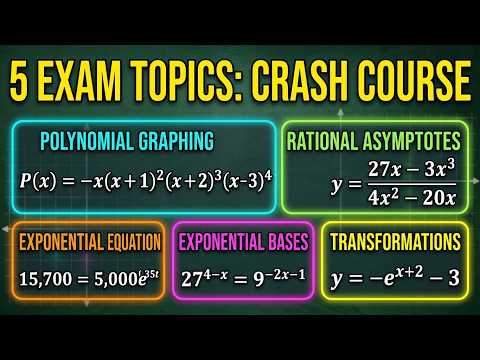
Shahera Jannah reviews the planned Exam 2 scope: Chapter 2 sections 2.1, 2.2, 2.6, and 2.7, plus the exponential material from Chapter 3, excluding logarithmic topics. The review covers polynomial transformations, intercepts, graphing and inequalities, rational-function holes and asymptotes, exponential equations and models, and quadratic vertices; exam solutions should show simplified work and stop before calculator-dependent arithmetic.
Key takeaways
- Exam 2 covers Chapter 2 sections 2.1, 2.2, 2.6, and 2.7, together with exponential material from Chapter 3; logarithmic topics are excluded.
- Simplify rational functions before finding intercepts or asymptotes: cancelled factors create holes, while uncancelled denominator zeros create vertical asymptotes.
- Polynomial root multiplicity predicts local graph behavior: odd multiplicities cross the x-axis, even multiplicities touch and turn, and higher multiplicities flatten the graph near the root.
- For exponential transformations, an outside negative reflects across the x-axis, a negative exponent reflects across the y-axis, and vertical shifts determine the horizontal asymptote.
- When solving exponential equations, first seek a common base; otherwise use natural logarithms to isolate the exponent, and show the setup without calculator-based decimal evaluation.
- In quadratic applications, the vertex's y-coordinate gives a maximum or minimum value, while its x-coordinate gives when that value occurs.
Chapters
- The exam covers all four assigned Chapter 2 sections: 2.1, 2.2, 2.6, and 2.7.
- Chapter 3 coverage is limited to exponential equations, transformations, and models; logarithmic equations and models are excluded.
- Chapter 3 homework deadlines will be extended because the class has not yet covered all assigned material.
- Shahera Jannah advises using homework problems to practice, since exam question types come from material worked in class and the assigned exercises.
- For calculator-style questions, students should simplify and show the setup, then stop before the calculator-dependent final value.
- Students are told to prioritize Chapter 2 homework and review Chapter 3 exponential material, while postponing logarithmic topics.
- A planned transformation problem asks students to draw the original parabola and its transformed graph, then mark the new vertex.
- Apply reflection first, followed by horizontal left or right shifts and vertical up or down shifts.
- The expected work includes identifying the original graph, showing each transformation, and stating the transformed vertex.
- A quadratic question may ask for the vertex, axis of symmetry, x- and y-intercepts, graph, and whether the parabola has a maximum or minimum.
- A negative leading coefficient makes a parabola open downward and have a maximum; a positive coefficient makes it open upward and have a minimum.
- The review plan includes polynomial and rational-function questions, inequalities, exponential transformations, and exponential equations or models.
- A rational-function question may request the domain, vertical and horizontal asymptotes, and x- and y-intercepts; graphing may be offered as extra credit.
- For exponential applications, students may need to choose the correct model and show its setup without calculating a final decimal.
- For compound interest, use the continuous-compounding form A = Pe^(rt), identify the principal and rate, and isolate the time variable.
- The Exam 2 review discussion describes a 1-hour-40-minute exam; the final exam is described as about 40 questions over two hours.
- Most final-exam questions are multiple choice, but correct supporting work is required; the class discussion estimates about 10 non-multiple-choice questions.
- Partial credit is reserved for minor errors, and students are warned not to assume a strong course grade guarantees success on the final.
- To find polynomial x-intercepts, set y = 0, factor the expression, and solve each factor for x.
- Factor out the greatest common factor first; for example, a polynomial with terms x^5, -x^3, and -9x has a common factor of x.
- For y-intercepts, set x = 0; in the illustrated polynomial example, this produces y = 0.
- Before finding a rational function's x-intercepts, factor and cancel common factors so a cancelled zero is not incorrectly counted as an intercept.
- A cancelled factor creates a removable discontinuity, or hole; solve the cancelled factor for its x-coordinate and use the simplified function to find its y-coordinate.
- The x-intercepts come from zeros of the simplified numerator, while denominator zeros that remain after cancellation produce vertical asymptotes.
- For a factored polynomial, each factor's root gives an x-intercept, and the exponent on that factor gives the root's multiplicity.
- Odd multiplicities cross the x-axis; even multiplicities touch and turn, with larger multiplicities producing flatter behavior near the intercept.
- Determine the end behavior from degree parity and the leading coefficient; the worked degree-10 example has a negative leading coefficient, so both ends point downward.
- For an inequality such as f(x) ≥ 0, find the real zeros, divide the number line into intervals, and identify where the function is positive or zero.
- Odd-multiplicity roots change the sign across an interval boundary; even-multiplicity roots preserve the sign.
- Include equality roots with brackets or braces as appropriate, but use parentheses at infinity; nonreal roots such as those from x² + 4 do not create real number-line boundaries.
- An exponential function has a horizontal asymptote; a vertical shift of -3 changes it to y = -3, while a shift of +4 changes it to y = 4.
- A negative sign outside the exponential reflects the graph across the x-axis; a negative sign on the exponent reflects it across the y-axis.
- Apply reflection before horizontal and vertical shifts, and use a transformed point such as the y-intercept to distinguish similar-looking graph choices.
- Use the inverse relationship f(x) = y and f⁻¹(y) = x to interpret a supplied output as the original function's y-value.
- For an equation such as 3 = 5^(2x - 1), take natural logarithms to obtain ln(3) = (2x - 1)ln(5), then isolate x.
- For the exam, show the logarithmic expression and algebraic steps rather than using a calculator for the final numerical approximation.
- The worked investment setup uses principal P = 5,000, target amount A = 15,700, and continuous rate r = 0.035.
- Substitute into A = Pe^(rt), divide by the principal, and apply ln to isolate the time t.
- The expected exam response may stop at the expression for t after simplifying, without calculating its decimal value.
- Compare the highest-degree terms in the numerator and denominator after simplifying the rational function.
- If the denominator's degree is larger, the horizontal asymptote is y = 0; if the degrees match, divide the leading coefficients.
- If the numerator's degree is larger, the function does not have a horizontal asymptote under these degree rules.
- Find the domain from the original denominator, excluding every value that makes it zero, including values that later cancel.
- Find vertical asymptotes from zeros of the simplified denominator; cancelled denominator factors instead correspond to holes.
- In the example that simplifies to 5(2 - x)/[6(2x + 1)], x = 0 is excluded as a hole and x = -1/2 is the vertical asymptote.
- For the simplified example 5(2 - x)/[6(2x + 1)], the hole at x = 0 has y-coordinate 5/3.
- The same function has x-intercept x = 2 and horizontal asymptote y = -5/12, found from the ratio of leading coefficients.
- A hole at x = 0 is not a genuine y-intercept, even though its plotted location lies on the y-axis.
- Rewrite reciprocal powers using negative exponents, such as 1/a = a⁻¹, and express both sides using a common base when possible.
- Once the bases match, equate the exponents and solve the resulting algebraic equation.
- If no common-base rewrite is practical, take natural logarithms to bring the exponent down.
- Use the four degree-and-sign patterns to predict polynomial ends: even degree with a positive leading coefficient rises on both ends, while even degree with a negative coefficient falls on both.
- For an odd-degree polynomial, a positive leading coefficient falls left and rises right; a negative leading coefficient rises left and falls right.
- For a quadratic, the vertex x-coordinate is -b/(2a), the y-coordinate comes from substitution, and the axis of symmetry is the vertical line through the vertex.
- In applications, maximum height is the vertex's y-value and the time at which it occurs is the vertex's x-value; vertex form is y = a(x - h)² + k.
Transcript excerpt
0:03 Okay. So, my plan for today is to do a review and then when is your exam? Do you remember? Friday. How ready you think you are for the exam? >> Any comments? >> Uh, one thing [clears throat] that we stopped at 3.1, right? No, not 3.1. We did many sections of chapter 3. >> Mhm. I didn't go section wise. I went over uh topic wise. >> Okay. >> So, you'll find those sections >> because I checked it the previous section. We went over um the interest rate, right?
0:53 Or we just saw >> interest rate. Yeah, those things. So that part was basically >> but in the middle we did so many things >> display. >> Okay. So chapter three, if you look at [laughter] we look at chapter three, >> we haven't talked to Dr. >> Right. My point is um on sage. Yeah. On sage was
1:44 >> okay. So what I did oops what happened uh here what I did in class was this we did anti exponential function we did exponential equation we did exponential model >> oh >> you see >> we did much more than section 3.1 >> okay I was just looking at this so much how much is due I didn't assign the homework for chapter three yet. It will be end of October. Sorry, October is this month. End of November. >> So if I [laughter] >> as much as it >> No, if you say so. >> True. This is logarithmic equation. So
2:32 in 3.4 we have two types of equation. Logarithmic and exponential. >> I want about the exponential part. I skip the logarithmic. Okay. >> In 3.5 we have two types of model. Exponential and logarithmic. I want you to exponential I skip. >> Okay. Got it. So it was a blended right.
This is the start of the transcript. Save this video free for the whole transcript, searchable and time-coded.
Related notes
Summary, takeaways, and chapters were generated by AI from the video's transcript and may contain errors. The video belongs to its creator, Shahera Jannah's Math World! 😁😎.