Lec7 Chp3 M2001 Summer26 Exponential and Logarithmic functions, Solvinig Exp Equations
 Watch on YouTube →
Overview
Shahera Jannah reviews exam priorities from Chapters 1 and 2, then teaches exponential equations, logarithms, and continuous and periodic compound interest. The lesson develops a practical method for solving exponential equations, explains how logarithmic and exponential functions relate, and applies the formulas to financial problems and logarithmic domains.
Key takeaways
- Match exponential bases before using logarithms: rewrite compatible bases such as 16 as 2^4, compare exponents, and use ln only when a common base is unavailable.
- For an exponential equation with base e, isolate the exponential first, then apply ln; for example, e^(2x)−3=16 gives x=ln(19)/2.
- Continuous compounding uses A=Pe^(rt), while periodic compounding uses A=P(1+r/n)^(nt); the periodic formula uses the same n in both locations.
- To double principal P in five years with continuous compounding, P cancels from the equation and the required rate is ln(2)/5, approximately 13.86%.
- A logarithm's argument must be strictly positive; solving argument=0 locates the vertical asymptote, and testing either side identifies the function's domain.
- Inverse exponential and logarithmic functions reflect across y=x, swap x and y coordinates, and exchange their domain and range.
Chapters
- The class has two exams, and the final is scheduled for Thursday after Tuesday and Wednesday review days.
- Chapter 1 and 2 homework deadlines were extended to Monday at midnight, but no further extensions are planned.
- Bring a scientific calculator for the exam; Shahera Jannah emphasizes practicing solution methods rather than memorizing example numbers.
- Review slope rules for parallel and perpendicular lines and know how to find their equations.
- Prepare for linear application problems by learning the setup and solving process, since exam values may differ from examples.
- Find x- and y-intercepts by setting the appropriate variable to zero and factoring where needed.
- For rational functions, identify the domain, x-intercept, y-intercept, vertical asymptote, and horizontal asymptote.
- Find restrictions by checking denominator zeros, then use the remaining information to describe the graph's key features.
- Test evenness with f(-x)=f(x) and oddness with f(-x)=-f(x); if neither equality holds, the function is neither.
- A sum containing only even powers is even, and a sum of odd-power terms is odd, but constants or mixed powers require checking.
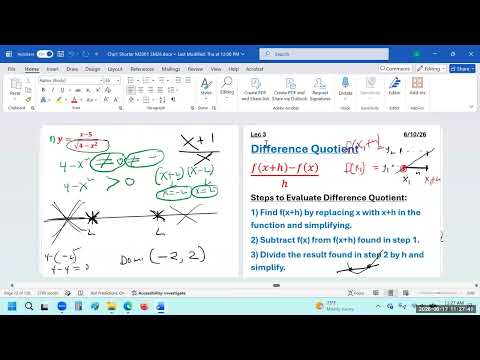
- For domains, exclude denominator zeros and require square-root radicands to be nonnegative, then intersect the restrictions.
- Difference quotients are identified as an exam topic, with at least one question expected.
- Recognize transformations from equations and graphs, including shifts and the contrasting shapes of exponential and logarithmic graphs.
- Composite-function questions may provide two functions, a function and a graph, or two graphs; evaluation is an emphasized skill.
- An inverse-function question is expected, while decomposition is considered less likely to appear on the final.
- For a piecewise graph, read the y-value at the requested x-value and choose a closed point rather than an open circle at a shared boundary.
- For a piecewise formula, locate the input in the correct interval before substituting it into that rule.
- A number line helps distinguish included endpoints, such as x≤1 or 1<x≤3, from excluded endpoints.
- Know how to find a quadratic's vertex from standard or general form and how to find intercepts across several function types.
- For rational functions, prepare the same five features: domain, x-intercept, y-intercept, vertical asymptote, and horizontal asymptote.
- When a vertex and another point are given, substitute them into vertex form to solve for the leading coefficient.
- A maximum or minimum in a quadratic application indicates the vertex; find its x-coordinate, then substitute to obtain the y-coordinate if needed.
- Use polynomial end behavior and turning points to match equations with graphs.
- Expect an inequality question, alongside the rational-function and quadratic topics emphasized in the review.
- The parent exponential form is f(x)=a·b^x, with a positive base b that is not 1; a negative leading coefficient reflects the graph across the x-axis.
- A base greater than 1 gives an increasing exponential, while a base between 0 and 1 gives a decreasing exponential.
- The parent function b^x has domain all real numbers, y-intercept 1, and horizontal asymptote y=0; vertical shifts move the asymptote.
- A negative exponent input reflects across the y-axis, while changes inside or outside the exponent produce horizontal or vertical shifts.
- When both sides have the same base and no extra terms obstruct comparison, set the exponents equal and solve for x.
- If the bases differ, first check whether one can be rewritten as a power of the other.
- After matching bases, remember that an expression with no visible exponent has an implicit exponent of 1.
- For an equation involving bases 2 and 16, rewrite 16 as 2^4 before comparing exponents.
- Use the power-of-a-power rule, multiplying exponents such as 4(3x−1) to obtain 12x−4.
- Set the exponents equal and solve the resulting linear equation, keeping algebraic steps separate from the base conversion.
- Some equations become familiar polynomial equations after removing an added constant and matching the exponential bases.
- The worked approach turns the exponent relationship into x²+x−2=0, which factors as (x+2)(x−1)=0.
- Check both roots, x=−2 and x=1, in the transformed equation.
- When bases such as 8 and 4 cannot be rewritten as powers of each other, express both using their common factor 2.
- Rewrite 8 as 2^3 and 4 as 2^2, then compare the resulting exponents.
- This method preserves the same-base strategy without requiring logarithms.
- Use 1/x=x^−1 and 1/x^n=x^−n to rewrite reciprocal expressions as exponential forms.
- After converting the bases, distribute negative exponents carefully before equating powers.
- The example simplifies a reciprocal-base equation into a linear equation with solution x=−10.
- If two bases cannot be converted to a common base, apply ln to both sides to bring the exponent down.
- For 7^(x−2)=3, take natural logs to obtain (x−2)ln(7)=ln(3), then isolate x.
- Use parentheses and a scientific calculator to evaluate logarithmic quotients; retain the exact expression until the final rounding.
- For equations such as 3^(2x−2)=2, take ln on both sides, divide by ln(3), then isolate x and round only at the end.
- To evaluate an inverse function at 3, treat 3 as an input to f⁻¹ and use the inverse relationship between the original function's range and the inverse's domain.
- The example reduces to solving 3=5^(2x−1), using logarithms to find the required input.
- For e^(2x)−3=16, first isolate the exponential, then apply ln to both sides.
- The inverse relationship ln(e^u)=u gives 2x=ln(19), so x=ln(19)/2.
- For 3e^x+4=5.6, isolate e^x, divide by 3, and then take ln; avoid rounding intermediate values.
- For periodic compounding, use A=P(1+r/n)^(nt), where P is principal, r is the annual rate, n is compounding periods per year, and t is years.
- For continuous compounding, use A=Pe^(rt), where A is the future amount and r and t are the annual rate and time.
- Convert percentage rates to decimals before substitution, and keep the formulas available for solving for principal, rate, time, or amount.
- For a $20,000 target in 10 years at 4.2% continuous interest, substitute A=20,000, r=0.042, and t=10 into A=Pe^(rt).
- Rearrange to P=A/e^(rt) to calculate the amount that must be invested today.
- Because the result is money, round to the nearest cent rather than rounding intermediate calculations.
- With continuous compounding, doubling means A=2P; substituting into A=Pe^(rt) cancels P, so the initial investment amount does not matter.
- For a five-year doubling period, solve 2=e^(5r) to get r=ln(2)/5.
- The required annual rate is approximately 13.86%, or 13.9% to one decimal place.
- Students work through three compound-interest problems with neighbors and check answers during a roughly 10-minute practice period.
- The comparison asks which yields more: annual, monthly, daily, or continuous compounding.
- At the same principal, rate, and time, more frequent compounding produces a larger final amount; continuous compounding is the limiting case.
- For $5,000 growing to $15,700 at 3.5% continuous interest, divide by the principal, take ln, and divide by 0.035 to solve for time.
- The calculation gives approximately 32.7 years, illustrating how long a modest continuous rate can take to grow an investment substantially.
- For $7,000 invested for 8 years at 3.5%, substitute directly into A=Pe^(rt) to find a future value of about $9,261.
- Use A=P(1+r/n)^(nt) when interest is not compounded continuously.
- For the $7,000, 3.5%, eight-year example, set n=1 for annual, n=12 for monthly, or n=365 for daily compounding.
- The same n must appear in both r/n and nt; use a calculator after substituting the selected frequency.
- A logarithm answers the question: what exponent on base b produces the argument?
- In log_b(x)=y, b is the base, x is the argument, and y is the exponent.
- Convert between forms with b^y=x; for example, log_5(√5)=1/2 corresponds to 5^(1/2)=√5.
- Negative exponents represent reciprocals, as in 3^−3=1/27.
- Exponential and logarithmic functions are inverses, so their graphs reflect across y=x and swap corresponding coordinates (x,y) and (y,x).
- The parent exponential has y-intercept 1 and horizontal asymptote y=0; the parent logarithm has x-intercept 1 and vertical asymptote x=0.
- Their domains and ranges exchange: the exponential's real-number domain becomes the logarithm's range, while its positive range becomes the logarithm's domain.
- For bases greater than 1, exponential and logarithmic graphs increase, with exponential growth faster than logarithmic growth.
- For logarithmic bases greater than 1, increasing the base brings the graph closer to the x-axis; bases between 0 and 1 produce decreasing logarithmic functions.
- A logarithm's argument must be positive, so the value that makes the argument zero gives a vertical asymptote and is excluded from the domain.
- For ln(12−3x), the argument is positive only when x<4, giving a vertical asymptote at x=4 and domain (−∞,4).
- For transformed examples such as log(x+2) and log(x−5)+2, horizontal shifts place the vertical asymptotes at x=−2 and x=5, respectively; the asymptote itself is never included.
Transcript excerpt
0:10 Hi everyone. How are you guys doing today? Good. Great. Great. I'm okay. I'm bad. Um, so tomorrow is what? Do you remember that? What you're going to do tomorrow? Exam. Did you study last night? >> I did homework. >> Homework. Great. I actually extended the homework. I believe I did. Right. >> Chapter one homework. I extended till chapter two homework. So if you haven't done homework few things or something you wasn't able to you are not able to uh complete by the deadline Monday midnight then you still have time
0:57 next Monday midnight but I would suggest not to delay your homework because you don't have time we already passed one week and tomorrow we'll pass two weeks so that means you have only three more weeks the last week no homework okay the last week Monday is the last homework and then you have Tuesday, Wednesday to review and then Thursday we're going to have our final exam. Okay? So no matter how much you beg me after Monday to open the homework, I'm not going to open the homework because there is no point of doing the homework if you fail the final exam to pass this class. The first requirement is you have to pass the final exam. So you have to really study and tomorrow I mean after tomorrow you'll know how you're doing in this class. We're going to only two exams. Will we be able to do something today?
1:46 >> It depends on you. Do you have any question? >> Uh well, we went over a lot, you know, the first first. >> Yeah. >> Quick review. Okay, let's see. >> Uh we only had four classes and five. Yeah. So I don't even know what to review because I tell to you everything that
This is the start of the transcript. Save this video free for the whole transcript, searchable and time-coded.
Related notes
Summary, takeaways, and chapters were generated by AI from the video's transcript and may contain errors. The video belongs to its creator, Shahera Jannah's Math World! 😁😎.