Lec15 Chp3 M2001 Solving Exponential Equations, Compounding Money with Interest Rate
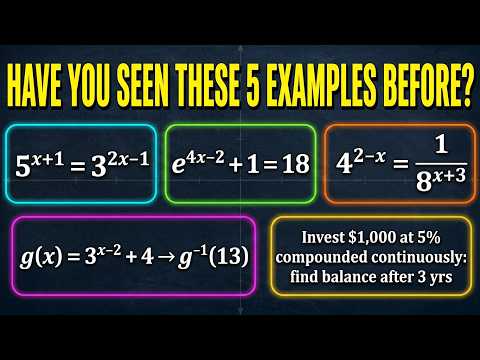 Watch on YouTube →
Overview
Shahera Jannah reviews exponential graph transformations and equation-solving methods, including rewriting expressions with a shared base and applying logarithms when bases are unrelated. She then applies continuous and periodic compound-interest formulas to savings problems, showing how to solve for principal, interest rate, time, and future value, and compares compounding frequencies.
Key takeaways
- Match exponential bases and equate exponents when possible; when bases are unrelated, apply ln or log to both sides and use the power rule.
- Before taking a logarithm, isolate the exponential expression completely, including removing coefficients and constants.
- For continuous compounding, A = Pe^(rt); converting a percentage to decimal is essential, so 4.2% becomes 0.042.
- Solving for a continuous rate uses r = ln(A/P)/t; doubling money in five years requires about 13.8% annually.
- Periodic compounding uses A = P(1 + r/n)^(nt), and increasing n raises the balance toward the continuous-compounding result.
- Financial answers should be rounded to cents, while calculator inputs involving logarithm ratios or exponents should be grouped carefully with parentheses.
Chapters
- The next exam is scheduled for the following Friday, one week after class.
- The review groups Chapter 3 by topic rather than section, covering exponential material before logarithms.
- The Chapter 2 homework is due the following Tuesday; the Chapter 3 homework receives a later due date.
- For an exponential graph with no vertical shift, the horizontal asymptote is y = 0; adding or subtracting 1 shifts it to y = 1 or y = -1.
- Draw the horizontal asymptote as a boundary the graph does not cross; a reflection across the x-axis places the graph below it.
- A negative on x reflects across the y-axis, while changes inside the exponent such as x + 1 shift horizontally in the opposite direction.
- When both sides can be expressed with the same base, equate the exponents and solve the resulting algebraic equation.
- Rewrite related bases using a common smaller base, for example, 8 = 2^3 and 4 = 2^2.
- Convert reciprocals using negative exponents, such as 1/x^n = x^-n, before matching bases.
- When bases cannot be rewritten with a common base, apply log or ln to both sides of the equation.
- Use ln naturally with base e, since ln and the exponential function e cancel when composed.
- The power rule for logarithms brings an exponent down as a coefficient, allowing algebra to isolate x.
- Apply ln to both sides, then use the power rule to rewrite ln(3^(2x - 2)) as (2x - 2)ln(3).
- Divide by ln(3), add 2, and divide by 2 to obtain x = (ln(2)/ln(3) + 2)/2.
- For calculator entry, group the logarithm ratio and the full numerator with parentheses before dividing by 2.
- Use the inverse relationship that an input to f inverse is an output of f, and the inverse output is the original input.
- To find f inverse(3), set the original function's output equal to 3 and solve the resulting exponential equation.
- For the example f(x) = 5^(2x - 1), logarithms give f inverse(3) = (ln(3)/ln(5) + 1)/2, approximately 0.841.
- For an equation such as e^(2x) = 19, apply ln to both sides to get 2x = ln(19), then divide by 2.
- If a coefficient or constant remains, isolate the exponential first; for example, subtract 4 and divide by 3 before taking ln.
- The calculator approximation for ln(19)/2 is about 1.472, and ln(1.6/2) is about -0.223.
- For periodic compounding, use A = P(1 + r/n)^(nt), where P is principal, r is the annual rate, n is compounds per year, and t is years.
- For continuous compounding, use A = Pe^(rt), often remembered as the PERT formula.
- The lesson connects exponential models to bank savings and rapid growth such as bacteria or viruses.
- To have $20,000 after 10 years at 4.2% continuously compounded, identify A = 20,000, t = 10, and r = 0.042.
- Rearrange A = Pe^(rt) to P = A/e^(rt), giving P = 20,000/e^0.42.
- For money calculations, round the final dollar amount to two decimal places; the lesson estimates the required deposit at roughly $13,100.
- Represent doubling with A = 2P and substitute into A = Pe^(rt), so 2P = Pe^(5r) for a five-year goal.
- Cancel P, apply ln, and solve r = ln(2)/5.
- The required continuous annual rate is approximately 0.138, or 13.8%.
- Use A = Pe^(rt) with P = $5,000, a 3.5% rate, and a target of about $15,700.
- Divide by the principal, take ln to bring the exponent down, then divide by r = 0.035 to isolate time.
- The continuous-growth model gives a waiting time of approximately 33 years.
- For $7,000 invested at 3.5% continuously for 8 years, substitute into A = Pe^(rt) to get A = 7,000e^(0.035 × 8).
- The estimated future balance is about $9,262.
- Calculator entry requires grouping the exponent 0.035 × 8 inside parentheses before evaluating e to that power.
- For the $7,000, 3.5%, 8-year comparison, use n = 1 for annual compounding, n = 12 for monthly, and n = 365 for daily.
- Substitute each n into A = P(1 + r/n)^(nt), keeping P, r, and t fixed across the cases.
- The comparison shows that more frequent compounding produces a larger balance, with continuous compounding giving the highest amount.
- Students are asked to attempt the Brightspace review sheet independently before the next class, with worked problems available in lecture notes.
- A final sign check emphasizes that an exponential base between 0 and 1 represents decay and can produce a negative exponent in the setup.
- The class ends with a reminder that the next Friday is the exam, despite a student's conflicting doctor's appointment.
Transcript excerpt
0:03 Hello everyone. How are you guys doing today? I am feeling okay. Not bad. I went to the doctor and they told me um the reason I'm coughing is acid reflux mainly and uh also my allergy seasonal allergy. So, they gave me antibiotic with my acid reflux medicine and allergy medicine. So, I'm taking them um from last 3 days. So, I feel like sometimes my coffee is better, sometimes it's worse. So, I'm not sure if it's working or not. But I'm much better than last class.
0:53 That's why we are being in person. Otherwise, I would have held this class online. Do you remember how many days till our next exam? Exactly 1 week from today. The next week Friday, we are going to have our second exam. Did you notice that I posted the review sheet on Brightspace? You did not notice that? I worked so hard. And I posted as soon as possible after my next class I mean last class. 3. Chapter 3 I'm not going section wise, I'm going topic wise. So, 3.6 Chapter 3 talks
1:43 about logarithm and exponential and they are in different sections. So, what I'm doing is I'm combining all the exponential, putting them together, all the logarithm, putting them together. So, in this exam you're going to have all the exponential, not all the logarithm. Okay? So, for the homework, for chapter three homework, I'm going to put the due date later. So, you have enough time to do home on exponential, also the logarithmic stuff. So, definitely homework for chapter two do next week. Next week Tuesday, I believe. Chapter three later. Okay, any question before we start?
2:33 Any comments, concerns? Chapter three, which section I have no idea. Like I said, I'm this note is not based
This is the start of the transcript. Save this video free for the whole transcript, searchable and time-coded.
Related notes
Summary, takeaways, and chapters were generated by AI from the video's transcript and may contain errors. The video belongs to its creator, Shahera Jannah's Math World! 😁😎.