Lec14 Chp4 M2001 Summer26 Composition of trig with Inverse Trig Functions
 Watch on YouTube →
Overview
Shahera Jannah teaches M2001 students how to evaluate inverse trigonometric functions and compositions by tracking principal-value ranges, reference angles, quadrant signs, and triangle ratios. The lesson distinguishes inverse-trig functions outside regular trig functions from regular trig functions outside inverse-trig functions, then applies the methods to special and general triangles, including Pythagorean-theorem examples; it closes with Chapter 4 exam planning and grade-recovery advice.
Key takeaways
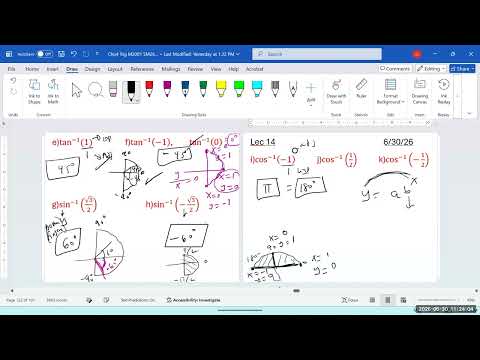
- Inverse sine returns angles in [-90°, 90°], inverse cosine in [0°, 180°], and inverse tangent in (-90°, 90°); compositions must respect the outer inverse function's principal range.
- For sin⁻¹(sin θ), cos⁻¹(cos θ), or tan⁻¹(tan θ), an angle outside the principal range must be replaced by the angle in that range with the same trig value.
- For a composition such as cos⁻¹(sin 330°), evaluate the inner function first: sin 330° = -1/2, then cos⁻¹(-1/2) = 120°.
- For a regular trig function applied to an inverse trig value, such as cos(tan⁻¹ x), turn the inverse-trig input into a triangle, complete any missing side, and apply the outer function's side ratio.
- Quadrant signs are essential: ASTC identifies which trig ratios are positive, while unit-circle coordinates explain the signs of sine, cosine, and tangent.
- When a ratio does not match a 30°-60°-90° or 45°-45°-90° triangle, use a calculator for the inverse angle or use the Pythagorean theorem to complete a general triangle.
Chapters
- Shahera Jannah reviews the crowded Chapter 4 schedule, including composition problems and applications.
- The class discusses whether to test before beginning Chapter 5 and reserve later classes for final-exam review.
- Inverse sine and inverse tangent return angles in the principal range from -90° to 90°, with tangent excluding both endpoints.
- Inverse cosine returns angles from 0° to 180°.
- When evaluating an inverse trig function, choose an answer inside its principal range rather than any coterminal angle.
- For an inverse trig ratio, first test whether the numerator and denominator can represent sides of a right triangle.
- If the ratio cannot describe a triangle, use the principal range and quadrantal angles instead.
- For cosine inverse, the lecture uses the unit-circle x-coordinate at 0°, 90°, and 180° to identify the valid angle.
- For an exponential model y = a·b^x with two points, substitute both points and solve for the unknown parameters a and b.
- Jannah says material not taught in class is unlikely to appear on the final, while noting that the course is relatively new.
- The class returns to inverse-trig examples after briefly addressing the homework question.
- Cosine represents adjacent over hypotenuse, so a ratio of 1/2 identifies the 60° angle in a 30°-60°-90° triangle.
- For a negative cosine ratio, use the inverse-cosine range of 0° to 180° to select the second-quadrant angle.
- The lesson emphasizes that the triangle must be placed in a quadrant allowed by the inverse function's range.
- Tangent represents opposite over adjacent; a ratio of 1/√3 corresponds to a 30° reference angle.
- A negative tangent ratio selects a negative principal angle for inverse tangent, rather than a positive coterminal angle outside its range.
- For a general right triangle, select the inverse function from the known sides, such as tan⁻¹(opposite/adjacent) or cos⁻¹(adjacent/hypotenuse).
- The lesson distinguishes inverse trig applied to regular trig, such as sin⁻¹(sin θ), from regular trig applied to an inverse, such as sin(tan⁻¹ x).
- For compositions with an inverse function on the outside, the outer function's principal range determines the result.
- For compositions with a regular trig function on the outside, first use the inverse function to build a triangle or obtain a ratio.
- For sin⁻¹(sin 150°), 150° lies outside the inverse-sine range, so the matching principal angle is 30°.
- The sign of the original trig value matters: sine is positive in quadrant II, while tangent is negative there.
- For tan⁻¹(tan θ), return the coterminal angle that lies strictly between -90° and 90°.
- For an angle outside an inverse function's range, use its reference angle and the original trig ratio's sign to identify the principal-value result.
- The lecture applies the method to tangent compositions involving angles such as 50° and -135°.
- tan⁻¹(tan 90°) and tan⁻¹(tan -90°) are undefined because tangent itself is undefined at those angles.
- For cos⁻¹(cos 150°), the answer remains 150° because it is already in the 0° to 180° range.
- For angles outside that range, identify the angle in [0°, 180°] with the same cosine value.
- Cosine is even, so cos(-θ) = cos(θ), and inverse cosine still returns a nonnegative principal angle.
- The class compares inverse-sine and inverse-tangent results for angles such as 210° and 330°.
- A reference angle alone does not determine the answer; the trig function's sign and the inverse function's range are both required.
- For inverse cosine, select the matching angle from quadrants I or II and measure it from the positive x-axis.
- After practicing compositions such as sin⁻¹(sin θ), the lesson moves to different functions inside and outside.
- For a form such as cos⁻¹(sin θ), evaluate the inner sine first, then interpret that ratio as a cosine value.
- The new angle must satisfy the outer inverse function's principal range.
- The reference angle for 330° is 30°, and sine is negative in quadrant IV, so sin 330° = -1/2.
- Then cos⁻¹(-1/2) selects 120° from the arccosine range.
- The inner function supplies a signed ratio; the outer function determines which angle represents that ratio.
- The lesson reviews the ASTC mnemonic: all trig functions are positive in quadrant I, sine in II, tangent in III, and cosine in IV.
- Signs can be read from unit-circle coordinates: cosine uses x, sine uses y, and tangent uses y/x.
- Carry the ratio's sign into the outer function rather than treating all triangle side lengths as positive.
- The reference angle for 225° is 45°, and cosine is negative in quadrant III, giving cos 225° = -√2/2.
- Inverse sine returns -45° because -45° is in its principal range and has sine -√2/2.
- A mixed composition can often be resolved by identifying a special-triangle ratio before applying the outer inverse.
- The angle -225° is coterminal with 135°, so its sine is √2/2.
- The outer inverse cosine returns 45°, the angle in [0°, 180°] whose cosine is √2/2.
- The procedure is to evaluate the inner function first, then choose the outer function's principal angle.
- Jannah compares a mixed composition with a ratio that does not match a 30°-60°-90° or 45°-45°-90° triangle.
- For a non-special ratio such as 1/√2, use a calculator to evaluate the inverse tangent, approximately 35.26°.
- Special triangles are shortcuts, not a limit on possible angles; other ratios still define valid angles.
- For expressions such as cos(tan⁻¹ x), interpret x as a tangent ratio and draw a right triangle.
- Complete the triangle, then evaluate the outer trig function using its side ratio.
- For cancellation in an inverse-trig composition, check that the input is in the relevant domain; inverse sine and inverse cosine accept ratios from -1 to 1.
- The class models an inverse tangent input as opposite over adjacent and adds the hypotenuse with the Pythagorean theorem when needed.
- For a special-triangle ratio, identify its angle and then use cosine as adjacent over hypotenuse.
- The method works even when the angle itself is not explicitly calculated.
- For a composition such as sin(tan⁻¹ x), the inverse tangent's principal range places the angle in quadrant I or IV.
- A negative tangent input selects quadrant IV, so the sine output is negative.
- The sign and side ratio must both be retained when transferring the inverse-tangent triangle to the outer sine function.
- Students practice building a triangle from an inverse-trig ratio and identifying familiar 30°-60°-90° or 45°-45°-90° side lengths.
- One worked example uses sine as opposite over hypotenuse and completes the remaining side before evaluating tangent.
- The class is reminded that an outer function may require a different side ratio from the inner inverse function.
- For a triangle with hypotenuse 6 and opposite side 1, the adjacent side is √(6² - 1²) = √35.
- The outer tangent is then opposite over adjacent, giving -1/√35 when the angle lies in quadrant IV.
- For an algebraic triangle with hypotenuse 3 and adjacent side x, the missing side is √(9 - x²), with its sign determined by the quadrant.
- The same triangle procedure applies to cosecant, secant, and cotangent as well as sine, cosine, and tangent.
- Cosecant is hypotenuse over opposite, secant is hypotenuse over adjacent, and cotangent is adjacent over opposite.
- For an inverse cotangent input of 9/11, the missing hypotenuse is √(9² + 11²) = √202.
- Since arccosine returns an angle in quadrant I or II, cos⁻¹(-9/11) places the reference triangle in quadrant II.
- With hypotenuse 11 and adjacent side -9, the opposite side has length √(11² - 9²) = √40.
- The corresponding secant is 11/(-9), while tangent uses the signed opposite-to-adjacent ratio.
- Jannah concludes the Chapter 4 composition material, distinguishing it from the remaining application section.
- The announced Thursday exam covers sections 4.1 through 4.7; section 4.8 remains assigned homework.
- Chapter 5 material is planned for upcoming classes, with later sessions reserved for final-exam review.
- Jannah shows a calculator posted on Brightspace for estimating current standing and the scores needed on future work.
- Example inputs include 30% homework completion, quiz scores of 50 and 40, and exam scores of 45 and 35.
- The examples show how completing homework and improving later exam scores can move a student closer to the stated passing threshold.
- Jannah offers to reopen homework so students can earn points before the course ends.
- She emphasizes finishing Chapter 4 homework and says additional assignments may be reopened after the Thursday exam.
- The closing discussion reinforces that homework, remaining exams, and the final can still provide opportunities to improve a course grade.
Transcript excerpt
0:03 Good morning everyone. How are you guys doing today? Is the microphone on? Right. Okay, now it's fine. Okay. Um
0:55 still deciding should I give you the exam on test day or next week Monday? >> It's chapter 4 but chapter 4 has lots of materials. If you look at the green examples there are so many examples in chapter 4. Uh let's see we have composition two types of composition and then water problem and then chapter five. Yeah we'll we will finish it today. You'll fit more today.
1:41 >> Chapter four. >> Um, can we do like review all day tomorrow? >> Not possible. You have to finish chapter five. >> You can't finish on Monday. >> Um, what happens today? Then you'll decide. If we think we can able to finish everything next week because I want to finish I want to keep twist Tuesday and Wednesday the review the entire math review for final. So you'll [clears throat] see later what
2:27 happens. Okay. So for now we are still in chapter four and we are doing inverse. So do you remember how do you find inverse trig? So origin trig the regular trig takes an angle and gives us the ratio of the triangle. But what inverse is >> the length of side >> take the ratio give us the angle. They're opposite. So anytime you [clears throat] you are given the inverse you always have to remember the range of what >> the range of the inverse function. Do you remember what's the range for sign and tangent inverse? The yaxis is
3:22 >> p / 2 to positive / 2. So everything >> fromative 90° to positive 90° the right side of your uh unit circle. And how about cosine? What's the range for the cosine inverse?
This is the start of the transcript. Save this video free for the whole transcript, searchable and time-coded.
Related notes
Summary, takeaways, and chapters were generated by AI from the video's transcript and may contain errors. The video belongs to its creator, Shahera Jannah's Math World! 😁😎.