L26 Stabilizer Code
Overview
Quantum error correction encodes a logical qubit as a superposition of the three-qubit codewords |000⟩ and |111⟩, then uses parity measurements to identify and correct any single bit flip without measuring the logical information. The lesson derives the same syndrome checks from stabilizer generators, explains their group structure and +1 eigenspace, and reviews how Hadamard conjugation exchanges X and Z operations between computational and |+⟩, |−⟩ bases.
Key takeaways
- The three-qubit bit-flip code stores one logical qubit in α|000⟩ + β|111⟩, with |000⟩ and |111⟩ as codewords spanning the protected code space.
- Parity checks ZZI and IZZ produce a syndrome that distinguishes a single X error on each of the three data qubits from the no-error case.
- A valid code state is a +1 eigenstate of every stabilizer; a bit flip can change one or more check outcomes to −1 without revealing α or β.
- The three-qubit repetition code corrects one physical bit flip, but it does not guarantee correction when multiple qubits flip.
- The stabilizer group can be generated by two operators, ZZI and IZZ; their product adds ZIZ, demonstrating how generators compactly define the full group.
- Hadamard conjugation swaps X and Z, explaining why bit-flip and phase-flip checks are related through a change between computational and |+⟩, |−⟩ bases.
Chapters
- Quantum error correction encodes a state with density operator ρ into a larger space, protects it through a noisy channel, then decodes to recover ρ.
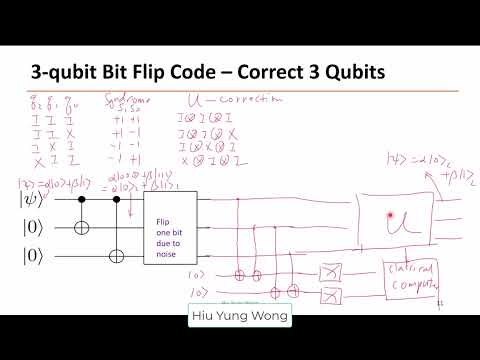
- The three-qubit bit-flip code maps logical |0⟩ to |000⟩ and logical |1⟩ to |111⟩, so α|0⟩ + β|1⟩ becomes α|000⟩ + β|111⟩.
- Codewords span the code space; a bit flip such as |000⟩ → |100⟩ moves a state outside that space and makes the error detectable.
- Two ancilla qubits collect parity checks between neighboring data qubits, producing syndrome bits without directly measuring the encoded logical state.
- The two checks distinguish errors on Q0, Q1, or Q2 from the no-error case; the syndrome is then used to apply an X correction to the affected qubit.
- The code corrects one bit flip among three physical qubits; simultaneous flips are outside the correction guarantee described here.
- Compared with using data qubits for detection and correction, dedicated ancillas avoid discarding corrupted ancillas and keep the logical state encoded during correction.
- A stabilizer is an operator that leaves every valid codeword unchanged, making the code space the shared +1 eigenspace of its stabilizers.
- For the three-qubit repetition code, ZZI and IZZ generate the stabilizer group; their product is ZIZ, alongside the identity.
- The group elements obey identity, inverse, associativity, and closure; these properties allow a compact generator set to represent the full group.
- Applying a stabilizer generator to a state with a bit flip can produce eigenvalue −1, and the two generator outcomes reproduce the single-error syndrome table.
- For example, flipping the middle qubit changes the signs detected by both Z-pair checks, identifying that location for correction.
- In the computational basis, X flips |0⟩ and |1⟩; in the |+⟩, |−⟩ basis, X acts as a phase operation, while Z acts as a bit flip.
- Hadamard conjugation exchanges the Pauli operators: H X H = Z and H Z H = X.
Transcript excerpt
0:08 Okay, I forgot to record the video in today's class. Now I will just go over it again and um briefly. So the first concept we introduced today is code words and code space. So let's take a look just remind oursel what is quantum error correction. It basically is a process that you have a message in here it is like Z equal to alpha 0 plus beta 1 1 cubit. Yeah, you usually in a more formal approach we start with the density matrix uh in the description and you have this message you do encoding right when you do encoding you encode it in a larger space and then when you go through a noisy channel uh it might uh got uh flipped the bit might got flipped
0:57 or uh face flip or other issue right but after that you will do decoding And the purpose of quantum error correction is that you through this encoding and decoding process you will be able to correct the noise so that you recover row which is the density matrix of the information. So basically it means that the row after multiply by encoding process um noise and decoding we recover row. Okay. So this is the overview. I hope you can bear this in mind. But what is code words? So in this encoding process we try to uh encode our information. Now we actually use a
1:44 larger space to encode it. For okay for example I we use three physical cubit 0 to encode logical zero. Right now um the code word is the basis of the encoder. So this encoding process it has some basis right it con construct the whole code space. I just want to uh uh make it clear that this basis is not the basis
This is the start of the transcript. Save this video free for the whole transcript, searchable and time-coded.
In this course
Related notes
Summary, takeaways, and chapters were generated by AI from the video's transcript and may contain errors. The video belongs to its creator, Quantum Computing, TCAD, Semicond by Hiu-Yung Wong.