L2 Vector Space, Inner Product, Bra Ket Notation
Overview
Hiu-Yung Wong develops vector-space and inner-product ideas from familiar 2D coordinates to complex, higher-dimensional spaces, emphasizing that vector components only make sense relative to a chosen basis. The lesson derives the complex inner product, introduces orthonormal bases and Dirac bra-ket notation, and connects quantum states to superpositions of basis states such as spin up and spin down.
Key takeaways
- Vector components are basis-dependent: the same 2D vector is (3, 2) in one coordinate system and (6, 4) when the reference unit vectors are half as long.
- For an orthonormal basis, a real inner product can be calculated as a transpose times a column, while complex vectors require conjugating the first vector.
- The complex inner product ⟨a|b⟩ = Σᵢ aᵢ* bᵢ is generally order-sensitive, unlike the symmetric dot product of real vectors.
- An orthonormal basis has unit-length vectors with zero pairwise inner products, giving a reliable algebraic test for orthogonality in spaces that cannot be visualized.
- Dirac notation makes the dual relationship explicit: a ket |a⟩ becomes the bra ⟨a| through conjugate transpose, and their product with |b⟩ is the inner product ⟨a|b⟩.
- A spin state is a superposition α|spin up⟩ + β|spin down⟩ in an abstract two-dimensional space, not a conventional vector pointing in a 3D direction.
Chapters
- Students are invited to join the IBM Quantum account so usage stops at a limit instead of risking charges described as $10 per second.
- The assigned preparation is chapters 1 through 3 of the course book.
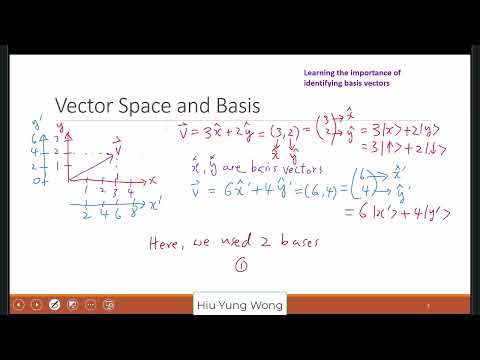
- In the familiar 2D coordinate system, a vector with components 3 and 2 is written as 3 x-hat + 2 y-hat.
- The ordered pair (3, 2) abbreviates those coefficients only when the x-hat and y-hat basis is understood.
- A basis supplies the reference units needed to interpret vector components, much like specifying whether a quantity counts eggs or dozens.
- A second coordinate system uses x-dash and y-dash unit vectors that are half the length of the original x-hat and y-hat vectors.
- The same geometric vector has coordinates (3, 2) in the original basis and (6, 4) in the scaled basis.
- Quantum computing papers must identify their basis because identical-looking coordinate lists can describe different vectors when the reference basis changes.
- For vectors v1 = (√3, 1) and v2 = (1, 1), their directions are 30° and 45°, so their angle is 15°.
- The geometric inner product is |v1||v2| cos θ, which gives √3 + 1, approximately 2.732, for the example.
- The inner product relates to the projection of one vector onto another, with the projected length scaled by the other vector's magnitude.
- A zero inner product in ordinary 2D geometry indicates perpendicular vectors and no projection onto one another.
- Write v1 as the column (√3, 1) and v2 as the column (1, 1), then transpose v1 to form a row.
- The matrix product v1ᵀv2 computes √3·1 + 1·1, matching the geometric result of approximately 2.732.
- This coordinate calculation avoids finding the angle and generalizes to higher dimensions when the basis is orthonormal.
- An n-dimensional space needs n linearly independent basis vectors to span the space; one direction alone cannot represent every 2D vector.
- A general vector is a linear combination a₀v₀ + a₁v₁ + … + aₙ₋₁vₙ₋₁.
- The coefficients may be real or complex depending on the vector space, and the vector can be recorded as an n-entry column.
- For coefficient vectors a and b, the inner product is defined as the sum a₀* b₀ + a₁* b₁ + … + aₙ₋₁* bₙ₋₁.
- The star denotes complex conjugation: for example, 3 + 2i becomes 3 − 2i.
- The compact summation is Σᵢ₌₀ⁿ⁻¹ aᵢ* bᵢ, and the result can be complex rather than a real magnitude.
- For column vectors, take the first vector's transpose and complex conjugate, then multiply by the second vector.
- The resulting row-by-column product expands to Σᵢ₌₀ⁿ⁻¹ aᵢ* bᵢ, matching the complex inner-product definition.
- Order matters: the inner product of a with b is not generally equal to the inner product of b with a; the distinction disappears for real-valued components.
- In 3D real space, x-hat, y-hat, and z-hat form three independent basis vectors.
- A two-dimensional spin space can instead use spin up and spin down as its basis states.
- Spin-space vectors are mathematical state descriptions, not ordinary arrows pointing through physical 3D space.
- A basis is orthonormal when the inner product of basis vectors i and j is 1 for i = j and 0 for i ≠ j.
- The diagonal condition means each basis vector has unit length; the off-diagonal condition means distinct basis vectors are orthogonal.
- For the 2D basis, x-hat = (1, 0) and y-hat = (0, 1), giving x-hat·x-hat = 1 and x-hat·y-hat = 0.
- In higher-dimensional spaces, inner products test orthogonality even when geometric angles cannot be visualized.
- Dirac ket notation writes a vector as |a⟩, replacing an arrow or other vector label with a vertical bar and right angle bracket.
- Vector addition can be written |c⟩ = |a⟩ + |b⟩, while scalar multiplication is written n|a⟩.
- The label inside the ket is a name for the vector; its meaning depends on an agreed basis and context.
- The bra ⟨a| is the dual of ket |a⟩ and is formed by transposing the coefficient column and taking its complex conjugate.
- If |a⟩ = (a₀, a₁, a₂)ᵀ, then ⟨a| = (a₀*, a₁*, a₂*).
- The inner product becomes ⟨a|b⟩, a row-by-column product that reproduces the conjugated-coefficient formula.
- A physical system's state is represented by a vector, and every vector is a linear combination of the system's basis states.
- A spin state can be written |ψ⟩ = α|spin up⟩ + β|spin down⟩, where α and β are its complex coefficients.
- The spin basis belongs to an abstract state space; a Bloch sphere can visualize that space, but spin up does not simply mean an arrow pointing upward in 3D.
- The closing exchange confirms that a quantum state is taken to have unit magnitude.
Transcript excerpt
0:07 Uh first I have invited all of you to join the IBM quantum account. In principle you can join by yourself but you need to put your credit card and if you're careless they are charging you like $10 per second in that order, right? Uh but if you use this one then there will be no problem. Once you hit limit then they they will just stop you. So make sure that uh if you have not received the invitations let me know. Um also for today please read chapter one to three. My books is very easy to read right? If you want to complain about it the only thing you can complain may be too easy. Okay other than that you should you should not complain about it. I mean oh okay so uh let's go directly to the content. So I will start talking about vectors space and bases. You know
0:57 about this already but I want to emphasize it and because we will keep referring to this concept throughout the classes. So let's look at this a twodimensional space which you know very well. For example, I have this coordinate. This is X. This is Y. This is just the 2D coordinates you learn in middle school already. And I have vector a vector here. Let me redraw it. And this vector hits three here. So this is one, two, three, 4. One, two, three,
1:50 four. Okay. And then I don't know why I call it. This is one. This is two. This is three. What is the value of this vector? Anyone knows? So I call it V. I mean this is V arrow. So this is a vector, right? Is that okay? So I want to express it as the X and Y
This is the start of the transcript. Save this video free for the whole transcript, searchable and time-coded.
In this course
Related notes
Summary, takeaways, and chapters were generated by AI from the video's transcript and may contain errors. The video belongs to its creator, Quantum Computing, TCAD, Semicond by Hiu-Yung Wong.