L1A: How to use AI and LLM in this Quantum Computing Class
Overview
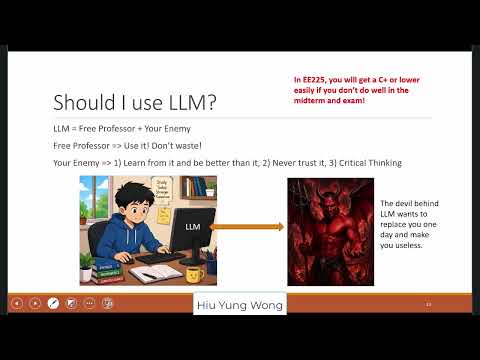
Hiu-Yung Wong frames ChatGPT and other large language models as both a free professor and a potential enemy in a quantum computing class: useful for explanations and derivations, but harmful when students copy answers without learning. He demonstrates asking ChatGPT to derive a quantum-circuit result step by step, then using a mistaken control-qubit explanation to uncover phase kickback, while emphasizing verification and critical thinking.
Key takeaways
- Use ChatGPT as a quantum-computing tutor by asking for step-by-step derivations, then working through the equations instead of copying a final circuit output.
- Sharing your own reasoning in a prompt gives ChatGPT something specific to assess, but a reassuring response does not prove that your reasoning is correct.
- Quantum-computing explanations require verification: Wong's circuit example turns on phase kickback, which overturns an intuitive claim about a control qubit.
- Repeatedly accepting LLM answers without learning can erode critical thinking and undermine performance on independent exams and future work.
- ChatGPT can provide patient, on-demand discussion of difficult, nonintuitive topics, but its answers and derivations still need to be checked.
Chapters
- Wong recommends using free access to ChatGPT and other LLMs as a learning resource, while using them reasonably because each query consumes energy.
- Treat AI answers as explanations to study, not final answers to copy; work through code syntax, algorithms, and quantum mathematics such as entanglement.
- LLMs can be wrong, and habitual reliance can weaken critical thinking and leave students unable to perform without AI.
- Copying ChatGPT homework without learning may lead to poor midterm and exam performance, including a C or below in the graduate class.
- Wong contrasts pasting an assignment and asking ChatGPT for only the answer with requesting a step-by-step derivation of a controlled-gate operation.
- In the demonstrated first circuit, ChatGPT returns an output of zero with 100% probability; copying that result alone is presented as a way to fail the class.
- A derivation-focused prompt encourages students to inspect each equation and understand how the circuit produces its result.
- Wong enters his own reasoning about control qubits and Hadamard gates, then asks ChatGPT to evaluate it instead of presenting the model with only a bare question.
- ChatGPT initially responds reassuringly, but Wong points out that the reasoning is wrong and introduces phase kickback as the important quantum effect.
- Follow up on unfamiliar terms, such as phase kickback, and verify the model's explanations and derivations rather than assuming they are correct.
- ChatGPT's patience and availability, even for questions at 2 a.m., can support discussion of counterintuitive quantum computing concepts, provided students retain independent judgment.
Transcript excerpt
0:07 Now, I want to talk about the rule of using large language model in our class. So, should I use large language model? So, what is large language model? It's free professor plus your enemy. That's what I see, okay? It's free. Why is it free? Because we already have a free subscription from ChatGPT. And many of you have free access to other type of LLM, right? And you should ask both if you have this time and resources. So, it is free. Uh but it's also your enemy. So, since it is a free professor, you need to use it. Don't waste it. Right? Uh of course, some people have concern about environmental impact. It's true. When you ask question, it's
0:57 uh consume a lot of energy. So, don't don't say hi to it, okay? And when it give you an answer, don't say thank you. So, there was a cartoon joke, right? So, like 50 years later, the uh the LLM govern the world govern human, right? And they start punishing the those people uh human that has problem. The first type they are going to punish that uh why why I can't why I need to go to jail? Because every time you ask us a question, you end with thank you. You wasted a lot of energy. So, so yeah. So, try to use it uh reasonably uh in a reasonable way and be uh environmental friendly, right? Uh but
1:45 really learn from it. But it's your enemy. I would say I want to tell you uh it is your enemy. But if it's it is your enemy, what would you do? Right? It's not a human. You cannot damage it. You cannot destroy it. So, [snorts] what is the best how to treat your
This is the start of the transcript. Save this video free for the whole transcript, searchable and time-coded.
In this course
Related notes
Summary, takeaways, and chapters were generated by AI from the video's transcript and may contain errors. The video belongs to its creator, Quantum Computing, TCAD, Semicond by Hiu-Yung Wong.