L24 Bloch Sphere 2
Overview
Hiu-Yung Wong connects the Bloch sphere representation of a pure qubit to measurable quantities: the state’s Bloch vector has components equal to the expectation values of the Pauli matrices, and measurement along any unit direction returns the vector’s projection onto that direction. He then uses the sphere to explain single-qubit gates as rotations, introduces a three-rotation Euler decomposition, and derives an X gate implementation while warning that flipping computational-basis states alone does not fully define a gate.
Key takeaways
- For a pure qubit with Bloch angles θ and φ, the Pauli expectation values are ⟨σx⟩ = sin θ cos φ, ⟨σy⟩ = sin θ sin φ, and ⟨σz⟩ = cos θ.
- Measuring Pauli Z yields +1 and −1 with probabilities cos²(θ/2) and sin²(θ/2), so its expectation value is the Bloch vector’s z-coordinate, cos θ.
- For any unit measurement direction n, the observable n·σ has expectation value n·r, the projection of the qubit’s Bloch vector r onto that direction.
- Global phase changes the written amplitudes but not measurement probabilities or the physical state represented by a Bloch-sphere point.
- A single-qubit rotation can be represented by three Euler rotations about z, y, and z; in the lecture’s convention, X uses θ = π, λ = π, and φ = 0.
- Verifying a gate only on |0⟩ and |1⟩ is insufficient: X must also leave |+⟩ unchanged, unlike a lone π rotation about y.
Chapters
- A pure qubit is parameterized by polar angle θ and azimuthal angle φ on the Bloch sphere.
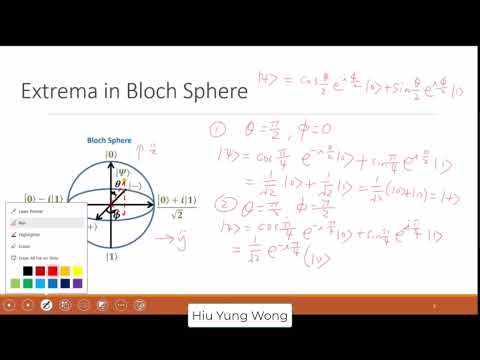
- The state is written as cos(θ/2)|0⟩ + e^(iφ)sin(θ/2)|1⟩, with the angles locating its point on the sphere.
- The polar angle θ is measured from the positive z-axis, and φ is measured around the equator from the positive x-axis.
- |0⟩ is at the north pole and |1⟩ is at the south pole, corresponding to θ = 0 and θ = π.
- At θ = π/2 and φ = 0, substitution into the state formula gives (|0⟩ + |1⟩)/√2, the |+⟩ state on the positive x-axis.
- The sphere is an embedding used to visualize qubit states, not a claim that the qubit physically occupies ordinary three-dimensional space.
- Setting θ = π/2 and φ = π/2 gives a state equivalent to (|0⟩ + i|1⟩)/√2, located on the positive y-axis.
- The state is an eigenstate of the Pauli Y matrix with eigenvalue +1.
- Factoring out e^(iπ/4) changes the written state by a global phase, but does not change measurement probabilities or the represented Bloch-sphere point.
- A symmetric phase convention places e^(iφ/2) on |0⟩ and e^(-iφ/2) on |1⟩.
- Many textbooks instead use |ψ⟩ = cos(θ/2)|0⟩ + e^(iφ)sin(θ/2)|1⟩.
- The two conventions differ only by an overall phase, so they describe the same physical qubit state.
- An expectation value is the probability-weighted average of possible measurement outcomes, like the mean of an unbiased six-sided die, which is 3.5.
- Measuring Pauli Z produces eigenvalues +1 and −1, associated with |0⟩ and |1⟩ respectively.
- For a qubit parameterized by θ, the probabilities of those outcomes are cos²(θ/2) and sin²(θ/2), giving an expectation value of cos²(θ/2) − sin²(θ/2) = cos θ.
- The Pauli Z expectation value, ⟨σz⟩ = cos θ, equals the qubit point’s z-coordinate on the unit Bloch sphere.
- At the equator, θ = π/2 and ⟨σz⟩ = 0, so measurements give +1 and −1 with equal probability.
- At |1⟩, θ = π and ⟨σz⟩ = −1, matching the certainty of obtaining the −1 outcome.
- The Pauli Z matrix is diag(1, −1), and the expectation value is calculated as ⟨ψ|σz|ψ⟩.
- Taking the conjugate transpose of the state conjugates its complex amplitudes before the matrix multiplication.
- The bra-ket calculation returns cos²(θ/2) − sin²(θ/2) = cos θ, agreeing with the geometric z-projection.
- The Pauli X matrix swaps the |0⟩ and |1⟩ amplitudes in a two-component state vector.
- Using the general Bloch state in ⟨ψ|σx|ψ⟩ gives sin θ cos φ.
- That result is the x-coordinate of the Bloch vector, showing that ⟨σx⟩ equals the state’s projection onto the x-axis.
- The Pauli Y matrix has off-diagonal entries −i and i, so its expectation value depends on the relative phase between amplitudes.
- Evaluating ⟨ψ|σy|ψ⟩ gives sin θ sin φ.
- This is the y-coordinate of the Bloch vector, completing the correspondence between Pauli X, Y, Z expectations and the x, y, z projections.
- The Bloch vector is a real, unit-length 3D vector associated with a pure qubit state.
- In spherical coordinates it is r = (sin θ cos φ, sin θ sin φ, cos θ).
- Equivalently, its components are rₓ = ⟨σx⟩, rᵧ = ⟨σy⟩, and r_z = ⟨σz⟩.
- The Pauli vector is σ = σx x̂ + σy ŷ + σz ẑ, with matrix-valued Pauli operators as its components.
- For a unit direction n = (nₓ, nᵧ, n_z), the operator n·σ is nₓσx + nᵧσy + n_zσz.
- Its matrix is [[n_z, nₓ − i nᵧ], [nₓ + i nᵧ, −n_z]], representing a spin observable measured along direction n.
- Linearity gives ⟨n·σ⟩ = nₓrₓ + nᵧrᵧ + n_zr_z = n·r.
- Because n and r are unit vectors for a pure state and a chosen measurement direction, the expectation is the projection of the Bloch vector onto n.
- The x, y, and z Pauli measurements are special cases of this rule, which also applies when the magnetic field points in any direction.
- A single-qubit gate maps one state to another, represented on the Bloch sphere as a rotation from one point to another.
- An arbitrary rotation can be decomposed into three rotations: about z by λ, about y by θ, and about z by φ.
- The rotation angles are inserted into the corresponding matrix representation; different Euler conventions can use different axis orders.
- Matching the Euler-form matrix to the Pauli X matrix gives θ = π, λ = π, and φ = 0 in the lecture’s convention.
- The resulting operation is equivalent to a z rotation by π followed by a y rotation by π, with overall phase not affecting the gate’s observable action.
- For IBM Quantum’s parameter order θ, φ, λ, the corresponding values are π, 0, π; applying the gate to |0⟩ produces |1⟩, with the displayed register result interpreted using the most-significant-bit convention.
- A π rotation about y swaps |0⟩ and |1⟩ up to phase, but it is not the same operation as X on every superposition.
- For |+⟩, X leaves the state unchanged, whereas a y-axis π rotation maps it to a state equivalent to |−⟩.
- The full z-then-y rotation decomposition reproduces X on both computational-basis states and superpositions, so checking only |0⟩ and |1⟩ can miss an incorrect gate.
Transcript excerpt
0:07 How do you write the a general word uh state of one cubit when you represent by theta and five on brophere? Anyone remember equals to what? forgot cosine beta / 2 e power - i / 2 zero. Right? And then how about the other term? Sin >> sin theta / 2 e^ i over two one. Yeah. Something like that.
0:55 Right. Good. Yeah. So let's continue. Now my question to you is um sure I admit to everyone. My question my question to you is what is which point it is or which state it is when theta = to pi / 2 and then 5 = z. Just looking at this sphere when theta= pi / 2 where will that point be? Huh? I say again when it is pi / two. How do you measure
1:44 theta based on this drawing? Yeah, it will be along the equator right because we measure from top. When theta is zero then it must be on north at the north pole. Yeah. So must be on the equator. Great. And when phi equal to zero, what would that be based on this joint? Plus it should be at this point because we measure five from this plus location. Okay. Or actually I should mention that if you remember I said this is to embed the cubit space in our 3D coordinate space. Right? So in this case the top corres this direction will correspond to Z. This direction correspond to X and
2:35 this direction corresponds to Y. Right? Of course the cubid does not live in the 3D space where we live in but we just embed just like I told you I draw a map on my table. The the Earth is does not live on top my on my table. Right. I
This is the start of the transcript. Save this video free for the whole transcript, searchable and time-coded.
In this course
Related notes
Summary, takeaways, and chapters were generated by AI from the video's transcript and may contain errors. The video belongs to its creator, Quantum Computing, TCAD, Semicond by Hiu-Yung Wong.