L1B: A Very Short Overview of Quantum Computing
 Watch on YouTube →
Overview
Hiu-Yung Wong introduces quantum computing through superposition, entanglement, and interference, distinguishing gate-based machines from quantum annealers such as D-Wave. He explains how qubit state spaces scale exponentially, why measurement limits what can be read from a computation, and how entanglement and reversible gates differ from classical computation.
Key takeaways
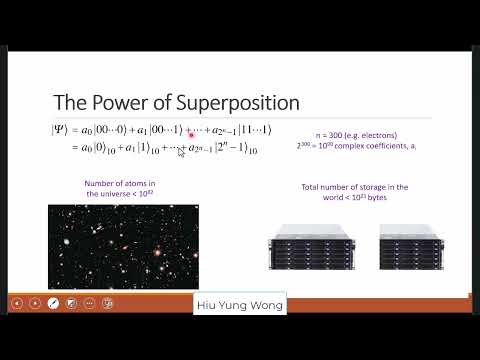
- A 300-qubit pure state has 2^300 possible basis states and takes about 10^90 complex amplitudes to represent, illustrating why classical simulation becomes intractable at scale.
- Superposition alone does not provide a readable answer to every computation: measurement returns a single outcome, with probabilities set by the squared magnitudes of the state amplitudes.
- Quantum annealing encodes an optimization objective as an energy landscape and searches for a low-energy state, unlike a gate-based algorithm that applies a defined sequence of operations.
- Entanglement means a joint state cannot be decomposed into independent qubit states; correlated outcomes such as 00 and 11 can therefore carry information that separate qubit descriptions miss.
- Quantum gates are reversible transformations, whereas measurement collapses the state and cannot generally be undone; this distinction is central to the lecture's comparison with classical logic.
Chapters
- Quantum computing uses superposition and entanglement for computation, with interference helping extract useful information.
- Gate-based systems apply operations such as NOT and Hadamard gates to quantum states, paralleling classical logic circuits.
- D-Wave-style quantum annealing maps optimization problems, such as finding a shortest route through 100 cities, to a physical energy landscape and seeks its low-energy solution.
- Potential applications include molecular energy calculations for drug design, portfolio optimization at firms such as HSBC and Wells Fargo, and secure communication; quantum computers are not replacements for ordinary arithmetic.
- A qubit can be a superposition of basis states 0 and 1; a system of 300 qubits has 2^300 basis states and requires roughly 10^90 complex amplitudes to describe in full.
- Quantum operations act linearly on superpositions, but that does not make every result directly accessible as parallel computation.
- Measurement collapses a superposition to a classical outcome; the probability of each result is determined by the squared magnitude of its amplitude.
- Entangled states cannot be factored into independent qubit states; for example, two qubits can produce correlated measurement results such as 00 or 11.
- Quantum gates are commonly implemented with laser or microwave pulses and, unlike irreversible classical AND gates, are reversible; a controlled-NOT gate can be inverted to recover its input.
- Gate operations rotate the quantum state and can be undone by applying the inverse gate, while measurement is irreversible because it collapses the state.
- Wong contrasts the reversible computation model with the energy and heat associated with classical computation, while noting the substantial cooling demands of quantum hardware.
- Citing Niels Bohr, Albert Einstein, and David Mermin, Wong encourages learners to work with quantum mechanics mathematically even when its behavior conflicts with everyday intuition.
Transcript excerpt
0:07 the background of quantum computing. You don't need to fully understand, but I want to give you a feeling of what a quantum computing what a quantum computer is. Uh you can go to this video uh that is about 1 hour long. Uh I did that uh in the past in the class, but I want to shorten it this semester cuz I want to cover new topics. So, we start already. So, quantum computing, right? What is this? It is uh try to use two phenomena. One is superposition and and the another is entanglement. It used these two physical phenomena to do computation. Now, we have been using quantum mechanics for computation a long time. Because transistor does not exist if it
0:58 doesn't rely on quantum mechanics. For those who have learned device physics, you learn about band structure, you learn about electron-hole pair. You don't have band structure if there was no quantum mechanics. So, we do use quantum mechanics a lot. LED is quantum mechanics for I uh and uh many other electronic devices. So, everything on your iPhone rely on quantum mechanics. But, they don't use superposition and entanglement to do computation. Also, we need to use interference to extract information, right? Just remember these three keywords. That is what we're going to cover in this semester. There are two types of quantum computers. One is gate-based.
1:47 Gate-based quantum computers has a concept just like a classical computer. You have gate. You have a signal in classical computer go to land gate, nor gate, or gate, and then eventually all this gate become an adder or uh accumulator, whatever, and then you do the computation. Here I have a quantum signal. You go through not gate, Hadamard gate, etc., and then you do quantum computation. But this
This is the start of the transcript. Save this video free for the whole transcript, searchable and time-coded.
In this course
Related notes
Summary, takeaways, and chapters were generated by AI from the video's transcript and may contain errors. The video belongs to its creator, Quantum Computing, TCAD, Semicond by Hiu-Yung Wong.