Inflammation 1of2 Fall 2026
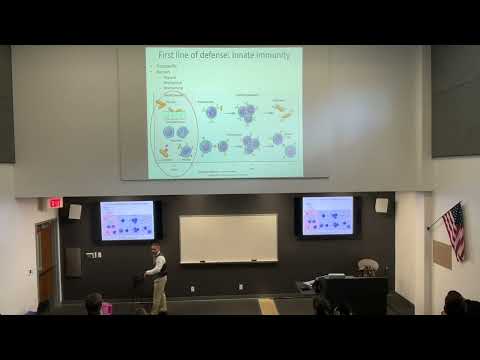 Watch on YouTube →
Overview
Robert Kellar explains acute inflammation as a necessary, nonspecific part of innate immunity that initiates healing, while persistent inflammation can become pathological and contribute to chronic disease. He traces the response from histamine-driven vasodilation and fluid leakage through leukocyte recruitment, macrophage phagocytosis, and tissue repair, distinguishing outcomes such as resolution, chronic inflammation, and fibrosis.
Key takeaways
- Acute inflammation is a normal component of innate immunity and initiates healing; the pathological risk arises when the response remains elevated and uncontrolled.
- Histamine from mast cells, along with TNF-alpha, IL-1, and VEGF, promotes vascular dilation and permeability changes that enable fluid and immune-cell movement into tissue.
- Leukocyte recruitment follows a specific sequence: margination, selectin-mediated rolling, integrin-mediated adhesion to endothelial ICAMs, diapedesis, and chemotaxis.
- Macrophages destroy engulfed microbes inside phagolysosomes using enzymes, reactive oxygen species, and nitric oxide; loss of containment can expose surrounding tissue to damaging substances.
- Neutrophils are prominent during the first 24 hours of acute inflammation, while monocytes and tissue macrophages become more prominent around 48 hours and later.
- Inflammation may resolve with normal function restored, persist as chronic inflammation, or lead to fibrosis and reduced tissue function; serous, fibrinous, suppurative, and ulcerative forms describe different patterns of injury and fluid or cell accumulation.
Chapters
- The inflammation unit has a pre-quiz due tonight by 11:59 and a post-quiz due Thursday by 11:59.
- Robert Kellar expects to be away next Tuesday for a family member’s surgery and plans to return for Thursday’s lecture.
- Students are directed to Canvas announcements for updates and told next week’s in-person class will use a recorded lecture from a prior semester.
- Kellar frames inflammation as foundational because many diseases involve inflammatory processes, especially when they persist over time.
- Acute inflammation is a normal protective response and helps trigger healing, rather than being inherently harmful.
- Chronic inflammation is elevated and uncontrolled over the long term, making it a pathological state.
- Innate immunity is present from birth, acts without prior learning, and produces a broadly similar response each time.
- The first line of defense includes physical barriers such as skin, mechanical barriers such as eyelashes and nasal cilia, and biochemical barriers such as protective enzymes in tears and mucous membranes.
- Burns and wounds compromise the skin barrier, raising concerns about dehydration and, after severe injury, infection.
- Inflammation is the second line of defense, activated when pathogens, foreign material, or damaged tissue pass the body’s external barriers.
- Unlike adaptive immunity, inflammation is nonspecific and does not need prior exposure to a particular pathogen.
- The adaptive immune system is presented as the learned third line of defense, which underlies immune memory and vaccination.
- The traditional local signs are dolor, pain; rubor, redness; calor, heat; and tumor, swelling.
- Swelling can press on nociceptors, producing pain and sensitivity in affected tissue.
- Acute inflammation is a rapid response to injury involving both vascular changes and cellular recruitment.
- Vasodilation enlarges vessels and contributes to separation or retraction of endothelial cells, creating openings through which fluid, proteins, and cells can leave.
- Fluid accumulation in tissue produces edema and swelling; leukocyte movement out of vessels is especially prominent on the venular side of the capillary bed.
- Slower blood flow, or stasis, helps circulating immune cells attach to vessel walls and exit into tissue.
- A transudate is predominantly watery, relatively protein-poor fluid, while an exudate contains substantially more protein as vascular permeability increases.
- Hydrostatic pressure pushes fluid out of vessels, while plasma proteins such as albumin generate oncotic pressure that normally draws fluid back into venous circulation.
- A friction blister is used as an example of a mostly clear, serous fluid collection; congestive heart failure and reduced albumin production are discussed as causes of abnormal fluid accumulation.
- Mast cells release histamine, an early signal that promotes vasodilation and increased vascular permeability.
- Other mediators include tumor necrosis factor alpha, interleukin-1, and vascular endothelial growth factor, or VEGF.
- Kellar connects TNF-alpha and VEGF signaling to endothelial changes that can support new blood-vessel growth, including in tumors.
- Inflammation must recruit leukocytes from the bloodstream into tissue where the injury, microbe, or foreign object is located.
- Circulating monocytes can leave the vessel and become tissue macrophages; chemical gradients then guide cells toward the affected area.
- The lecture’s animation introduces leukocyte extravasation as a sequence of rolling, activation, adhesion, and transendothelial migration.
- Vasodilation and fluid leakage disrupt normal laminar flow, moving leukocytes toward the vessel wall in a process called margination.
- Weak selectin interactions with leukocyte glycoproteins create rolling; rolling helps activate integrins on leukocytes.
- High-affinity integrins bind endothelial ICAMs to produce firm adhesion, after which cells cross the vessel wall by diapedesis, also called transendothelial migration.
- Chemotaxis guides the cells onward through tissue along a chemical gradient toward the injury.
- Students practice explaining the leukocyte-recruitment steps without notes and give partners constructive corrections.
- Kellar emphasizes the order: margination, rolling and tethering, adhesion, diapedesis, then chemotaxis toward the target.
- The process occurs across the capillary bed, with more cell exit generally occurring on the venular side.
- After reaching tissue, macrophages use toll-like receptors, or TLRs, to recognize microbial features and can engulf targets by phagocytosis.
- The engulfed target enters a phagosome, which fuses with a lysosome to form a phagolysosome containing degradative enzymes.
- A respiratory burst produces reactive oxygen species, while an inducible nitric oxide pathway produces nitric oxide; both help destroy microbes inside the cell.
- When the response is contained, these toxic substances attack microbes within the phagolysosome; failed containment can release damaging contents into surrounding tissue.
- Activated leukocytes can injure tissue through toxic oxygen metabolites, proteases, chemotactic factors, and other inflammatory products.
- Macrophage growth factors can promote fibrosis, or scarring, when inflammatory activity persists.
- Edema appears early, neutrophils are prominent in roughly the first 24 hours, and monocytes and macrophages become more prominent around 48 hours and afterward.
- In a resolving acute response, swelling, redness, and warmth decline over days as healing proceeds.
- Serous inflammation produces watery, relatively protein-poor fluid, as in a typical blister; fibrinous inflammation involves leakage and tissue deposition of fibrinogen-derived fibrin.
- Suppurative, or purulent, inflammation involves neutrophils and pus; a localized pocket of pus is an abscess.
- An ulcer is a surface erosion caused by loss of necrotic cells, illustrated with a duodenal ulcer.
- Acute inflammation can resolve and restore normal function, persist as chronic inflammation, or proceed to repair with fibrosis and loss of tissue function.
Transcript excerpt
0:00 Y'all [clears throat] have a good weekend. Nice long weekend. Feel rested. All right, we got some issues with the computer screen, so I'll have to kind of turn around a little bit. I don't know why this one's not working, but all of these look like they're working just fine, so that's good. Anybody go to the uh fair? [snorts] Anybody know there was a fair? Okay. [laughter] County fair. It's actually kind of fun. Small town county fair. You're from a big town, big county. It's kind of a cute county fair, but I don't know. It's fun. Saw camels. Few different types of camels. They were kind of cool. That was my highlight. I like the camels. I thought they were cool.
0:47 Okay. Uh, what did the baby corn? Asked the mama corn. Where's popcorn? Nicely done. Who earns a living driving people away? A taxi driver, Uber driver. Sure. Sure. What is rotten? What do rotten eggs, rotten fruit, and spoiled milk? What are they? Rotten eggs, rotten fruit, and spoiled milk. Any ideas? groceries. No. Well, they are. [snorts] Okay. Schedule check.
1:35 [clears throat] Um, so this week we're in inflammation. Everybody get the message. So, even though yesterday was a holiday, it doesn't really impact our cadence. We have a pre-quiz tonight due by 11:59. We have a post quiz due Thursday by 11:59. Uh, next week, if you look at the schedule, next Tuesday, so a week from today, I'm going to be out of town. I got a family member having surgery, so I'm going to be out of town for that. Um, and I should be back by Thursday's lecture. Everything goes smoothly. That's my plan. Okay. Uh, so I'll send out announcements next week. If you're not looking at those announcements or
This is the start of the transcript. Save this video free for the whole transcript, searchable and time-coded.
Related notes
Summary, takeaways, and chapters were generated by AI from the video's transcript and may contain errors. The video belongs to its creator, Robert Kellar, Ph.D..