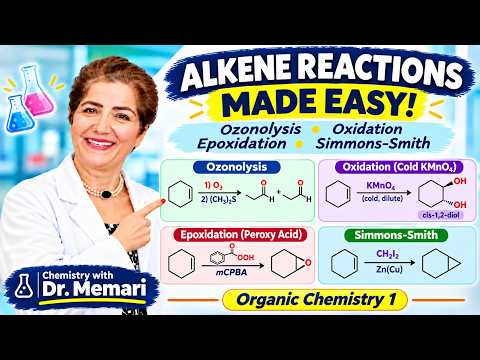
Alkene Reactions Made Easy! | Ozonolysis, Oxidation, Epoxidation & More
Overview
Alkene reactions are organized by what adds across or cleaves the C=C bond, the reaction conditions, and whether intermediates allow rearrangement. The lesson reviews hydration, halogenation, and radical addition, then covers catalytic hydrogenation, epoxidation, ozonolysis, potassium permanganate and osmium tetroxide dihydroxylation, and alkoxymercuration, emphasizing how reagent choice controls regiochemistry, stereochemistry, and whether cleavage products are aldehydes, ketones, or carboxylic acids.
Key takeaways
- Carbocation-forming hydration and HBr addition can rearrange, whereas bridged intermediates in oxymercuration and halogenation prevent rearrangement.
- Catalytic hydrogenation with H₂ and Pt, Pd, or Ni adds two hydrogens syn and reduces an alkene to an alkane.
- In ozonolysis with O₃ and dimethyl sulfide, alkene carbons bearing hydrogen become aldehydes, while alkene carbons bearing two carbon substituents become ketones.
- Ozonolysis workup determines aldehyde fate: dimethyl sulfide preserves aldehydes, while oxidative conditions can convert them to carboxylic acids.
- Hot KMnO₄ cleaves alkenes, but cold dilute KMnO₄ and OsO₄ add two OH groups to form vicinal diols; OsO₄ addition is syn.
- Alkoxymercuration-demercuration uses an alcohol and NaBH₄ to make a Markovnikov ether without rearrangement, with anti addition across the original alkene.
Chapters
- Direct acid-catalyzed hydration and HBr addition proceed through carbocations, give Markovnikov products, and can allow rearrangements.
- Oxymercuration-demercuration gives Markovnikov hydration without rearrangement and with anti addition; hydroboration-oxidation gives anti-Markovnikov hydration with syn addition.
- Br₂/CCl₄ forms vicinal dibromides by anti addition through a bridged bromonium ion, which prevents carbocation rearrangements.
- HBr with ROOR gives anti-Markovnikov addition through a radical chain; Br₂ and H₂O with excess water favor a bromohydrin over dibromide.
- H₂ with a Pt, Pd, or Ni catalyst converts a C=C bond into a C–C bond, adding one hydrogen to each alkene carbon.
- Hydrogen and the alkene adsorb on the metal surface, so hydrogenation adds both hydrogens syn.
- Hydrogenation has no Markovnikov orientation because the two added atoms are identical, and it does not form a carbocation that could rearrange.
- A peroxy acid such as mCPBA transfers an oxygen to an alkene, forming a three-membered epoxide ring; peroxybenzoic acid is another example.
- Epoxidation is not classified as Markovnikov or anti-Markovnikov addition because one oxygen bridges both alkene carbons; alkene stereochemistry is retained in the epoxide.
- Cl₂ adds across an alkene by the same bridged-halonium pathway as Br₂, producing a vicinal dichloride by anti addition.
- The reaction name epoxidation identifies the transformation from an alkene to an epoxide, also called an oxirane.
- O₃ performs oxidative cleavage by breaking the alkene double bond and converting each alkene carbon into a carbonyl carbon.
- With reductive workup such as dimethyl sulfide, a C=C carbon bearing two carbon substituents becomes a ketone, while one bearing a hydrogen becomes an aldehyde.
- A symmetrical alkene with two disubstituted alkene carbons can yield two ketones; alkene carbons each bearing a hydrogen can yield aldehydes.
- Dimethyl sulfide is oxidized to dimethyl sulfoxide as it consumes excess oxygen, helping preserve aldehyde products.
- Inspect the two alkene carbons separately: their substituents determine whether cleavage gives ketones, aldehydes, or a mixture.
- To design an alkene precursor for a target ketone, place the ketone's two carbon substituents on one alkene carbon before ozonolysis.
- Choosing matching substituents on both sides of an alkene can produce the same ketone from each side and simplify product separation.
- For example, an alkene arranged to give identical five-carbon ketones avoids a mixture that would require additional purification.
- O₃ followed by dimethyl sulfide gives aldehydes and ketones, because the sulfide consumes oxygen that could otherwise oxidize aldehydes further.
- Aqueous oxidative workup can convert aldehyde cleavage products into carboxylic acids, while ketones generally remain ketones under these conditions.
- Hot permanganate is a strong oxidant; its cleavage products include carboxylic acids where the corresponding alkene carbon bears a hydrogen.
- Ozone, hydrogen peroxide, permanganate, nitric acid, and chromic acid are identified as oxidizing agents; sodium borohydride is a reducing agent.
- Hot, concentrated KMnO₄ causes oxidative cleavage; aldehyde intermediates are further oxidized to carboxylic acids, while ketones generally stop at the ketone stage.
- Cold, dilute KMnO₄ is milder and adds two OH groups across the alkene without cleaving the C–C sigma bond.
- The cold, dilute reaction forms a vicinal diol, with one OH on each of the two formerly double-bonded carbons.
- Distinguish vicinal diols, whose OH groups occupy adjacent carbons, from geminal diols, whose two OH groups are on the same carbon.
- OsO₄ converts an alkene into a vicinal diol by adding two hydroxyl groups across the double bond.
- Both OH groups add from the same face, making osmium tetroxide dihydroxylation syn and stereospecific.
- The lesson compares OsO₄ with cold, dilute KMnO₄, which also gives diols without oxidative cleavage.
- Replace water in oxymercuration-demercuration with an alcohol such as methanol or ethanol to add an OR group instead of OH.
- Hg(OAc)₂ forms a bridged mercurinium intermediate; alcohol attacks the more substituted carbon from the opposite face, giving anti addition without rearrangement.
- NaBH₄ replaces the mercury substituent with hydrogen, yielding a Markovnikov ether: OR goes to the more substituted carbon and H to the less substituted carbon.
- The alcohol determines the ether group: methanol supplies OCH₃, while ethanol supplies OCH₂CH₃.
Transcript excerpt
0:05 I was hoping to have a bigger map here to to add all the reactions we are covering tonight in addition to what we covered last time, but it kind of got crowded, so I may have to make another map or extend this for the next one. Anyway, these are the reactions we covered last class. Summary of the reactions we covered last class was hydration, which is direct hydration. In direct hydration, your intermediate is The intermediate for the reaction is carbocation. Because carbocation forms, there is a chance for hydride shift. Of course, methyl shift also is understood, but this note that I'm adding, the side note I'm adding here, is just saying that there is chance for rearrangement or is there is no chance for rearrangement. So, there is chance for rearrangement because we get the carbocation formation of carbocation.
0:52 Addition of water is Markovnikov addition, and Mark is abbreviation for Markovnikov addition. Because the carbocation forms, then there is a sp2 hybridization, the syn or anti addition does not apply here. Syn or anti, it applies often when there is like a bridge from the same side attack, or you have a restricted carbocation, like a triangle forms, like in this case for oxymercuration-demercuration. So, I'm adding here that this is an anti anti addition. So, that's first reaction we covered last time. Oxymercuration-demercuration, again the summary, it's Markovnikov addition. Carbocation forms, but there is no chance for rearrangement because this restricted with that triangle that is forming with the mercury is attached to
1:38 the carbon, and there is no chance for rearrangement. The addition in this case is anti addition. The addition is also Markovnikov addition. So, Mark for Markovnikov, and this anti versus syn addition. Next reaction we covered last class was the hydroboration-oxidation,
This is the start of the transcript. Save this video free for the whole transcript, searchable and time-coded.
In this course
Related notes
Summary, takeaways, and chapters were generated by AI from the video's transcript and may contain errors. The video belongs to its creator, Chemistry with Dr. Memari.