Gravitation
Overview
The lesson develops circular satellite motion from orbital velocity and angular momentum to kinetic, gravitational potential, and total energy, emphasizing that circular-orbit energy is bound and negative. It then applies orbital relations to escape velocity, satellite comparisons, and equal-density planets, before explaining how polar satellites support Earth observation and how equatorial geostationary satellites enable communications.
Key takeaways
- For a satellite in a circular orbit, gravity supplies centripetal force, yielding v = √(GM/r), K = GMm/(2r), and total energy E = −GMm/(2r).
- The negative total energy of a circular orbit marks a bound state; energy must be added to raise the satellite to a higher orbit or bring its total energy to zero for escape.
- For fixed planet and satellite masses, increasing orbital radius lowers kinetic energy but raises total energy toward zero; potential energy remains negative and equals −2K.
- Escape speed is √2 times circular orbital speed at the same radius; the lesson gives approximately 11 km/s for Earth's surface and notes that ideal escape speed is independent of the object's mass and launch angle.
- Near a planet's surface, substituting M = ρ(4/3)πRₚ³ into the orbital-period equation shows that equal-density planets have the same near-surface satellite period.
- Polar satellites observe successive regions as Earth rotates beneath their paths, while geostationary satellites match Earth's roughly 24-hour rotation to appear stationary for communications.
Chapters
- The class opens with greetings and checks that students can hear the lesson clearly.
- Students are encouraged to practice with chapter worksheets and review recordings if they missed earlier classes.
- The next topics are identified as the remaining gravitation material, followed by motion in a straight line.
- The instructor recommends repeated revision and problem practice when physics concepts become mixed up.
- Students are balancing college, coaching, board preparation, aptitude work, mathematics, and chemistry.
- The course aims to cover the syllabus and build practice through MCQs and numerical problems.
- For a circular orbit of radius r around a planet of mass M, orbital speed is v = √(GM/r).
- The orbital period follows T² = 4π²r³/(GM), so the period depends on the cube of orbital radius.
- Orbital angular momentum is L = m√(GMr), where m is satellite mass.
- The angular-momentum formula identifies satellite mass m, planet mass M, and orbital radius r as its variable factors.
- For a fixed planet and satellite, L varies with √r, a relationship later used to solve a radius-change question.
- The orbital radius is measured from the planet's center, not from its surface.
- The center-to-satellite distance is written as r = Rₚ + h, where Rₚ is planet radius and h is altitude above the surface.
- A satellite remains within the planet's gravitational field because gravity acts throughout the surrounding region.
- The apparent floating of astronauts is not evidence that gravity has disappeared; the lesson schedules weightlessness for a later class.
- For a satellite in a circular orbit, gravitational force GMm/r² supplies the required centripetal force mv²/r.
- Equating these forces gives v² = GM/r and therefore v = √(GM/r).
- The near-Earth orbital speed is recalled as approximately 8 km/s.
- A moving satellite has kinetic energy K = ½mv².
- Substituting v² = GM/r gives K = GMm/(2r).
- For fixed planet and satellite masses, orbital kinetic energy varies inversely with orbital radius.
- For two attracting masses M and m separated by distance r, gravitational potential energy is U = −GMm/r.
- The negative sign represents an attractive, bound gravitational system under the usual zero-at-infinity convention.
- A satellite in a planet's gravitational field therefore has both kinetic energy and gravitational potential energy.
- Total orbital energy is the sum of kinetic and potential energy: E = K + U.
- Using K = GMm/(2r) and U = −GMm/r gives E = −GMm/(2r).
- The negative total energy indicates that the satellite is gravitationally bound to its orbit.
- The total-energy formula contains fixed G, M, and m for a given system, leaving orbital radius r as the changing factor.
- Moving a satellite from a lower orbit to a higher orbit makes its total energy less negative, such as changing from −100 to −50 energy units.
- Energy must be supplied to move a bound satellite to a higher orbit or release it from the system.
- Because E = −GMm/(2r), increasing r raises total energy toward zero even though its magnitude decreases.
- The numerical ordering of negative values matters: −10 is greater than −50, which is greater than −100.
- An energy input of 50 units can move the example satellite from an orbit with energy −100 to one with energy −50.
- In a circular orbit, total energy equals negative kinetic energy: E = −K.
- Potential energy is twice the magnitude of kinetic energy and remains negative: U = −2K.
- For K = 100 J, the corresponding values are U = −200 J and E = −100 J.
- A satellite with negative total energy is bound; raising its energy to zero removes it from the bound state.
- The example satellite at energy −100 requires an input of +100 energy units to reach zero energy and escape to infinity.
- Escape velocity is introduced as the launch speed that lets an object leave a planet's gravitational field.
- The escape speed is given as vₑ = √2 times the circular orbital speed at the same radius.
- The lesson describes Earth's surface escape speed as approximately 11 km/s, compared with a near-surface orbital speed of about 8 km/s.
- In the idealized formula, escape speed depends on the planet and launch radius, not on the escaping object's mass or launch angle.
- If orbital radius increases by a factor of 16, angular momentum increases by √16, or a factor of 4, when the masses and planet stay fixed.
- The ratio method is presented as L₂/L₁ = √(r₂/r₁) for comparing two circular orbits.
- An MCQ checks the result that escape speed is √2 times orbital speed.
- The lesson distinguishes kinetic energy, which comes from motion, from potential energy, which reflects gravitational interaction.
- The circular-orbit period formula is restated as T² = 4π²r³/(GM).
- The next problem compares orbital periods around planets with different radii but equal density.
- For a satellite close to a planet's surface, the orbital radius is approximately the planet radius because altitude h is near zero.
- Planet mass can be written as M = ρ(4/3)πRₚ³, connecting mass to density and planet radius.
- Substituting this mass into the period relation shows that near-surface T² varies inversely with density, so equal-density planets have the same near-surface period.
- The satellite kinetic-energy formula K = GMm/(2r) makes K inversely proportional to r for fixed masses.
- If orbital radius changes from R to 2R, kinetic energy falls from K₁ to K₁/2.
- The worked MCQ uses the proportionality directly rather than recalculating every constant.
- The class pauses after a lengthy comparison problem involving satellites at radii R and 3R.
- The instructor announces a short break and plans to restart the force calculation afterward.
- The recording resumes at 120:39 with the centripetal-force comparison and a correction to the earlier working.
- For circular satellite motion, centripetal force equals gravitational force, F = GMm/r².
- With equal satellite masses at radii R and 3R, the force ratio is Fₐ/Fᵦ = (3R)²/R² = 9.
- The instructor corrects an earlier simplification that had produced 3, confirming Fₐ = 9Fᵦ.
- Two satellites with equal masses orbit at radii r and 2r.
- Since K = GMm/(2r), the satellite at radius r has twice the kinetic energy of the satellite at radius 2r.
- The resulting ratio is K₁/K₂ = 2.
- Kinetic energy is directly proportional to satellite mass m and inversely proportional to orbital radius r.
- If satellite mass becomes four times larger while orbital radius becomes half as large, kinetic energy scales by 4 × 2.
- The combined change is an eightfold increase in kinetic energy.
- Earth-observation satellites can carry cameras to collect images and data for surveying and prediction.
- A satellite can receive uploaded signals or data and send information back for downloading.
- High-resolution imaging is described through the analogy of using binoculars to see small details from far away.
- Visible image colors can help distinguish land-cover types, with green associated with vegetation, brown with desert terrain, and blue with water.
- Repeated imagery lets analysts survey regions and compare environmental features across areas.
- The lesson presents satellite imaging as a way to gather information about places that are difficult to inspect directly.
- The lesson describes sending electromagnetic waves toward Earth's surface and analyzing the signal reflected back to a satellite.
- Different materials, including silver, gold, and iron, are described as producing distinct signal responses in laboratory comparisons.
- Comparing measured satellite returns with known material responses can support estimates of surface composition and mineral presence.
- Polar satellites are described as low-altitude spacecraft carrying powerful imaging equipment.
- Their near-polar paths let them pass over successive regions while Earth rotates beneath them, building broad geographic coverage.
- The lesson connects polar satellite imagery to surveillance, mapping, and observation of land and borders.
- Cloud images can support forecasts by revealing cloud concentration, movement direction, and likely rain.
- Satellite observations of ocean conditions can help identify developing storms and high waves.
- The lesson also cites forestry surveys and mineral mapping as uses of remote-sensing data.
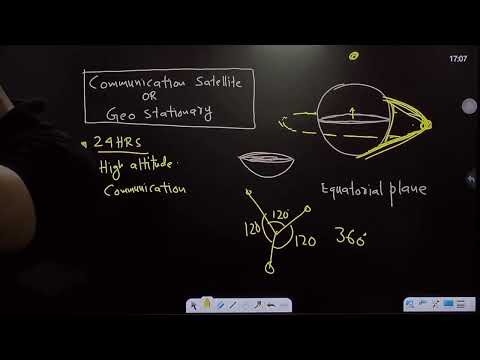
- Communication satellites are also called geostationary satellites in the lesson.
- Their orbits lie in Earth's equatorial plane, the plane through the planet's equator.
- Unlike the lower-altitude polar satellites discussed earlier, communication satellites are described as operating at high altitude.
- A geostationary satellite has an orbital period of approximately 24 hours, matching Earth's rotation period in the lesson's model.
- When the satellite moves in step with Earth's rotation, it appears fixed above the same equatorial location to an observer on Earth.
- This apparent stationary position makes it useful for maintaining a communications link with a ground location.
- The lesson uses three geostationary satellites spaced about 120° apart as a simplified way to illustrate broad global communications coverage.
- Communication satellites support signal transmission, including the upload and download of online content.
- The next class is scheduled to cover weightlessness in satellites, artificial gravity, and additional gravitation numericals.
- Students are advised to use recorded lectures for detailed explanations and solve chapter-specific practice sheets.
- The instructor says the course will continue with gravitation review before moving to kinematics and motion in one dimension.
- Students who have not studied displacement vectors are advised to review vector basics before the next chapter.
- The closing discussion reiterates that satellite kinetic energy varies inversely with orbital radius.
- Students are told that constants such as the factor 2 do not affect the proportionality between kinetic energy and radius.
- The class ends with a plan to revisit the density-based period problem and continue remaining gravitation material.
Transcript excerpt
0:36 जी बच्चों अस्सलाम वालेकुम कैसे हैं आप लोग? खैरियत से हैं? आवाज सही आ रही होगी आपको? ठीक-ठाक हैं। जेफरा बेटा वालेकुम सलाम अरीज वालेकुम सलाम अब्दुल रहमान उस्मान वालेकुम सलाम मोहम्मद शाफ मुबशिर आफियत जमीन बेटा मैं ठीक-ठाक हूं। ईमान उस्मान रोटेशनल मोशन बेटा अपकमिंग ट्यूसडे को फिर उसकी एक एक्स्ट्रा क्लास होगी। मुबशिर अहमद अंसारी वालेकुम सलाम जुनेद अहमद वालेकुम सलाम। क्लास में बस स्टार्ट कर दी है। अब्दुल रहमान उस्मान सैयद आपका बहुत-बहुत
1:32 शुक्रिया चाय पिलवाने के लिए। बताता हूं बेटा आपको सेट के पेपर का। दिशा कुमारी बेटा वालेकुम अस्सलाम। दिशा सब समझ आ रहा है आपको? ऐसा लग रहा है आजकल कम कम रिप्लाई करती हैं। सर्कुलर मोशन खत्म नहीं हो गया बेटा। सर्कुलर मोशन में भी पढ़ाएंगे। हां, तकरीबन आज लास्ट क्लास करेंगे ग्रेविटेशन की। कुछ रह गया तो कल और देखेंगे। जैनुल आबदीन वालेकुम अस्सलाम
2:27 ठीक है दिशा हां मेरे बच्चे करें प्रैक्टिस शीट स्टार्ट करें अगर आप प्रैक्टिस शीट ले रहे हैं तो प्रैक्टिस शीट को सॉल्व करें अच्छा आपकी प्रैक्टिस होगी हां यार इस वक्त इस वक्त स्कूल की छुट्टी होती है। ट्रैफिक बहुत होता है रोड पर जो रोड्स हैं वहां पे एक नियर बाय स्कूल बहुत हैं। ट्रैफिक बहुत जैम हो जाता है। इरशा गुड आफ्टरनून। कल जो चैप्टर स्टार्ट करेंगे बेटा कल या परसों जो नया चैप्टर स्टार्ट होगा वह होगा मोशन इन अ स्ट्रेट लाइन। शौकत मैं ठीक-ठाक हूं बेटा सेट का बताता हूं मेरे बच्चे मैं आपको
3:19 जी मुबशरा करें सवाल अच्छा कल की क्लास अगर नहीं ली तो आप ले आज की क्लास देखिएगा आपको कितना समझ में आता है कितना नहीं आता प्रैक्टिस करिएगा बेटा मोहम्मद हुसनैन जमान बेटा बस दुआ करें कि आपके पूरे नंबर आ जाए मेहनत से और पढ़ें मैं भी मेहनत से पढ़ाऊं तो खुदा ने चाचा अच्छा पेपर हो जाएगा आपका नायब वालेकुम
This is the start of the transcript. Save this video free for the whole transcript, searchable and time-coded.
Related notes
Summary, takeaways, and chapters were generated by AI from the video's transcript and may contain errors. The video belongs to its creator, Batch Operator PKM.