Gravitation
Overview
The lesson develops gravitation through measurable weight, showing that a scale reads the support reaction rather than an object's fixed gravitational force. It derives elevator apparent-weight cases, explains weightlessness in free fall and orbit, and connects Newton's cannon thought experiment to satellite motion, artificial gravity, geostationary and polar satellites, and numerical methods for surface gravity and gravitational potential energy.
Key takeaways
- A scale measures the normal reaction, not gravitational force directly: a person of mass m in an elevator accelerating upward at a has apparent weight m(g + a).
- In a downward-accelerating elevator, apparent weight is m(g − a); when the elevator is in free fall with a = g, the reaction and scale reading are zero.
- Astronauts in orbit remain under Earth's gravitational force; they feel weightless because the satellite and its contents are continuously falling together without a supporting floor reaction.
- Gravity provides the centripetal force for a satellite orbit, with orbital velocity tangent to the path and gravitational force directed toward Earth's center.
- A rotating habitat can simulate Earth's gravity when its spin creates centripetal acceleration g; its required frequency is f = (1/2π)√(g/r).
- For a spherical planet, surface gravity can be expressed as g = (4π/3)GρR, making it directly proportional to both average density and radius.
Chapters
- The class finishes the remaining gravitation material before moving on to kinematics.
- Students joining late are directed to recorded gravitation and vectors lessons to fill gaps.
- The instructor recommends following one teacher consistently for exam preparation and reviewing formulas repeatedly.
- Earth's mass is recalled as approximately 6 × 10^24 kg and its radius as about 6,400 km.
- Earth's average density is given as approximately 5.5 × 10^3 kg/m³.
- Surface gravitational acceleration follows g = GM/R², and g changes with altitude and depth.
- A person standing on a floor pushes downward on it, and the floor exerts an upward normal reaction.
- The person's gravitational force points toward Earth's center, while the floor's reaction acts on the person.
- Action and reaction forces act on different bodies, so they do not cancel on a single-body force diagram.
- A block resting on a platform pushes on it because Earth attracts the block downward.
- For an object at rest on a horizontal surface, the support reaction equals its weight: R = W = mg.
- The lesson calls this reading the true or real weight when the measuring frame is at rest or moves uniformly.
- Weight is described as the force sensation associated with being pressed by a floor, chair, or bed.
- A person standing barefoot feels the floor's reaction through the soles of the feet.
- A scale measures weight indirectly through its reaction force, rather than measuring Earth's attraction directly.
- A frame of reference is presented as a place with coordinate axes from which an observer makes measurements.
- Examples include a room, a taxi, a rickshaw, or a satellite, each with an observer making observations.
- The observer needs measurement instruments such as a clock, metre rule, and balance to measure time, length, and mass.
- Newton's second law is used as F_net = ma: an unbalanced force produces acceleration in its direction.
- In the example, opposing forces of 100 N and 50 N leave a net force of 50 N.
- The elevator analysis applies this law to the person, distinguishing the person's weight from the floor's reaction.
- An elevator is useful because it can accelerate upward or downward, unlike a stationary measuring frame.
- A person standing on a weighing machine compresses its spring, producing a reaction that the pointer records.
- When the elevator is at rest or moves at uniform velocity, the scale reading is R = mg.
- For upward elevator acceleration a, the upward reaction R exceeds the downward gravitational force mg.
- Applying Newton's second law gives R − mg = ma, so the scale reads R = m(g + a).
- The increased reading is apparent weight, not an increase in the person's mass or gravitational force.
- The apparent-weight equation can be written R = m(g + a), showing that a larger upward acceleration raises the reading.
- If a = g, the reaction becomes 2mg, so a 1,000 N true weight would produce a 2,000 N scale reading.
- The lesson emphasizes that mass stays constant while the measured support reaction changes.
- Rocket launch acceleration increases astronauts' apparent weight, which is why launch crews train to tolerate high-g forces.
- Rapid upward manoeuvres in fighter aircraft can make a pilot's arms and body feel heavier.
- The lesson links these effects to the upward-acceleration relation R = m(g + a), not to a change in mass.
- A rotating amusement ride can create changing support forces as riders move through upward and downward parts of the ride.
- The seat's changing pressure produces sensations such as heaviness, stomach flutter, dizziness, or excitement.
- The example connects everyday ride sensations to changes in apparent weight.
- The law of inertia says an object at rest tends to remain at rest unless a net force changes its motion.
- A book can briefly remain nearly in place when a support is pulled away quickly, before falling under gravity.
- When an elevator floor accelerates upward, it must push harder on a person whose inertia resists the change in motion.
- A mass hanging from a spring stretches it until the spring tension balances the mass's weight.
- At rest, the balance reads T = mg; the spring tension is the measured support force.
- If the elevator ceiling accelerates upward, the mass's inertia increases the spring stretch and T becomes m(g + a).
- A frame at rest or moving with uniform velocity measures true weight through floor reaction or spring tension.
- In an upward-accelerating frame, the effective measured acceleration is g + a and apparent weight increases.
- The lesson summarizes the core distinction: weight readings depend on the frame's acceleration.
- For a frame accelerating downward with magnitude a, the floor's reaction is R = m(g − a).
- The apparent weight is therefore lower than mg, because the floor presses less strongly on the person.
- As the downward acceleration reaches g, the reaction becomes zero, introducing the free-fall condition for weightlessness.
- For a freely falling elevator, a = g downward, so R = m(g − g) = 0.
- With no support reaction, the occupant feels weightless even though gravity still acts.
- The same principle applies to an object falling without a supporting surface.
- The person and elevator floor both accelerate downward at g, so their separation stays unchanged during free fall.
- From inside the enclosed elevator, the occupant can appear to float at rest relative to the floor.
- The observed weightlessness comes from the absence of contact reaction, not from gravity disappearing.
- The lesson recaps the three elevator cases: rest gives mg, upward acceleration increases apparent weight, and downward acceleration decreases it.
- Students are reminded that jumping from a building is not a safe way to experience weightlessness.
- The discussion shifts from elevator free fall to Newton's explanation of how satellites can orbit Earth.
- Newton's cannon thought experiment places a cannon on a high mountain and fires projectiles horizontally at increasing speeds.
- At ordinary speeds, gravity curves the projectile's path until it strikes Earth.
- At a sufficiently high horizontal speed, the projectile can keep falling around Earth instead of reaching the ground.
- A satellite's velocity is tangent to its orbit while Earth's gravitational force points toward Earth's center.
- Gravity supplies the centripetal force that continually bends the satellite's path into an orbit.
- The orbital radius is measured from Earth's center and equals Earth's radius plus the satellite's altitude.
- A multistage rocket first carries a satellite upward, building speed and altitude.
- Near the target orbit, the satellite is given horizontal orbital velocity so gravity bends its path around Earth.
- Astronauts may experience increased apparent weight during launch acceleration, before the satellite reaches free-fall orbit.
- In an inertial description, Earth's gravity supplies the centripetal force that keeps an orbiting satellite moving around Earth.
- A rotating observer may describe an outward centrifugal force; the lesson identifies it as a fictitious or pseudo force in that frame.
- A rotating platform example shows how a rider presses against a seat while turning.
- An orbiting satellite and its contents are in continuous free fall under Earth's gravity, producing apparent weightlessness.
- Astronauts float because there is no steady floor reaction holding them down, not because gravity is absent.
- Walls can still exert reactions when astronauts push against them, while food and water also float unless constrained.
- Long periods of weightlessness make sleeping, eating, and moving difficult for astronauts.
- Artificial gravity can be produced by spinning a satellite about its own axis so occupants are pressed toward an outer surface.
- The desired spin rate is chosen to create a centripetal acceleration comparable to Earth's g.
- The proposed rotating habitat has a dumbbell shape, with two compartments connected by a central tunnel.
- As it spins, the tunnel length acts as the diameter of the circular path traced by the compartments.
- The rotation radius is half the tunnel length, r = L/2.
- Centripetal acceleration is written as a_c = rω², with angular speed ω = 2πf.
- Setting a_c equal to g gives f = (1/2π)√(g/r) for the required rotation frequency.
- For a tunnel 20 m long, the orbital radius is 10 m, which can be substituted into the frequency formula.
- A geostationary satellite orbits west to east above Earth's equatorial plane with a 24-hour period, appearing fixed relative to the ground.
- Its altitude is described as about 36,000 km, and its fixed apparent position makes it useful for communications and television signals.
- Polar satellites pass over Earth's poles and collect successive strips of imagery for mapping, observation, and military uses.
- Students are advised to keep a separate notebook for worked numerical problems and leave 8 to 10 pages after each chapter for later examples.
- Vectors are recommended as a prerequisite because they recur in kinematics, dynamics, work, power, energy, and waves.
- The instructor encourages consistent preparation rather than rushing through the syllabus or relying on memorized formulas alone.
- The class pauses after announcing a 10-minute break, later extended to 15 minutes.
- The lesson resumes at approximately 151:12 with gravitation questions and numerical practice.
- This interval contains no substantive new physics explanation.
- Starting from g = GM/R², the planet's mass is replaced by density times spherical volume.
- Using M = ρ(4πR³/3) gives g = (4π/3)GρR at a planet's surface.
- For two planets, the gravity ratio is g₁/g₂ = (ρ₁R₁)/(ρ₂R₂).
- A comparison problem uses g proportional to GρR to relate surface gravity when density and the universal gravitational constant differ.
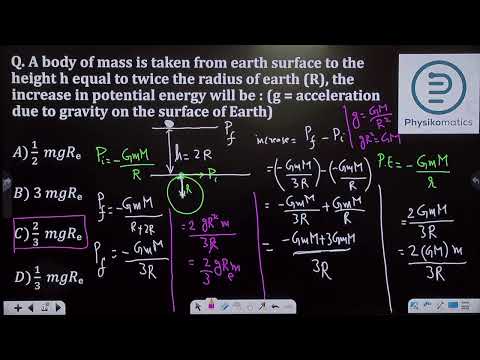
- For a mass moved from Earth's surface to altitude 2R, its distance from Earth's center changes from R to 3R.
- Using U = −GMm/r, the potential-energy increase is ΔU = 2GMm/(3R) = (2/3)mgR.
- The gravitation chapter is treated as complete, with additional numerical practice planned alongside vectors and projectile motion.
- Kinematics is announced as the next topic, followed later by dynamics.
- The next class is scheduled for 2:00 to 4:00.
Transcript excerpt
0:19 जी बच्चों अस्सलाम वालेकुम कैसे हैं आप लोग? खैरियत से हैं बेटा? भर सिंह यह सवाल तो आपको नहीं करने चाहिए बेटा कि क्लास स्टार्ट होने में देर क्यों होती है? देर सवेेर हो जाती है। ठीक है? ऐसे बेकार सवालात नहीं किया करें। जी कृपा रानी बेटा वालेकुम अस्सलाम अहमद वालेकुम अस्सलाम मोहम्मद शाफ बिन सोहेल वालेकुम अस्सलाम
1:08 गुलाम नबी बेटा मैं ठीक-ठाक हूं। वहां बताएं सब बच्चों की पढ़ाई वगैरह सही हो रही है और भरत सिंह बेटा यह बताओ फिर तुम वही सवाल कर रहे हो कि आज फिर से ग्रेविटेशन क्या करें छुड़वा दें? हैं भरत सिंह। क्या हो गया तुम्हारे को? भाई पढ़ने के लिए आए ना तो पढ़ाई करेंगे। जाहिर है जो जो चीजें रहती हैं वह तरीके से पढ़ेंगे। तुलसी बेटा नमस्ते। मोहम्मद नुमान मैं ठीक-ठाक हूं। इमान अकबर
1:57 मैं भी ठीक-ठाक हूं। डायनामेटिक्स एक घंटे बाद स्टार्ट करेंगे। पहले हम पढ़ेंगे ग्रेविटेशन का रिमेनिंग काम। फिर उसके बाद हम कयनामेटिक्स स्टार्ट करेंगे। मोहम्मद फैजान मेरे बच्चे कैसे हैं आप? आपकी पढ़ाई कैसी हो रही है? सब ठीक-ठाक है। [गला साफ़ करने की आवाज़] जी अहमदन जारा वेरी नाइस। बहुत अच्छी बात आपको समझ में आ रही है। आलमजेब शुक्रिया मेरे बच्चे। देखिए सामिया अगर आपकी तैयारी अच्छी है तो आप नेट वन भी देना बेटा दोहा खान वालेकुम अस्सलाम सैयदा रिदा वालेकुम सलाम हाजरा
2:47 दोहा मैं ठीक-ठाक हूं आलमजेब थैंक यू बेटा मोहम्मद नोमान बहुत-बहुत शुक्रिया आपका अच्छे वर्ड्स के लिए आप अच्छा पढ़ते हैं। वालेकुम अस्सलाम अब्दुल रहमान उस्मानी आज का टॉपिक्स कनामेटिक स्टार्ट करेंगे। पहले ग्रेविटेशन का काम कंप्लीट कर लें। फिर करते हैं कयनामेटिक्स भी स्टार्ट। ग्रेविटेशन भी हमारे लिए कुछ काम बाकी है। गुड हो गया। सब समझ में आ रहा है। इमान अकबर बेटा साथ-साथ प्रिपरेशन करनी पड़ेगी सेट की भी आपको। प्रतिज्ञा कुमारी वालेकुम अस्सलाम। हेलो मेरा बच्चा मैं
This is the start of the transcript. Save this video free for the whole transcript, searchable and time-coded.
Related notes
Summary, takeaways, and chapters were generated by AI from the video's transcript and may contain errors. The video belongs to its creator, Batch Operator PKM.