General Chemistry I : Gravimetric Analysis and Combustion Analysis
Overview
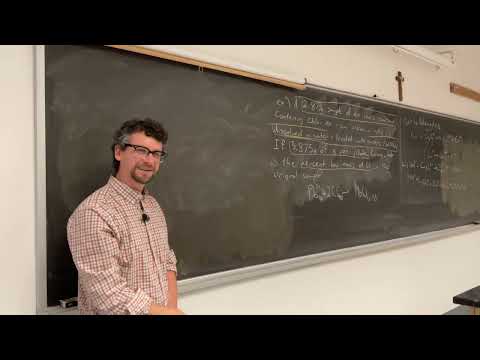
Scott Simpson explains gravimetric and combustion analysis as applications of stoichiometry, using precipitate mass or combustion-product masses to determine an unknown composition. He works through chloride analysis with lead(II) nitrate, then derives the empirical formula C5H8 and molecular formula C15H24 from measured water and carbon dioxide.
Key takeaways
- In gravimetric chloride analysis, precipitating chloride as PbCl2 makes its amount measurable: each mole of PbCl2 represents two moles of chloride.
- For the 2.873 g sample and 3.875 g PbCl2 precipitate, the calculation gives approximately 34.4% chlorine by mass.
- Complete hydrocarbon combustion converts carbon and hydrogen into CO2 and H2O, so product amounts reveal the original sample's carbon-to-hydrogen ratio.
- The example's 1.410 g H2O and 4.305 g CO2 correspond to an empirical formula of C5H8.
- Combining an empirical formula with an independently measured molar mass identifies the molecular formula: 204.35 g/mol is three times the C5H8 empirical formula mass, yielding C15H24.
Chapters
- Gravimetric analysis uses measured mass to determine an analyte's quantity, with mass being more precise than weight because weight depends on gravity.
- The method requires an analyte that can be precipitated, collected, and weighed.
- Precipitation rules help select a reagent that forms an insoluble compound containing the analyte.
- A 2.873 g ionic sample containing chloride and an unknown metal is dissolved and treated with excess lead(II) nitrate.
- Nitrate remains soluble, while Pb2+ reacts with chloride to form solid PbCl2; the net ionic equation is Pb2+ + 2Cl− → PbCl2(s).
- The reaction produces 3.875 g of lead(II) chloride, which provides a measurable link to the original sample's chloride content.
- Convert the 3.875 g PbCl2 precipitate to moles using its molar mass, approximately 278.1 g/mol.
- Use the 2:1 chloride-to-lead(II) chloride mole ratio, then convert moles of chlorine to grams using 35.45 g/mol.
- Divide the chlorine mass by the original 2.873 g sample mass and multiply by 100 to obtain about 34.4% chlorine by mass.
- The worked example emphasizes choosing a useful known quantity and following the stoichiometric path rather than memorizing a fixed procedure.
- Combustion analysis burns a combustible sample, usually a hydrocarbon made of carbon and hydrogen, in oxygen.
- Complete combustion converts carbon to CO2 and hydrogen to H2O; an open flame would disperse these products instead of collecting them.
- A high-temperature furnace and oxygen stream promote combustion, while traps capture and measure the produced water and carbon dioxide.
- Anhydrous salts can absorb water to form hydrates, and carbon dioxide traps collect CO2 for mass measurement.
- For a generic hydrocarbon C_aH_b, complete combustion produces a CO2 molecules and b/2 H2O molecules per formula unit.
- The example burns 1.333 g of an unknown hydrocarbon and measures 1.410 g H2O and 4.305 g CO2.
- A separate mass spectrometry measurement gives the hydrocarbon's molecular mass as 204.35 g/mol.
- Convert 1.410 g H2O to moles, then use two hydrogen atoms per water molecule to obtain about 0.1565 mol H.
- Convert 4.305 g CO2 to about 0.09782 mol C, using one carbon atom per CO2 molecule.
- Divide by the carbon amount to get an H:C ratio of approximately 1.6:1, then multiply by five to obtain empirical formula C5H8.
- The empirical formula mass is about 68.113 g/mol; 204.35 divided by 68.113 is 3, giving molecular formula C15H24.
Transcript excerpt
0:00 So today we're going to talk more about some other types of analyses you can do with uh titrations, um or other methodologies that involve stoichiometry. pretty basic ones. Uh they're still utilized in many labs across the country. Uh a lot of a lot of the stuff you can do better with high-end instrumentation, but a lot of those instruments cost, you know, like half a million dollars or so. In some places you might be at might not have the the ability to actually purchase something that expensive, but you still have to do that analysis. Um let's talk about gravimetric analysis, which I know everybody has done in lab.
0:55 That word gravimetric, what's that telling you? Yeah, go for it. >> Letting gravity do the work. >> Yeah, letting the gravity do the work. Gravity measurement, we're basically measuring a weight, but we equate that weight to a mass, right? We know weight changes depending on the planets, so to be a little more planet planets pull, so to be a little more thorough, we would say mass. So we're utilizing masses to determine an analyte. And what do we know about that analyte? So when you guys did gravimetric
1:43 analysis where you made that pretty cobalt solution, what did you do? So experimentally, what did you do? Go for it. >> You know put the state and put it in the public area like that. >> Yeah. You crashed something out of solution, you collected it, then you weighed it, right? You use some stoichiometry to figure stuff out. That's what we're going to do. So what do we know our analyte has to be if we wanted to utilize gravimetric analysis? Yeah. Precipitate. That way if you have an analyte that you
2:30 want to know,
This is the start of the transcript. Save this video free for the whole transcript, searchable and time-coded.
Related notes
Summary, takeaways, and chapters were generated by AI from the video's transcript and may contain errors. The video belongs to its creator, Scott Simpson.