Alcohols Made Easy! 🧪 | Naming, Properties & Acidity | Organic Chemistry 1
Overview
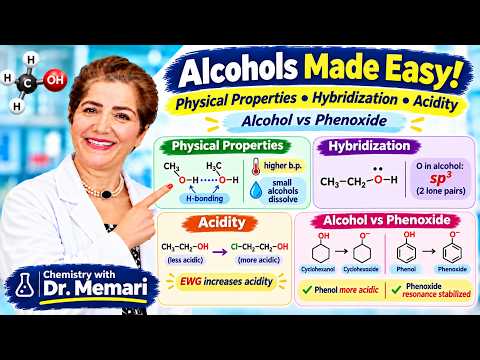
The lesson builds a practical framework for identifying and naming alcohols, including primary, secondary, and tertiary alcohols, IUPAC numbering and suffix rules, and cases where carboxylic acids or phenols affect naming priority. It then connects alcohol structure to boiling point, water solubility, and acidity, emphasizing hydrogen bonding, the effect of carbon-chain length, resonance stabilization of phenoxide, and the relationship between pKa and acid strength.
Key takeaways
- Classify an alcohol by counting carbon neighbors on the carbon bonded to OH: one neighbor is primary, two is secondary, and three is tertiary.
- For alcohol nomenclature, number the parent chain to give OH the lowest locant and use the -ol suffix; when a carboxylic acid is present, it takes priority and OH becomes a hydroxy- substituent.
- Alcohol hydrogen bonding is stronger than the dipole-dipole forces associated with ethers and the dispersion forces of alkanes, helping explain alcohols’ comparatively high boiling points.
- Water solubility reflects the balance between the polar OH group and the nonpolar carbon chain: methanol and ethanol dissolve readily, while longer chains reduce solubility.
- Phenol is more acidic than a typical alcohol because its conjugate base, phenoxide, is resonance-stabilized, whereas an alkoxide lacks comparable resonance stabilization.
- The pKa scale is logarithmic: a difference of eight units, such as the lesson’s approximate comparison of phenol at 10 and cyclohexanol at 18, represents about a 100-million-fold acidity difference.
Chapters
- An alcohol has an O–H group attached to carbon; its oxygen is described as sp3-hybridized.
- The lesson compares the approximately 108° C–O–H angle in an alcohol with water’s approximately 105° angle, attributing the difference partly to the bulk of the carbon group.
- Classification depends on the carbon bearing the hydroxyl group: attachment to one, two, or three other carbons makes the alcohol primary, secondary, or tertiary.
- Choose and number the parent chain so the hydroxyl group receives the lowest possible locant, then replace the alkane ending -e with -ol.
- Specify the hydroxyl position when needed, as in butan-1-ol versus butan-2-ol; list substituents such as methyl before the parent name.
- When an alkene and alcohol occur together, the lesson gives the alcohol priority for numbering and uses both the alkene and alcohol suffixes.
- A carboxylic acid outranks an alcohol, so the acid takes the principal suffix and the alcohol is named with the hydroxy- prefix.
- Two hydroxyl groups are named with the suffix -diol and locants; the lesson distinguishes geminal diols on one carbon from vicinal diols on adjacent carbons.
- A hydroxyl group directly attached to a benzene ring gives a phenol parent; substituents are numbered from the carbon bearing OH, as in 3-methylphenol and 2-chlorophenol.
- For a benzene ring with a carboxylic acid, benzoic acid is the parent and an additional ring hydroxyl group is named hydroxy, as in 4-hydroxybenzoic acid.
- To draw a name such as 2-methyl-3-ethylhexan-1-ol, first draw and number the six-carbon parent chain, then place OH and substituents at their stated positions.
- The boiling-point comparison identifies London dispersion forces in an alkane, dipole-dipole forces in an ether, and hydrogen bonding in an alcohol.
- The lesson ranks hydrogen bonding above dipole-dipole and London dispersion forces, predicting the alcohol has the highest boiling point among the compared compounds.
- The comparison focuses on intermolecular attractions as the cause of the boiling-point trend.
- An alcohol’s OH group is its polar, water-interacting region, while its carbon chain contributes a nonpolar region.
- Methanol and ethanol are described as highly water-soluble; solubility declines as the carbon chain grows.
- The lesson gives a rough four-carbon rule of thumb and says a five-carbon alcohol has very low solubility, while additional oxygen-containing groups can improve solubility.
- Ordinary alcohols are weak acids because losing H+ forms an alkoxide ion without resonance stabilization.
- When phenol loses H+, its phenoxide conjugate base can delocalize negative charge through the aromatic ring, stabilizing the product and making deprotonation more favorable.
- Electron-withdrawing groups increase acidity by drawing electron density away from the O–H system and making proton loss easier.
- The lesson contrasts sodium metal, which can deprotonate a weak alcohol, with sodium hydroxide, which is sufficient for the more acidic phenol but not cyclohexanol.
- It favors sodium hydroxide over sodium metal for phenol when either works, noting that sodium metal is hazardous and highly reactive.
- Lower pKa means stronger acidity; the lesson compares phenol at about pKa 10 with cyclohexanol at about pKa 18, an eight-unit difference corresponding to roughly 100 million-fold in acidity.
Transcript excerpt
0:00 bone group for alcohol is O group attached to carbon. It's kind of similar to what we had for water. We have hydrogen's attached to the oxygen. We have O the bond angle. Do you remember the bond angle and hybridization for the oxygen for in water molecule? What's the hybridization for water molecule is sp3, right? Sp3. What should be the bond angle? expected bond angle is >> 109.5 is the expected one, right? The actual bond angle for this one is 105 because the pair of electron repel each other and push the sigma bonds to the hydrogen down and it closes the angle but still is reasonable and it kind of
0:51 follows the hybridization. to 105. This one is closer to to 109. So it's about 108 something. Okay. How can you justify this one? 108 versus 105 for water. What makes this bond angle to the larger bangles? >> Because of the steric interest of the carbon, it's a bulkier group compared to hydrogen. Even though you have pair of unshared electron that is pushing down, but the metal group doesn't want to get too close. It's heavier and it's going to push back. Okay. And hybridization is sp3. The bond the functional group is the O attached to carbon. Now if the O
1:42 is attached to a primary carbon, can someone tell me what's the primary carbon one more time? >> Attached to one other carbon only. >> If the O is attached to primary carbon, the alcohol is classified as primary alcohol. Secondary alcohol would be what? >> If the O is attached to secondary carbon. So this is going to be secondary alcohol. And a tertiary alcohol is if O is attached to tertiary alcohol. We also have aromatic alcohol which they have their own name as phenol.
This is the start of the transcript. Save this video free for the whole transcript, searchable and time-coded.
In this course
Related notes
Summary, takeaways, and chapters were generated by AI from the video's transcript and may contain errors. The video belongs to its creator, Chemistry with Dr. Memari.