fnb100f261027
 Watch on YouTube →
Overview
Jeff Hunk introduces multiple cash flow analysis through annuities, distinguishing ordinary annuities with end-of-period deposits from annuities due with beginning-of-period deposits. Using a $60,000 graduate-school savings goal, he derives the future value of an ordinary annuity, applies it in Excel to compare monthly deposits, interest rates, and timelines, then rearranges the formula to solve for the exact payment.
Key takeaways
- A regular series of equal deposits is an annuity; for a $60,000 goal, the example models 60 monthly deposits over five years.
- For an ordinary annuity, the first deposit earns one fewer interest period than the total number of deposits, while the last deposit earns none before maturity.
- The future value of an ordinary annuity is payment multiplied by ((1 + r) raised to n minus 1) divided by r, with r expressed as the rate per payment period.
- An annuity due starts one period earlier than an ordinary annuity, so its future value equals the ordinary-annuity value multiplied by (1 + r).
- In the savings example, $800 per month at 6% APR for five years misses the $60,000 target; raising the deposit to about $860 or extending the timeline changes the outcome.
- Solving the annuity formula directly for payment gives the exact required deposit and avoids relying on repeated trial-and-error scenarios in Excel.
Chapters
- Jeff Hunk welcomes students and responds to Valeria, who explains that military-base Wi-Fi disruptions and caring for a baby caused her to miss two classes.
- The class begins with reminders that building work may interrupt the session.
- A $10,000 deposit today that produces one future payment is a single cash flow model.
- Multiple cash flow models involve several payments or deposits over time, rather than one inflow and one outflow.
- Jeff Hunk estimates a two-year graduate program could cost about $60,000, using an example of $30,000 per year.
- The planning scenario gives a student five years to save before graduate school and compares a $40,000 lump-sum investment with regular monthly savings.
- A $40,000 lump sum would need to grow at roughly 8.44% annually to reach $60,000 in five years.
- An annuity is a constant payment or deposit made at regular intervals; the intervals can be monthly, weekly, quarterly, or annual.
- The practical savings example uses $800 deposited at the end of each month for 60 months.
- Regular, predictable deposits distinguish the annuity model from irregular deposits of varying amounts.
- An ordinary annuity places each deposit at the end of a period, matching the example of saving money from monthly paychecks.
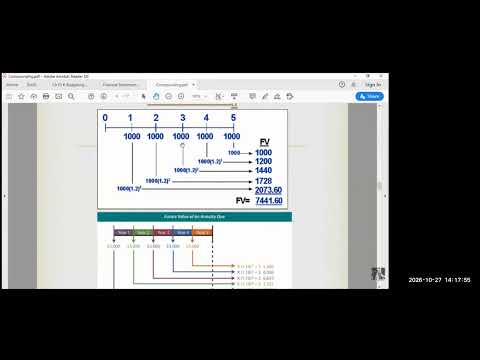
- For 60 end-of-month deposits, the first $800 deposit earns 59 monthly periods of interest before the end of month 60.
- The final deposit earns no interest before the account reaches its maturity value.
- A five-payment example at 20% shows that an ordinary annuity's first $1,000 deposit compounds four times, while its final deposit earns no interest.
- An annuity due begins at time zero, so each payment receives one additional compounding period compared with an ordinary annuity.
- Jeff Hunk recommends calculating an annuity due by multiplying the ordinary-annuity future value by one plus the periodic rate.
- Each payment grows for a different number of periods, from the first payment's t minus one periods to the last payment's zero periods.
- Summation notation compresses the repeated payment-and-growth terms into a compact expression.
- The closed-form formula is payment multiplied by ((1 + r) raised to n minus 1) divided by r, where r is the periodic rate and n is the number of payments.
- The spreadsheet scenario uses an $800 monthly deposit, a 6% APR, a five-year timeline, and 12 periods per year.
- The monthly periodic rate is 6% divided by 12, or 0.5%, and the total number of deposits is five times 12, or 60.
- Jeff Hunk enters the future-value-of-an-annuity formula in the class workbook's multiple cash flow tab.
- The $800 monthly deposit at 6% APR for five years falls short of the $60,000 goal.
- The class compares three alternatives: increasing deposits to $860 per month, assuming an 8% APR, or extending the savings period to six years.
- The $860 scenario slightly exceeds the target, while 8% APR still falls short; the six-year scenario exceeds the goal but delays graduate school by a year.
- Jeff Hunk notes that a one-year delay should be weighed against the potential salary from starting work sooner, using a $130,000 finance-industry salary as an example.
- The spreadsheet calculates annuity-due values by multiplying each ordinary-annuity future value by one plus the periodic rate.
- The annuity-due comparison reduces the shortfall in some scenarios but does not make every five-year option reach $60,000.
- The six-year option still involves a timing tradeoff, even when it builds savings beyond the target.
- Instead of testing nearby monthly deposits, the class rearranges the future-value formula to solve directly for the payment.
- The payment equals the target future value multiplied by the periodic rate, divided by ((1 + r) raised to n minus 1).
- The algebra relies on identifying the equation's multiplication structure and isolating payment by dividing by the annuity growth factor.
- Jeff Hunk enters the rearranged formula in Excel to find the monthly deposit needed to reach exactly $60,000 over 60 months at 6% APR.
- The result is close to $860 per month; using a rounded payment can create a noticeable difference in the final balance.
- Jeff Hunk ends early because of building interruptions, asks students to continue with the remaining material, and reminds a student to email about a Thursday training absence.
Transcript excerpt
1:37 Hey, good afternoon everyone. Good afternoon. Good afternoon. Let's see who's here. I got a chat message. Good afternoon, Valeria. Good afternoon. >> Good afternoon, professor. I actually had a quick thing to tell you. Um, I was I wasn't able to attend the last two classes because our Wi-Fi got cut. So, I'm currently um in a cafe just to be on Zoom in class. I wanted to let you know >> if I could just talk to you after class. No, it's okay. I live on a military base, so they are very strict sometimes and they cut it off. >> Oh, you're in uh you're in any service? Military service? >> Yes, sir. I'm a veteran and my husband is still active duty. >> Oh. Oh, that's wonderful. And uh >> Oh, it's a good thing. at least, you
2:24 know, uh you you live in a you live >> No, we definitely we live in a safer place, but it's it comes with a price when they, you know, they're doing training and they cut services and I'm like, I'm so sorry. I had a class and I have a baby, so I wasn't able to get in. >> All right. Yeah, you're, you know, multitasking, you know. >> Well, thank you, sir. Well, at least you know uh yeah, I value your, you know, um uh high spirit and you know uh the eagerness to participate. Uh I really appreciate it. But with that, uh that being said, we got to, you know, move on. >> Of course, sir. Thank you. Just wanted to let you know. >> All righty. All right. So, uh um I would also like to let you know that I might
3:12 be interrupted a little. um uh at some point during the class
This is the start of the transcript. Save this video free for the whole transcript, searchable and time-coded.
Related notes
Summary, takeaways, and chapters were generated by AI from the video's transcript and may contain errors. The video belongs to its creator, Jeff Hunk.