fnb100f261026a
 Watch on YouTube →
Overview
Jeff Hunk connects Euler’s number e to continuous compounding, then uses natural logarithms to solve for the number of compounding periods in time-value-of-money problems. He introduces ordinary annuities and annuities due, derives the future-value annuity formula, and applies it in Excel to test whether saving $800 monthly for five years at 6% can fund a $60,000 graduate program.
Key takeaways
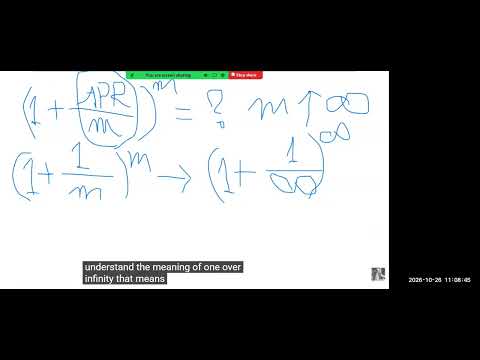
- As compounding frequency m approaches infinity, (1 + APR/m)^m approaches e^APR; with APR equal to 1, the limit is Euler’s number, approximately 2.718.
- Taking natural logs of FV/PV = (1 + r)^n yields n = ln(FV/PV) / ln(1 + r), allowing the number of compounding periods to be solved directly.
- When the logarithm formula returns 20 quarterly periods, divide by 4 to express the result as five years rather than incorrectly labeling it 20 years.
- An ordinary annuity deposits money at the end of each period, while an annuity due deposits at the beginning and earns one additional compounding period per payment.
- The ordinary-annuity future value is payment × ((1 + r)^n - 1) / r; $800 monthly for 60 months at a 0.5% monthly rate grows to about $55,816.
- For the $60,000 graduate-school target, raising monthly savings, finding a higher return, or extending the timeline are distinct tradeoffs; the six-year option produces a surplus but delays enrollment.
Chapters
- Jeff Hunk opens Module 3 by reviewing the prior lesson on compounding frequency and future value.
- The class shifts from the earlier time-value-of-money material to Euler’s number and natural logarithms.
- The periodic rate is APR divided by the number of compounding periods, such as 6% divided by 4 for a quarterly rate of 1.5%.
- The central question is what happens to (1 + APR/m)^m as the compounding frequency m increases without bound.
- The lesson uses APR = 1 as a simple case before relating the limit to actual growth rates.
- Jeff illustrates the limit with 1/10 = 0.1, 1/100 = 0.01, and 1/1,000 = 0.001.
- As the denominator grows, 1/m approaches zero but is not exactly zero for any finite m.
- That distinction matters because replacing 1/m with zero would incorrectly make the limiting expression equal to 1.
- With APR set to 1, the expression (1 + 1/m)^m approaches Euler’s number, approximately 2.718.
- The limiting value is irrational, so Jeff refers to it as Euler’s number rather than treating 2.718 as exact.
- The continuous-compounding limit explains why e is useful as a logarithm base.
- Common logarithms are easy to interpret for powers of 10, such as 1,000 = 10^3 and 10,000 = 10^4.
- For values such as 13.78, the exponent of 10 is difficult to determine mentally even though a calculator can compute it.
- The natural logarithm, log base e, provides a practical logarithm for arbitrary positive values in the lesson’s equations.
- Starting from FV/PV = (1 + r)^n, taking natural logs turns the exponent into a multiplier: ln(FV/PV) = n ln(1 + r).
- Solving for n gives n = ln(FV/PV) / ln(1 + r).
- Jeff connects the method to log linearization, which converts a power relationship into a form that can be rearranged.
- The class opens the existing Excel time-value-of-money workbook and checks a problem that triples an investment in five years.
- For annual compounding, the natural-log formula returns five periods, confirming the known five-year result.
- For quarterly compounding, dividing the annual rate by 4 produces a result of 20 quarters, which must then be divided by 4 to report five years.
- A quarterly rate can be found from the growth multiple using (FV/PV)^(1/n) - 1, where n is the total number of quarters.
- The periodic rate is multiplied by the compounding frequency to express it as an annual percentage rate.
- The class compares the rate-solving and period-solving formulas and checks that the quarterly example still corresponds to five years.
- A single-cash-flow example has one outflow and one later inflow, such as depositing $10,000 at 10% for five years.
- Jeff contrasts that pattern with saving toward a graduate-school fund, using a target of $60,000 for a two-year program.
- The example assumes a student has about five years to build the fund before enrolling.
- An annuity consists of equal payments or deposits made at regular intervals; the interval can be monthly, quarterly, weekly, or annual.
- Saving $800 at the end of each month for five years creates 60 deposits, with the first deposit earning 59 monthly compounding periods.
- Jeff calls end-of-period deposits an ordinary annuity and explains that paycheck timing makes this assumption realistic.
- The scaled example deposits $1,000 at the end of each year for five years at 20%.
- The first deposit compounds four times, the next three times, then two and one times; the final deposit earns no interest before the end date.
- The future value is found by adding the accumulated value of each deposit.
- An annuity due begins at time zero, so each deposit is made at the beginning rather than the end of its period.
- In the five-payment illustration, every deposit earns one more compounding period than in the corresponding ordinary annuity.
- Jeff recommends calculating the ordinary-annuity value and multiplying by (1 + r) to convert it to an annuity due.
- Jeff pauses the class at approximately 12:00 for a planned 10-minute break.
- The recording resumes at 73:49 and returns to deriving the future value of an annuity.
- For a terminal period T, the first end-of-period deposit compounds for T - 1 periods, the next for T - 2, and so on.
- The final deposit can be represented as payment times (1 + r)^0, which equals the payment because it earns no interest.
- For the 60-month savings example, the first $800 deposit compounds 59 times.
- Jeff compresses the repeated deposit terms into a summation of payment times (1 + r)^n, with n running from 0 to T - 1.
- The summation is concise but still requires adding many terms if used directly for 60 monthly deposits.
- The reduced ordinary-annuity formula is payment × ((1 + r)^n - 1) / r, with r as the periodic rate.
- The class enters the annuity formula in the workbook’s multiple-cash-flow tab for $800 monthly deposits.
- An APR of 6% with monthly compounding gives a periodic rate of 0.5% and 60 total payments.
- The spreadsheet returns a future value of about $55,816, below the $60,000 graduate-school target.
- Increasing the monthly deposit by $60 is presented as one way to raise the five-year balance to the target.
- A hypothetical 8% savings rate improves the result but still leaves the fund roughly $1,300 short.
- Saving $800 monthly for six years exceeds the target by about $9,000, but Jeff notes that delaying an MBA by a year has an opportunity cost.
- The annuity-due calculation multiplies the ordinary-annuity future value by 1 plus the periodic rate.
- The additional compounding period improves each scenario but does not change the overall comparison of the three savings strategies.
- The higher monthly deposit is identified as the most direct way to meet the target, while waiting an extra year requires weighing the delay against the larger balance.
- Jeff directs students to an announcement containing Quiz 1 summary statistics, including quiz averages, attendance, participation, and weighted averages.
- He explains that the displayed grades are interim and can change as the midterm, later quizzes, and final exam are added to the weighting.
- Jeff closes by asking students to review the grading formula and follow up by email if they will miss the next class.
Transcript excerpt
0:22 [music] Making
1:47 progress. Hey, good morning everyone. Good morning. Good morning. All right. Happy Monday to everyone. Happy Monday. Uh good morning, Issa, Ken, and who's here? Let me um Okay, we have uh like how many? Seven people here. I mean, six. Uh Isa, Shane, good morning. And uh Yianela, good morning.
2:36 Kina, good morning. And Kron, good morning. Kron, if you can please turn on your camera, right? Uh, some people look much better in person, right? Take Oh, Max. Good morning. Take Max and Shane for example. They look much better in person than uh in profile picture, right? Uh, good morning, Katherine. look better in person than in uh than the uh profile picture. Keep that on. Okay. Good morning. Good morning. All right. So, today, right, uh we're going to continue uh with the uh Oilers's number because we just touched on the Oilers's number in our last
3:24 class. So um u how Oiler's number and uh natural log are uh connected right that's what we are going to okay so here module not one it's three module three and just just to Um, just to have a quick refresher on our last Okay. So, here's our last class. Let's see.
4:12 So, the last it's not pronounced, [clears throat] it's pronounced. >> Okay. So, you know, this time zero at a higher frequency. I mean when n the compounding frequency per year is >> this was a small video embedded uh in the uh in our PDF reader >> fireed money let's make a table now number of time periods and the dollar value in the $2. >> Okay. >> So that was we're going to uh so uh that's all the time we have. So we're going to uh we're going to begin with
This is the start of the transcript. Save this video free for the whole transcript, searchable and time-coded.
Related notes
Summary, takeaways, and chapters were generated by AI from the video's transcript and may contain errors. The video belongs to its creator, Jeff Hunk.