fnb100f261019b
 Watch on YouTube →
Overview
Jeff Hunk introduces time value of money as the basis for valuing future cash flows, deriving compounding, discounting, and annualized growth rates. He uses Excel to model annual and quarterly compounding, showing how frequency changes future values and required rates, then reviews course assessment access and attendance questions.
Key takeaways
- For annual compounding, future value is FV = P × (1 + R)^N; with more frequent compounding, use the periodic rate APR/M and total periods M×T.
- Discounting reverses compounding: present value is FV divided by the growth factor, so a larger compounding frequency requires less initial principal to reach the same future target.
- The annualized rate formula, (FV/PV)^(1/N) − 1, follows by isolating the growth factor, taking an Nth root, and subtracting one; it is also called CAGR or geometric average growth.
- For $10,000 to grow to $30,000 in five years, the required annual rate is about 24.57% with annual compounding and about 22.59% nominal APR with quarterly compounding.
- Excel helper columns for periodic rate and total periods make formulas reusable across cases and simplify error checking; parentheses are essential when applying PEMDAS to rate calculations.
- The midterm, Quiz 2, and final are hosted on McGraw Hill Connect; Brightspace quiz access may depend on completing module release conditions, such as opening required course files.
Chapters
- Jeff Hunk welcomes students and checks who has joined the online session.
- He asks students to turn on cameras and notes that about 17 people are present.
- Jeff Hunk introduces Module 3, time value of money, and links it to compounding from Topic 1.
- He says the mathematical basis for the geometric average and CAGR formula will be developed in this module.
- The module introduction describes valuation as the present value of future cash flows discounted at a required return.
- Planned topics include cash-flow patterns, unknown rates and time periods, exponents, logarithms, and continuous time.
- The stated goal is to perform actuarial calculations with algebraic models in Excel, including large-scale computations.
- Jeff Hunk contrasts receiving $1,000 today with receiving the same nominal amount 10 years later.
- He explains that waiting and inflation reduce future purchasing power, using 5% annual inflation as an example.
- Inflation accumulates through compounding, so a future dollar amount must be adjusted to compare it with today's money.
- Jeff Hunk compares compounding to a snowball that collects more snow as its surface grows.
- For a $10,000 deposit earning 10%, the first year's interest is $1,000 and the balance becomes $11,000.
- In year two, interest is earned on the $11,000 balance, not just the original $10,000.
- The year-two balance is written as the year-one balance multiplied by 1 plus the rate.
- Repeated annual compounding produces the general formula FV = P × (1 + R)^N.
- Jeff Hunk identifies P as the initial principal, R as the periodic rate, and N as the number of periods.
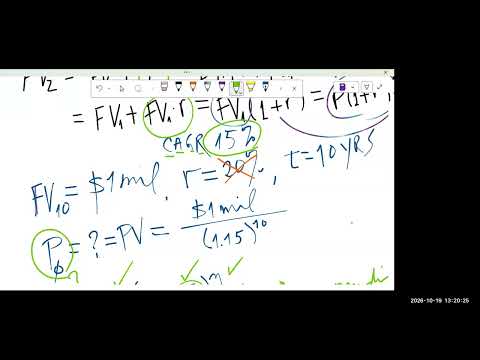
- Jeff Hunk frames present value as the seed investment needed to reach a target, such as $1 million in 10 years.
- Starting from FV = P × (1 + R)^N, solving for P means dividing the future value by the growth factor.
- He calls this reverse operation discounting and identifies principal at time zero as present value.
- Students are directed to Module 3 and asked to download the PDF reader and Excel exercise file.
- Jeff Hunk clarifies that the relevant workbook tab is named Single Cash Flow after a student sees a different value in column C.
- Students without a computer are told to catch up using the class recording.
- The first spreadsheet example uses a $10,000 principal, a 10% APR, and a 10-year term.
- Jeff Hunk enters the formula by referencing the principal and rate cells, then raising 1 plus the rate to the period count.
- He explains that the caret symbol, ^, represents exponentiation in Excel.
- For quarterly compounding, the 10% APR becomes a 2.5% periodic rate by dividing by four.
- The 10-year term becomes 40 compounding periods by multiplying years by four.
- The quarterly model produces a higher future value than annual compounding for the same APR and principal.
- Jeff Hunk adds a periodic-rate column calculated as APR divided by M, the compounding frequency per year.
- A separate period-count column calculates N as M multiplied by T, the number of years.
- The future-value calculation then uses one consistent structure: principal times 1 plus periodic rate raised to total periods.
- Jeff Hunk emphasizes that a simple, consistent model is easier to reuse and debug than a complicated formula.
- Excel can copy the formula across multiple cases with different principals, APRs, terms, and compounding frequencies.
- He restores a missing bottom border after copying cells, describing tidy formatting as part of professional work.
- Discounting reverses the future-value calculation by dividing FV by the growth factor.
- The annual example and its quarterly counterpart both recover the original $10,000 principal.
- Jeff Hunk copies the calculation into a uniform spreadsheet layout so annual and quarterly cases share the same model structure.
- A $1 million target illustrates how present value depends on the assumed return and compounding frequency.
- At a fixed nominal APR, more frequent compounding increases future value; for a fixed target, it reduces the required principal.
- Jeff Hunk asks students to verify the spreadsheet results with a new green-check response.
- Students confirm whether their Excel results match the examples before the session pauses.
- Jeff Hunk leaves the workbook in formula view so students can inspect the calculations during the break.
- The class takes a 10-minute break, with the lesson resuming at about 61:21.
- Jeff Hunk returns to FV = P × (1 + R)^N and distinguishes solving for P from solving for R.
- He explains that the exponent prevents direct isolation of R, so the power must be undone with an Nth root.
- He reviews fractional exponents, including the equivalence between a square root and raising a quantity to the one-half power.
- The equation is divided by present value so that the growth factor is isolated as FV divided by PV.
- Raising both sides to the power 1/N removes the exponent, after which subtracting one isolates the rate.
- The resulting formula, (FV/PV)^(1/N) − 1, is identified as geometric average growth, annualized return, or CAGR.
- The worksheet asks what annual rate grows $10,000 to $30,000 over five years.
- Annual compounding requires about 24.57% per year, while quarterly compounding requires a lower nominal APR.
- The quarterly calculation first finds a periodic rate over 20 periods, then multiplies by four to report the annual nominal rate.
- The quarterly result is about 22.59% APR, compared with about 24.57% under annual compounding.
- Jeff Hunk catches a missing-parentheses error and reviews PEMDAS to explain why Excel evaluated the expression incorrectly.
- He checks that the lower quarterly APR matches the expectation for reaching the same $30,000 target from the same $10,000 starting balance.
- Students report that Quiz 1 is missing, and Jeff Hunk demonstrates navigating through the course modules and assignments.
- In the example shown, the student needs to open the required Excel and PDF files in the Financial Statements module to satisfy release conditions.
- Jeff Hunk allows the students who missed the quiz to submit that evening without a late penalty.
- Jeff Hunk says the remaining midterm, Quiz 2, and final will use McGraw Hill Connect, not a Brightspace midterm.
- Students are directed to the Connect site link in Course Information for chapter exercises and assessments.
- He clarifies that the remaining in-person Wednesday meeting is in November after a prior meeting was missed for health reasons.
- A student reporting five absences as of October 7 is advised to avoid further absences and email specific dates and reasons.
- Jeff Hunk says Connect access costs about $63 and offers two weeks of courtesy access when a student first registers.
- He suggests asking BMCC about financial-hardship funds and notes that a new email account may be needed if an earlier courtesy period has expired.
- Students are advised to send detailed absence emails with dates and explanations; one student realizes the message was still in drafts.
Transcript excerpt
1:06 Good morning. >> Hey, good afternoon everyone. Good afternoon. Good afternoon. Good afternoon. Let's see who's here. Still Ian. Ian. Two people still in. All righty. All righty. So, good afternoon everyone. Good afternoon. Let's see. I can see Whitmer. Whitmer. All right. And uh Luca, Holy Matu, Olani, Brandon, Haley, Tyondre,
1:53 and someone is still connecting. That's Malik, still connecting. Yassir and Eleni, Leo, uh Alicia and Arman, Andy, and Blendy. All right. Good afternoon to everyone. Good afternoon. Uh and if you are not on your camera, please turn on your camera, right? Please turn on your camera. Okay? Please turn on your camera. Uh and I just admitted two more people. Uh Cortes, all right. >> Hi, Professor. >> Hi, Aaron. Hi, Cortes and Aaron. So, we have how many people? Like 17 people.
2:41 That's That's a very good number. All right. Very good number. All right. So, um let's uh Ian is still trying to Ian is out. I saw him as waiting in. Okay. So, we're we're starting on a new topic. We're starting a new topic today and uh uh which is, you know, topic three or module three, time value of money. Now, time value of money is not a new topic, actually, because you've been exposed to this in topic one. Uh Why? Uh so, I already Let me open this and go
3:28 Okay. I'm going to come back to this because uh because in topic one, remember, we need to to we needed, you know, geometric average and to calculate geometric average, uh the the formula was thrown to you, but I at the time I told you uh the, you know, a mathematical background will be discussed in more detail in topic three. So, uh And also in topic one, I briefly went
This is the start of the transcript. Save this video free for the whole transcript, searchable and time-coded.
Related notes
Summary, takeaways, and chapters were generated by AI from the video's transcript and may contain errors. The video belongs to its creator, Jeff Hunk.