fnb100f261022
 Watch on YouTube →
Overview
Jeff Hunk explains how logarithms make it possible to solve for the exponent in a compound-growth equation, then introduces Euler's number e through the limit of increasingly frequent compounding. Using a $1 investment growing at 100%, he shows that discrete compounding approaches $2.718 per year, yielding the continuous-compounding formula FV = PV × e^(rt), and explains that the natural logarithm is the log with base e.
Key takeaways
- For an exponential equation z = x^y, taking logarithms gives y = log(z) / log(x), which lets a solver isolate an unknown exponent.
- Compounding $1 at a 100% annual rate m times in one year gives (1 + 1/m)^m; as m approaches infinity, the value approaches e ≈ 2.71828.
- Continuous compounding is modeled by FV = PV × e^(rt), where PV is starting value, r is the rate, and t is time.
- At a 100% rate for one year, continuous compounding turns $1 into about $2.718 gross, or a net return of about 171.8%.
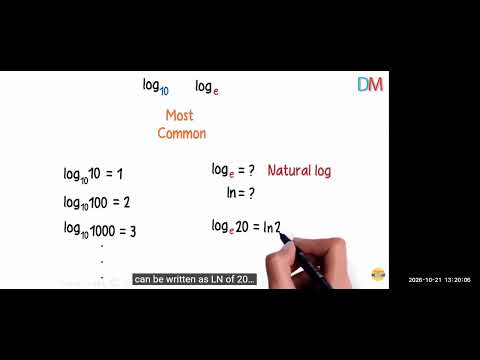
- Common logarithms use base 10, binary logarithms use base 2, and natural logarithms use base e and are written ln(x).
Chapters
- Jeff Hunk reviews the compounding equation's four variables: future value, principal, rate of return, and time.
- The class has already practiced solving for future value, principal, and rate, leaving the exponent or time period as the unknown.
- Solving for the exponent requires a logarithm because it cannot be isolated using ordinary arithmetic alone.
- Powers of 10 compactly represent large values: 1,000 = 10^3, 1 million = 10^6, and 1 billion = 10^9.
- A base-10 logarithm identifies the exponent, so log10(100) = 2 and log10(1,000) = 3.
- The power rule log_b(x^y) = y log_b(x) converts an exponent into a multiplicative factor.
- Jeff Hunk compares a compound-growth equation to the structure z = x^y, where y is the unknown exponent.
- Taking logarithms of both sides preserves equality and turns log(z) = log(x^y) into log(z) = y log(x).
- Rearranging gives y = log(z) / log(x), the general method for solving an exponential equation for its exponent.
- Common logarithms use base 10, while binary logarithms use base 2; for example, log2(8) = 3.
- Natural logarithms use Euler's number e as the base and are written ln(x).
- Jeff Hunk introduces e as the foundation for the next explanation of continuous growth and logarithms.
- An embedded explanation starts with $1 doubling at each time step, producing $2, $4, and $8 under discrete 100% growth.
- The same stepwise growth can be written as powers of 2 or as repeated 100% increases.
- Jeff Hunk contrasts discrete accounting periods with gradual growth, using human height as an example of change that happens continuously rather than in a sudden yearly jump.
- The annual rate is divided across m compounding periods, with each period applying a rate of r/m.
- For a 100% annual rate, compounding twice gives (1 + 1/2)^2 = 2.25, while quarterly compounding gives (1 + 1/4)^4 ≈ 2.441.
- The model generalizes to (1 + 1/m)^m for one year of 100% growth, and increasing m increases the final value.
- The one-year value from (1 + 1/m)^m rises as compounding periods increase, including for daily and million-period examples.
- As m becomes extremely large, the result converges to e ≈ 2.71828 rather than increasing without bound.
- With an initial $1 and a 100% rate, continuous compounding produces about $2.718 gross, equivalent to a net gain of about 171.8%.
- The discrete-growth model compounds in steps, while continuous compounding uses the exponential factor e^(rt).
- In the formula, r is the growth or interest rate and t is the elapsed time; a 200% rate over five years is represented by e^(2 × 5).
- Jeff Hunk distinguishes the gross value factor e^(rt) from net growth, which subtracts the original principal.
- Jeff Hunk revisits the limit as the compounding frequency m tends toward infinity, yielding (1 + 1/m)^m → e.
- The factor 1/m becomes increasingly small as m grows, but the base 1 + 1/m remains slightly above 1 while being raised to an increasingly large power.
- The limiting result is the irrational constant e, approximately 2.71828, rather than 1 or an unbounded value.
- The natural logarithm, ln(x), is the logarithm with base e and provides a standard way to express logarithms of positive values.
- Jeff Hunk contrasts natural logs with common logs, noting that non-power-of-10 inputs are not generally easy to evaluate mentally.
- The class ends with a brief attendance screenshot and a student question after the lesson on Euler's number and natural logs.
Transcript excerpt
1:14 Everything. All right. Good morning, everyone. Good morning. Good morning. So, how's everybody? Happy Wednesday to
2:08 everyone. Happy Wednesday. Lenny is in the >> hi good morning or good afternoon whichever it is. All righty. >> Okay. So um today uh uh we need to uh start with this video oil's number on um remembering in our last class um So there are four uh possible
2:58 unknown variables, right? Because you know we have in the base microphone background. There was some background noise. So I took the uh I took the liberty of muting whoever whoever's microphone is on. So remember uh when we have uh the base formula right which is the compounding compounding formula right uh an equation with four variables
3:45 can have four possibly four unknowns because there are four variables right so if the unknown future value Right? That's the base compounding formula. If the unknown is the uh principle, right, it's discounting. If the unknown is the rate or the return, then it's this, you know, uh uh geometric average formula or KGAR, right? KGAR compounded annual growth rate. And we've done the Excel exercise uh Excel exercises of all these three cases. Right? So we're now uh we have one unknown variable left. What if the n is the unknown? So how do we uh approach
4:37 this? How do we solve for this? Okay, to do that this this one is more this one is more complicated. It's more in mathematically involved, right? So we'll have to uh uh watch this video, right? Okay. Oiler's number and natural log solving for n. So let's take a listen. dressed up lately. Truth is >> uh again express one year. >> Okay, >> as you can see um you can consider this as x >> $2,000. So this term okay
This is the start of the transcript. Save this video free for the whole transcript, searchable and time-coded.
Related notes
Summary, takeaways, and chapters were generated by AI from the video's transcript and may contain errors. The video belongs to its creator, Jeff Hunk.