fnb100f261021b
 Watch on YouTube →
Overview
A finance lesson explains how logarithms solve for the unknown time period in compound-growth equations, then connects continuous compounding to Euler’s number, e ≈ 2.71828. It derives e as the limit of (1 + 1/n)^n, distinguishes discrete from continuous growth, and introduces natural logarithms, ln(x), as a way to work with exponents.
Key takeaways
- To solve for an unknown exponent in z = xʸ, take logarithms of both sides and divide: y = log(z) / log(x).
- For 100% growth over one year, increasing compounding frequency produces the limit (1 + 1/n)ⁿ = e ≈ 2.71828, so $1 approaches $2.71828.
- Continuous compounding uses FV = PV·e^(rt), while discrete compounding applies periodic growth factors such as (1 + r/m)^(mt).
- The increase in each interval becomes very small as n grows, but repeated compounding keeps the total limit above 1; the limit is e, not 1.
- A natural logarithm is log base e, written ln(x), and it converts exponential relationships into equations that can be solved for unknown rates or time periods.
Chapters
- The compound-growth equation has four variables, so any one may be the unknown.
- Future value uses the compounding formula, principal is found through discounting, and rate is found with a compound annual growth rate calculation.
- The remaining task is solving for the number of periods, n.
- Powers of 10 compactly represent large quantities: 1,000 is 10³, 1 million is 10⁶, and 1 billion is 10⁹.
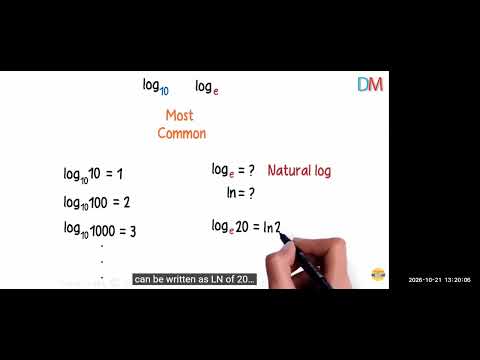
- A common logarithm uses base 10, so log₁₀(100) = 2 and log₁₀(1,000) = 3.
- The exponent rule log(xʸ) = y log(x) turns a power into multiplication.
- The unknown period appears as an exponent in a structure like z = xʸ, which cannot be solved by ordinary division alone.
- Taking logs of both sides gives log(z) = y log(x), making y = log(z) / log(x).
- For a compound-growth model, this transformation allows the unknown exponent n to be calculated.
- Common logarithms use base 10, while binary logarithms use base 2, so log₂(8) = 3.
- Natural logarithms use Euler’s number e as the base and are written ln(x).
- The lesson introduces e as the foundation for continuous-growth calculations.
- The embedded explanation starts with $1 doubling each time period, producing $2, $4, and $8 under discrete growth.
- A 100% increase per period can be written as (1 + 1) raised to the number of periods.
- The lesson contrasts sudden, stepwise changes with gradual growth, such as a child’s height increasing over a year.
- For a 100% annual growth rate, annual compounding turns $1 into $2 after one year.
- Semiannual compounding uses 50% growth twice, producing $2.25; quarterly compounding uses 25% four times, producing about $2.441.
- With n compounding intervals, the one-year result is (1 + 1/n)ⁿ, and more intervals produce a larger result.
- As the number of compounding intervals increases from daily to millions, (1 + 1/n)ⁿ approaches approximately 2.718.
- That limiting value is Euler’s number, e, an irrational constant whose decimal digits continue without repeating.
- At 100% growth over one period, $1 approaches $2.718 under continuous compounding, a net gain of about 171.8%.
- Continuous compounding is represented by e^(r·t), where r is the growth rate and t is the number of time periods.
- The example of 200% growth for five years becomes e^(2·5), using 2 for the rate and 5 for the periods.
- Discrete compounding instead uses a form such as (1 + r/m)^(mt), where m is the compounding frequency per year.
- The class considers what happens as the compounding frequency m grows without bound in (1 + 1/m)^m.
- Values such as 1/10 = 0.1 and 1/1,000 = 0.001 illustrate that 1/m approaches zero as m increases.
- Although the increment approaches zero, the entire expression approaches e rather than 1, because the slightly-above-one factor is repeatedly multiplied.
- Natural logarithms are written ln(x), meaning log base e; the lesson uses them to express exponents for non-power-of-10 values.
- Taking the natural log of both sides is a practical way to solve compound-growth equations for an unknown period.
- The class ends with an attendance screenshot and a reminder that the recording will be stopped after questions.
Transcript excerpt
1:52 LeBron and Savannah James Hospital. >> All right. Good morning everyone. Good morning. Good morning. So, how's everybody? Happy Wednesday to everyone. Happy Wednesday is in the >> hi good morning or good afternoon whichever it is. All righty. >> Okay. So [clears throat] um today uh uh we need to uh start with this video oil's number on um remembering in our last class
2:42 um So there are four uh possible unknown variables, right? Because you know we have in the base microphone background. There was some background noise. So I took the uh I took the liberty of muting whoever whoever's microphone is on. So remember uh when we have uh the base
3:33 formula right which is the compounding compounding formula right uh an equation with four variables can have four possibly four unknowns because there are four variables right so if the unknown future value Right? That's the base compounding formula. If the unknown is the uh principle, right, it's discounting. If the unknown is the rate or the return, then it's this, you know, uh uh geometric average formula or KGAR, right? KGAR compounded annual growth rate. [clears throat] And we've done the Excel exercise
4:23 uh Excel exercises of all these three cases. Right? So we're now uh we have one unknown variable left. What if the n is the unknown? So how do we uh approach this? How do we solve for this? Okay, to do that this this one is more this one is more complicated. It's more in mathematically involved, right? >> [clears throat] >> So we'll have to uh uh watch this video, right? Okay. Oiler's number and natural log solving for n. So let's take a listen. [music] dressed up lately. Truth is [music]
5:12 >> uh again express one year. >> Okay,
This is the start of the transcript. Save this video free for the whole transcript, searchable and time-coded.
Related notes
Summary, takeaways, and chapters were generated by AI from the video's transcript and may contain errors. The video belongs to its creator, Jeff Hunk.