EVEG 4156: Communication and EndNote Tips, etc.
 Watch on YouTube →
Overview
Samuel Snow resolves conflicting thesis-assignment dates, prepares students for Thursday elevator pitches, and offers practical guidance on persuasive presentations and EndNote. He connects communication to the spread of ideas through Matt Ridley’s “When Ideas Have Sex,” then teaches techniques including audience-facing posture, rehearsal, purposeful pauses, and the “and, but, therefore” narrative structure; he also reviews Procter & Gamble’s 10-liter coagulation-and-chlorination packets.
Key takeaways
- A research thesis should make a specific claim that the paper can argue for; students can present its core in conversational language rather than reciting formal wording.
- Procter & Gamble’s described purifier packets combine coagulation and chlorination for 10 liters of water, with 20–30 minutes for settling before cloth filtration.
- Matt Ridley’s “When Ideas Have Sex” frames exchange as a way to combine innovations, while his Adam-and-Oz example illustrates how specialization and trade can benefit both parties.
- A stable, audience-facing stance and practiced gestures can help manage nervous habits; Snow recommends feet roughly shoulder-width apart and facing the audience.
- The “and, but, therefore” pattern offers a practical narrative structure: provide context, identify a challenge, and lead toward a response or resolution.
- In EndNote, converting citations to plain text can prevent automatic updating, so manual formatting or hyperlinking may complicate later revisions.
Chapters
0:00
Thesis Assignment Dates: Moodle Submission and Thursday Pitches
- Conflicting dates appeared in the syllabus, rubric, Moodle, and paper instructions, so Snow resets expectations.
- Students should upload a thesis statement by Thursday at the latest; Thursday is also the in-class presentation day.
- Each student will give a short elevator pitch, then share feedback notes on effective approaches and areas to improve through Moodle.
3:12
Narrowing a Research Topic into an Arguable Thesis
- A thesis should make a claim that the research paper will support, such as arguing that a particular water-treatment approach is best for a defined reason.
- The proposed solution need not be technological; the assignment asks students to identify and argue a position on a specific problem.
- Students are moving from exploring a broad topic to deciding what they will actually describe or debate.
4:20
Thursday’s Thesis Pitch: Face the Audience and Invite Feedback
- Presenters should come to the front, face the class, and address the audience rather than speaking toward a wall or screen.
- Snow plans a prompt slide and peer feedback notes to help students evaluate the pitches.
- Arriving on time matters because each student will present before the class moves back to lecture material.
6:48
Procter & Gamble Water Purifier Packets Combine Coagulation and Chlorine
- The point-of-use packets described combine coagulant and chlorine to treat about 10 liters of water per packet.
- Users stir the packet into dirty water, allow roughly 20–30 minutes for flocculation and settling, then pour the water through cloth into a second container.
- The approach is presented as useful for camping, disaster relief, or off-grid situations rather than necessarily as a convenient permanent daily treatment.
10:20
Why Persuasive Communication Can Enable Social Change
- Changing practices involving people—such as adopting safer water habits—requires communication and interaction.
- Good communication can help people with competing values find solutions that satisfy more interests; poor communication can reduce opportunities for cooperation.
- Snow distinguishes persuasion aimed at public benefit from manipulative persuasion, such as a charlatan misleading an audience.
16:15
Matt Ridley’s “When Ideas Have Sex” as a Speaking Example
- Snow assigns Matt Ridley’s TED talk both as an argument about how ideas combine and as a model to analyze for presentation technique.
- The talk links exchange and communication to innovation, prosperity, and environmental or development challenges.
- Students are asked to notice what Ridley does well as a speaker, not just to follow the content of his argument.
18:36
Ridley’s Argument: Exchange Lets Ideas Combine and Improve
- Ridley contrasts a stone tool made to a stable design over many generations with a computer mouse assembled from many materials and ideas.
- He compares exchange in cultural evolution to sexual reproduction in biological evolution: innovations from separate lineages can combine.
- Using David Ricardo’s comparative-advantage example, Ridley shows how Adam and Oz can both save labor by specializing in axes or spears and trading.
22:20
Trade, Specialization, and the Collective Knowledge Behind Technology
- Ridley uses examples of long-distance exchange, including obsidian and shells found far from their sources, to argue that trade predates farming.
- His Tasmania example suggests isolation can make specialized skills and technologies difficult to maintain; he contrasts it with continued contact across a narrow strait near Tierra del Fuego.
- The computer mouse and Leonard Read’s essay “I, Pencil” illustrate how complex products depend on many people, each knowing only part of the production process.
27:25
The Collective Brain: Communication as a Driver of Innovation
- Ridley describes people as nodes in a collective brain, where exchanged ideas combine into incremental technological progress.
- He argues that social cooperation and communication can matter more to a society’s progress than the intelligence of any one individual.
- The talk concludes that broader connections—including cloud-based collaboration and crowdsourcing—can accelerate the exchange of ideas.
34:42
What Makes Matt Ridley’s TED Talk Engaging
- Students identify Ridley’s unscripted, conversational delivery, use of a physical pencil, rhetorical questions, and humor as techniques that hold attention.
- His vocal cadence, pauses, and changes in pitch make the talk more engaging than a steady, unvaried delivery.
- Sparse slides and concrete visuals support the argument; Snow notes that technical talks may need more detail depending on the audience and purpose.
46:13
Managing Presentation Nerves with Posture and Muscle Memory
- Snow normalizes physiological nerves, comparing the attention of an audience to the jolt of having a room look over after a loud noise.
- Practice can replace nervous habits such as fidgeting or shifting weight with controlled gestures and a stable stance.
- Planting feet about shoulder-width apart and facing the audience helps the presenter appear engaged rather than poised to turn away.
50:53
Make the Presenter—not the Slides—the Focus of a Thesis Pitch
- Classmates want to hear about each other’s projects from the presenter, so Snow recommends conversational delivery rather than reading a slide.
- Students should try to memorize the core of their thesis and explain the problem, proposed direction, or personal reason the topic matters.
- For Thursday’s short pitch, a written prompt is acceptable if needed, but students are encouraged to translate formal thesis wording into natural speech.
1:03:16
Audience Dialogue and the “And, But, Therefore” Story Structure
- Eye contact can be distributed around the room, or simulated by looking toward different seats, to create a sense of dialogue and check audience reactions.
- Snow presents “and, but, therefore” as a basic narrative pattern: establish context, introduce a problem, and move toward a response or resolution.
- The structure can work at different scales, including a research paper’s opening paragraph, where the “therefore” can lead into the thesis.
1:08:39
EndNote Questions and Final Thesis-Presentation Reminder
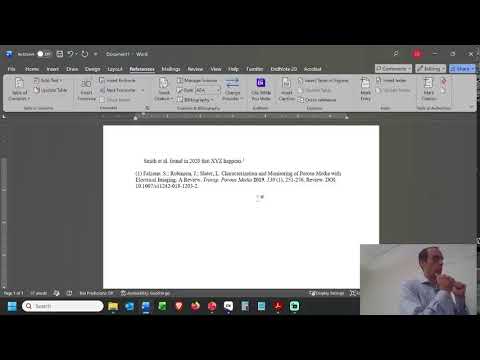
- Snow discusses converting an EndNote citation to plain text before adding another citation style, while warning that plain-text citations may no longer update automatically.
- For a question about linking a specific phrase such as “Smith et al. found in 2020” to a reference, he is unsure whether EndNote supports it directly and does not recommend manual hyperlinking in a research paper.
- Snow confirms that thesis statements must be uploaded by Thursday at the latest and that students will present them and submit peer-feedback notes afterward.
Summary, takeaways, and chapters were generated by AI from the video's transcript and may contain errors. The video belongs to its creator, Samuel Snow.