EVEG 4156: PoU Treatment - Coagulation
 Watch on YouTube →
Overview
Samuel Snow connects point-of-use coagulation theory to a field electrochlorination installation at the Amigos compound in Nicaragua, where a flow meter and controller regulate salt dosing and chlorine production. He explains how multivalent ions compress particles’ electrical double layers, why flocculation and controlled mixing increase settling and filtration, and how common coagulants such as alum and ferric salts are selected and tested with jar tests.
Key takeaways
- In the illustrated coagulation data, aluminum ions at about 10 mg/L reduced turbidity where calcium required roughly 80 mg/L and sodium roughly 4,000–5,000 mg/L, demonstrating the dosing advantage of multivalent cations.
- Coagulation removes the electrostatic barrier between colloids; subsequent gentle flocculation lets van der Waals attraction build aggregates without excessive shear.
- Because settling velocity scales with particle diameter squared under the reviewed Stokes relationship, aggregation can substantially improve sedimentation.
- The Amigos electrochlorinator uses a flow meter, controller, metering pump, and sodium chloride feed to regulate chlorine production; operators still need to measure residuals and calibrate for chlorine demand.
- A practical jar test compares several coagulant doses under consistent mixing, offering a direct way to select treatment conditions for variable source water.
Chapters
0:00
Nicaragua Water-Project Background and Solar-Powered Well
- Samuel Snow recalls a 2012–2013 project that installed solar panels and a storage tank to power a remote well.
- The community later gained grid electricity, making the original solar setup unnecessary.
1:45
Electrochlorinator Installation at the Amigos Compound
- Snow introduces the electrochlorinator installed at Amigos and the field team, including French professor François and Brian Peters.
- The donated system was designed by a small engineering company and adapted from agricultural uses such as treating water for pig farms.
5:00
Flow-Controlled Salt Dosing and Vertical Electrodes
- A metering pump adds sodium chloride because the groundwater is not salty enough for efficient electrolysis.
- A flow meter signals the controller to adjust dosing in proportion to water flow and the target chlorine concentration.
- Two vertical electrode units allow hydrogen and oxygen gases to escape through a gas-release fitting.
10:00
Connecting the Electrochlorinator to the Compound Water Supply
- The well feeds pressure tanks that maintain roughly 20–30 PSI for the compound’s distribution system.
- Plumbing diverts water through the electrochlorinator and returns it to the supply line; salt injection is followed by a static mixer.
- Operators received training and tested chlorine after installation; a pH meter was considered for monitoring, not adjustment.
17:00
Chlorine Demand, Residuals, and System Calibration
- Added chlorine can react with substances such as hydrogen sulfide or reduced iron, so the measured residual is not necessarily the dose applied.
- Iron can create chlorine demand and may form precipitates after oxidation, factors the treatment team must evaluate.
- Rather than predict every reaction, operators calibrate the controller by measuring residual chlorine and adjusting electrical input for the groundwater conditions.
20:00
Coagulation Makes Particles Easier to Settle or Filter
- Coagulation destabilizes suspended particles so they can stick together into larger aggregates.
- Larger particles settle more readily and are easier to capture in filters or membranes.
- The jar illustrations show cloudy, stable particles becoming clumps that sediment and leave clearer water.
23:50
Particle Sizes Explain Why Screening Cannot Remove Pathogens
- Viruses are roughly 20–100 nanometers and bacteria are commonly around 1–2 micrometers, too small to settle readily.
- Giardia and Cryptosporidium cysts are about 5–15 micrometers, but their density is close to water, limiting passive settling.
- Screens and cloth can capture larger clays or particles that may carry pathogens, but do not reliably remove free viruses or bacteria.
31:00
Electrical Double Layers Keep Colloids Apart
- Charged particle surfaces attract counterions, forming an electrical double layer that extends into the surrounding water.
- Like-charged particles repel one another over longer distances, while shorter-range van der Waals forces can pull them together.
- Coagulation reduces this repulsion enough for particles to approach within the range where attractive forces dominate.
38:00
Why Calcium and Aluminum Coagulate at Lower Doses Than Sodium
- In the illustrated suspension, sodium required roughly 4,000–5,000 mg/L before turbidity fell appreciably.
- Calcium achieved a similar effect at about 80 mg/L, while aluminum at a 3+ charge worked at about 10 mg/L.
- Multivalent cations provide more charge per ion and compress the electrical double layer more effectively than sodium.
40:00
Ionic Strength Formula and Magnesium Chloride Practice
- Snow reviews ionic strength as I = ½Σ(cᵢzᵢ²), using each ionic species’ concentration and squared charge.
- For 100 mg/L magnesium chloride, the exercise converts the salt dose into magnesium and chloride molar concentrations before calculating ionic strength.
- Activity coefficients matter more in concentrated or complex water because effective chemical activity can differ from molar concentration.
51:00
Flocculation Builds Aggregates After Coagulant Addition
- Stokes’ settling relationship makes particle diameter especially important: settling velocity scales with diameter squared.
- After coagulation, gentle mixing gives destabilized particles time to collide and form larger flocs without tearing them apart.
- Aggregation lowers particle count—for example, six initial particles could become two aggregates—while increasing particle size.
54:30
Mixing Intensity G Depends on Power, Viscosity, and Basin Volume
- Mixing intensity is described as G = √(P/(μV)), where P is power input, μ is dynamic viscosity, and V is basin volume.
- A pen can mix a small bottle of water effectively but cannot create the same conditions in a swimming pool; higher viscosity also requires more power.
- The velocity gradient near a paddle, propeller, or basin wall provides a physical interpretation of G.
1:00:00
Particle Aggregation Kinetics and Floc-Volume Calculation
- A simple batch model treats particle-number decline as first-order decay, with a rate constant describing how often particles combine.
- The rate constant depends on collision efficiency, mixing intensity, and the fraction of water volume occupied by particles.
- Assuming spherical particles and conserved volume, combining four equal particles gives an aggregate diameter proportional to the cube root of four.
1:10:00
Alum and Ferric Salts Form Coagulating Precipitates
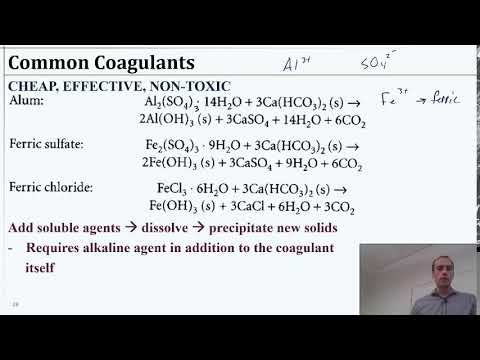
- Common coagulants include aluminum sulfate (alum), ferric sulfate, and ferric chloride; their dissolved multivalent ions destabilize particles.
- Aluminum hydroxide precipitates can remove added aluminum from the water and provide solids that capture other particles as they form.
- Alum treatment may need an alkaline agent such as calcium carbonate, caustic soda, soda ash, or lime to support the reactions.
1:15:00
Jar Tests Compare Coagulant Doses in Real Water
- Rather than calculate every water-chemistry interaction, operators test dose ranges such as 10, 20, 30, and 50 mg/L.
- Jar-test equipment applies consistent mixing so operators can compare turbidity removal and the time required for floc formation.
- The lecture closes with jar testing as the practical next step for selecting coagulant doses when source-water conditions vary.
Summary, takeaways, and chapters were generated by AI from the video's transcript and may contain errors. The video belongs to its creator, Samuel Snow.