EM fields lecture 25 - intro to multipole expansion of electrstatic potential and mulripole moments
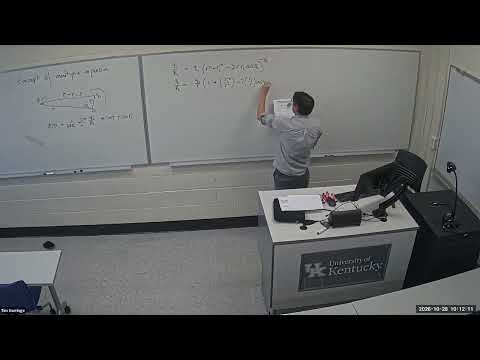 Watch on YouTube →
Overview
The lecture derives the far-field multipole expansion of electrostatic potential by expanding Coulomb's law for a field point much farther from the charge distribution than any source charge. It identifies the monopole, dipole, and quadrupole terms, explains how the first nonzero moment controls the leading potential, and presents Legendre polynomials and direction-cosine components as a compact notation for the moments.
Key takeaways
- The multipole expansion is a far-field approximation requiring the observation distance r to be much greater than the size of the charge distribution.
- The monopole, dipole, and quadrupole potentials scale respectively as 1/r, 1/r², and 1/r³, so the first nonzero moment determines the leading far-field behavior.
- A neutral distribution does not necessarily have zero far-field potential: if its dipole moment is nonzero, its leading potential decays as 1/r².
- Two equal negative charges placed symmetrically on opposite sides of two positive charges at the origin can cancel both net charge and dipole moment while retaining a quadrupole contribution.
- Legendre polynomials encode the angular dependence of the expansion; P₀(x) = 1, P₁(x) = x, and P₂(x) = (3x² - 1)/2 correspond to its first three orders.
- Multipole moments increase in mathematical structure: the monopole is a scalar, the dipole is a vector, and the quadrupole is a rank-two tensor with nine components in three dimensions.
Chapters
- The multipole expansion describes electrostatic potential at large distances and applies to nonspherical charge distributions.
- The source is represented by point charges qᵢ at position vectors rᵢ, with a field point at r.
- The separation vector from each charge to the field point is R = r - rᵢ, and the angle between r and rᵢ determines the angular dependence.
- The far-field condition is r much greater than every source distance rᵢ.
- The cosine rule rewrites each source distance using r, rᵢ, and the angle between their vectors.
- Factoring out r leaves a quantity of the form (1 + δ)⁻¹ᐟ², where δ contains small terms proportional to rᵢ/r and (rᵢ/r)².
- A binomial expansion in δ produces successive powers of 1/r and source-position terms.
- The leading potential term scales as 1/r and its coefficient is the total charge, Σqᵢ.
- The next term scales as 1/r² and depends on Σqᵢrᵢ cosθᵢ, the charge distribution's dipole contribution.
- The third term scales as 1/r³ and contains Σqᵢrᵢ²(3cos²θᵢ - 1)/2, the quadrupole contribution.
- Further terms continue with higher inverse powers of r, including an octupole term proportional to 1/r⁴.
- At large r, 1/r terms dominate 1/r² and 1/r³ terms whenever their coefficients are nonzero.
- A charge distribution with nonzero net charge is led by its monopole potential, proportional to 1/r.
- For a neutral distribution, the monopole term vanishes; a nonzero dipole moment then gives a leading 1/r² potential.
- Two positive charges at the origin balanced by equal negative charges at opposite positions have zero net charge and dipole moment, but can have a nonzero quadrupole term proportional to 1/r³.
- Legendre polynomials Pₗ(cosθ) organize the angular factors in the expansion, with the multipole order indexed by l.
- The first three are P₀(x) = 1, P₁(x) = x, and P₂(x) = (3x² - 1)/2.
- The expansion's first sum runs over multipole orders and inverse powers of the field-point distance; a second sum runs over source charges.
- Legendre polynomials arise in problems involving Laplace's equation, including gravitational and electrostatic potentials.
- The l = 0 term is the monopole contribution, whose source coefficient is Σqᵢ.
- That coefficient is the total charge of the distribution and is defined as its monopole moment.
- The monopole potential is proportional to the monopole moment divided by r.
- The l = 1 term scales as 1/r² and depends on both the charges and their positions.
- The dipole moment is a vector; for a simple pair of charges, it points from the negative charge toward the positive charge.
- Its components pₓ, pᵧ, and p_z can be combined with the field direction's direction cosines to express the dipole potential.
- The l = 2 contribution scales as 1/r³ and uses the angular factor P₂(cosθ).
- Unlike the scalar monopole moment and vector dipole moment, the quadrupole moment is represented by a two-index tensor.
- The tensor has 3 × 3 components, contracted with pairs of direction cosines to express the quadrupole potential.
- The monopole, dipole, and quadrupole terms provide a systematic description of how a charge distribution shapes its far-field potential.
- Adding higher moments extends the same pattern of increasing inverse powers of r and additional direction-cosine factors.
- The next class will apply the expansion to specific charge arrangements and calculate their moments, potentials, and fields.
Transcript excerpt
0:02 Last few classes we've been talking about conductors and capacitors and we've been talking about the energy stored and the forces on the plates of the conductors or the capacitors. Today we're moving on to a new topic that will um encompass the next I think three or four classes and it's a the multiple expansion multiple expansion of an electrical potential. So it's a a different way of writing the electrical potential for a charge distribution. It writes it in terms of what we call electrostatic moments. So monopole moment, a dipole moment, a quadripole moment. It's very handy and
0:53 it's very useful for writing down the electrical potential of complex complicated charge distributions um and describing the electrical potential of complicated complex charge distributions. So that's its use. Um it originated actually from Newton ton of Newton and attempts to describe gravity forces for non spherical mass distributions and here we'll be using it for describing electrostatic forces for nonsperical charge distributions. It's also built on the work of some famous mathematicians
1:42 um and is really an example of mathematical physics um so Leandra is one of them and Llass is another one of them. Okay. So the basic idea is that we're going to think of some charge distribution just some sort of general arrangement of charges. Uh maybe it's a assembly of point charges or it could be a distribution continuous distribution of charge and we're going to think about the potential of that distribution or assembly of charges and we're going to apply this multiple expansion to that potential. It's basically an expansion that says what does the potential look
2:30 like at um large distances from the arrangement of charge. So what does the potential look like when the field point is a long way from the uh local
This is the start of the transcript. Save this video free for the whole transcript, searchable and time-coded.
Related notes
Summary, takeaways, and chapters were generated by AI from the video's transcript and may contain errors. The video belongs to its creator, tim gorringe.