EM fields lecture 24 - electrical energy and forces involving capacitors and electrostatic pressure
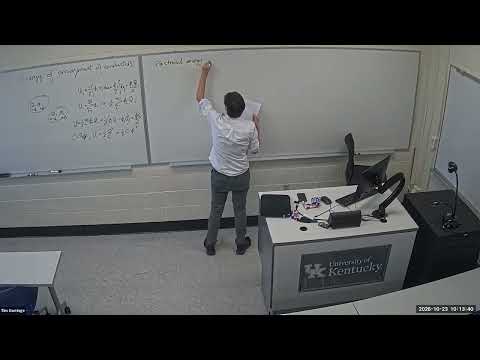 Watch on YouTube →
Overview
The lecture develops electrical energy and force formulas for capacitors, beginning with the energy of charged conductors and deriving the equivalent capacitor expressions U = 1/2 QV, U = Q²/(2C), and U = 1/2 CV². It applies these results to parallel-plate capacitors, uses energy changes to calculate attractive forces, generalizes the method to spherical and cylindrical capacitors, and identifies electrostatic pressure as the electric-field energy density, ε₀E²/2.
Key takeaways
- A capacitor with charge magnitude Q and potential difference V stores U = 1/2 QV; equivalent forms are Q²/(2C) and 1/2 CV².
- For a parallel-plate capacitor at fixed charge, U = Q²d/(2ε₀A), so increasing plate separation raises stored energy while increasing plate area lowers it.
- The ideal parallel-plate attraction has magnitude Q²/(2ε₀A) and is independent of plate separation when Q and A are fixed.
- For a capacitor whose capacitance varies with gap x, the fixed-charge energy method gives Fₑ = Q²/(2C²)·dC/dx, with direction determined by the chosen coordinate.
- Electrostatic pressure on a conducting surface is p = ε₀E²/2, equal to the electric-field energy density immediately outside the conductor.
- Spherical and cylindrical capacitor shells can have zero net vector force while still experiencing local electrostatic pressure that compresses the outer conductor and expands the inner one.
Chapters
- The lecture shifts from general electrical potential energy to energy stored in capacitors and forces between their conductors.
- The examples include parallel-plate, spherical-shell, and cylindrical capacitors, culminating in the concept of electrostatic pressure.
- For conductor i, constant potential across its surface lets the surface integral of potential times charge density reduce to 1/2 φᵢQᵢ.
- Summing over N conductors gives the total energy U = 1/2 Σᵢ φᵢQᵢ, with the factor of 1/2 accounting for double counting.
- For two capacitor conductors carrying +Q and −Q, choosing the negative conductor as zero potential makes the energy U = 1/2 QV.
- Using C = Q/V gives three equivalent forms: U = 1/2 QV, U = Q²/(2C), and U = 1/2 CV².
- Use the charge-based expression for an isolated capacitor with fixed Q, and the voltage-based expression when a battery holds V constant.
- For plate area A, separation d, and surface charge density ±σ, the approximately uniform field between large, closely spaced plates is E = σ/ε₀.
- The potential difference is V = Ed = σd/ε₀, while the capacitance is C = ε₀A/d and the plate charge is Q = σA.
- Substituting V = Qd/(ε₀A) into U = 1/2 QV gives U = Q²d/(2ε₀A).
- At fixed charge, stored energy grows with plate separation d and decreases with plate area A.
- The Q² dependence reflects the interaction energy of the equal and opposite charges on the two plates.
- Integrating the field energy density ε₀E²/2 over the interplate volume Ad reproduces U = Q²d/(2ε₀A).
- Substituting C = ε₀A/d into U = Q²/(2C) yields the same parallel-plate result.
- The three approaches use potential, field energy, and capacitance respectively, and agree for the same capacitor geometry.
- A direct force calculation uses the charge distribution and the relation between force, charge, and electric field.
- For conductors, the energy method can be convenient when potentials or capacitance are known: calculate force from the change in electrical energy with displacement.
- The energy approach replaces a vector-force calculation with a scalar energy derivative.
- Let x denote the plate gap and hold Q fixed while imagining a slow displacement dx against the plates' attraction.
- From U = Q²x/(2ε₀A), the force magnitude is Q²/(2ε₀A), directed to reduce the separation.
- For the ideal parallel-plate geometry, this force is independent of x because the field between the plates does not weaken as the gap changes.
- For fixed charge and capacitance C(x), U = Q²/[2C(x)] gives the generalized force Fₑ = −dU/dx = Q²/(2C²)·dC/dx.
- The same energy-derivative method applies to parallel-plate, spherical-shell, and cylindrical capacitors by inserting each geometry's C(x).
- In spherical and cylindrical arrangements, the net vector force on a complete shell can be zero even though local forces create compression of the outer conductor and expansion of the inner conductor.
- Dividing the parallel-plate force Q²/(2ε₀A) by area gives pressure p = σ²/(2ε₀).
- Using E = σ/ε₀ rewrites the pressure as p = ε₀E²/2, equal to the electric-field energy density just outside the conductor.
- This pressure acts attractively across capacitor gaps: it pulls parallel plates together, compresses an outer spherical or cylindrical shell, and pushes outward on an inner conductor.
Transcript excerpt
0:01 Last couple of classes we've been looking at electrical potential energy. We looked at electrical potential energy for arrangements of point charges. We looked at electrical potential energy for arrangements of continuous charge distributions. We looked at electrical potential energy calculated from the electrical potential and from the electrical field. In today's class, I wanted to talk more specifically about capacitors and the electrical energy and the electrical forces associated with capacitors. So, this is the electrical energy that's stored by the capacitor in the electrical field
0:50 between the plates of the capacitor. This is the electrical force between the attracting plates of a capacitor. So, those will be the topics. Um I'm going to start a little bit generally with some equations for arrangements of conductors. Uh capacitors are arrangements of conductors. So, I'll then rewrite that as arrangements of uh capacitors. And then we'll get on to looking at specific capacitors, their energies, their forces like the parallel plate capacitor, like spherical, cylindrical capacitors, and and so on. We'll introduce a a new idea, um a new concept, one of electrostatic pressure.
1:38 Uh that comes up in the context of thinking about the forces on the plates of a capacitor. >> Okay, let's start with just a
2:26 few uh remarks on the energy of an arrangement of conductors. I'm doing this because a capacitor is a an arrangement of conductors. Uh think back to when we imagined some sort of arrangement of conductors. Here I'm just picturing two of them. And these conductors may have charges, that charge is on them. Q1 Q2. Uh we'll imagine there will be more of these. Uh they will be at some potential. Um phi 1, phi 2, due to the interaction between the charges.
3:12 Uh and we can write down the energy
This is the start of the transcript. Save this video free for the whole transcript, searchable and time-coded.
Related notes
Summary, takeaways, and chapters were generated by AI from the video's transcript and may contain errors. The video belongs to its creator, tim gorringe.