Electromagnetic fields, lecture 10 - Coulomb law & superposition in spherical / cylindrical coords
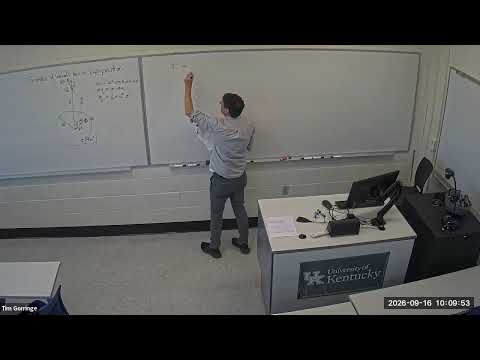 Watch on YouTube →
Overview
Tim Gorringe combines Coulomb’s law with superposition to derive the force on a point charge from a uniformly charged spherical shell and a finite straight filament, using spherical and cylindrical coordinates. The shell produces zero force inside and acts like a point charge outside, while an infinitely long filament produces a force proportional to 1/a; together with the earlier charged-sheet result, these examples show how force varies with the dimensions into which the field spreads.
Key takeaways
- A uniformly charged thin spherical shell produces zero net force on a point charge inside it because contributions from all surface elements cancel.
- Outside a uniformly charged spherical shell, the force is identical to that of a point charge equal to the shell’s total charge, 4πa²σ, located at its center.
- For a finite filament of length L, linear density λ, and perpendicular separation a, the radial force magnitude is QλL/[4πε₀a√(a² + (L/2)²)].
- An infinitely long filament gives a force proportional to 1/a, while an infinite sheet gives a distance-independent force and a spherical source gives a 1/r² force.
- Symmetry simplifies continuous-charge calculations: components perpendicular to the symmetry axis cancel, and only the aligned components need to be integrated.
Chapters
- The lecture combines Coulomb’s law with superposition to calculate forces from continuous charge distributions.
- A spherical shell, straight filament, and previously studied charged sheet serve as building blocks for solid spheres, slabs, and capacitors.
- Spherical and cylindrical coordinates match the geometry of the two new examples.
- The shell has radius a and uniform surface charge density σ; the point charge Q lies on the symmetry axis at distance z from the center.
- The point charge may be inside or outside the shell, corresponding to z < a or z > a.
- The calculation divides the shell into surface elements and sums each element’s Coulomb force on Q.
- A spherical surface element is dA = a² sinθ dθ dφ, formed by small angular steps in θ and φ.
- Each element carries charge dq = σ dA, and the complete shell carries Q_shell = 4πa²σ.
- The separation R and force angle δ vary with the surface element’s position.
- Transverse force components cancel in opposite pairs around the shell, while axial components add.
- The total force is found by integrating the axial component of each element’s Coulomb force over θ and φ.
- The integrand has no φ dependence, so the azimuthal integral contributes a factor of 2π.
- The remaining integral depends on θ through the element-to-charge distance R and the axial projection factor cosδ.
- The cosine rule gives R² = a² + z² − 2az cosθ.
- Expressing both R and cosδ in terms of θ makes the integral use one explicit variable.
- The integral contains sinθ dθ and a denominator involving cosθ, motivating the substitution u = cosθ.
- A second substitution replaces the resulting quadratic expression in u with a new variable, reducing the integral to powers of that variable.
- The integration limits transform from θ = 0 and π to squared distances (z − a)² and (z + a)².
- For z < a, the evaluated terms cancel, giving zero net force inside a uniformly charged thin shell.
- For z > a, the result reduces to the Coulomb force of a point charge Q_shell = 4πa²σ at the shell’s center.
- The result echoes Isaac Newton’s shell theorem for gravitation and its relevance to the Cavendish experiment.
- A finite straight filament of length L has linear charge density λ and lies along the z-axis.
- A point charge Q sits a perpendicular distance a from the filament; an element at coordinate z carries dq = λ dz.
- The separation vector has perpendicular components a and −z, so R² = a² + z².
- Opposite filament elements have transverse force components that cancel, while their radial components add.
- Integrating the radial Coulomb-force component over z from −L/2 to +L/2 gives F = QλL/[4πε₀a√(a² + (L/2)²)].
- The finite-length result depends on both the point’s distance a and the filament length L.
- Taking L to infinity in the finite-filament expression gives F = Qλ/(2πε₀a), an inverse-distance dependence.
- The shell’s external force falls as 1/r², the infinite filament’s force as 1/r, and the infinite sheet’s force is constant with distance.
- Gorringe previews electric flux as a framework for understanding how these distance laws relate to the dimensions over which a field spreads.
Transcript excerpt
0:06 I'll get started. Last Friday we introduced Kulum's law and on Monday we introduced superposition principle. Today's class is about putting those two things together, Kulum's law and superposition principle and solving problems of electrical forces with continuous distributions of charge. uh the continuous distributions of charge we'll explore today is one will be a spherical shell of charge which is an important problem and its interaction with a a point charge and the second one will be a long straight filament charge which is another important problem and its
0:55 interaction with with a neighboring point charge. uh by working through those two problems, we'll be working with the cylindrical coordinate systems that we learn about a week or two ago, the spherical coordinate systems that we learned about a week or two ago. So, it's an example of working with spherical and cylindrical coordinates. uh the problems that we'll meet today. So the spherical shell and the long streak filament together with the problem we met on Monday which was the sheet of charge. Those really represent a library, a basic library of building blocks out of which you can
1:43 construct um solutions to more sophisticated problems like uh solid spheres of charge or solid slabs of charge uh or parallel plate capacitors or cylindrical capacitors. So they're they're not just exercises in their own right to calculate the force between a point charge and a shell of charge or a force between a point charge and a long filament of charge. They are really a building blocks a library for more expansive more sophisticated problems. Okay, I'm going to start with the interaction between a uniform shell thin shell of charge and a single point charge. And that point
2:35 charge could be outside the uh spherical shell of charge or it could be inside
This is the start of the transcript. Save this video free for the whole transcript, searchable and time-coded.
Related notes
Summary, takeaways, and chapters were generated by AI from the video's transcript and may contain errors. The video belongs to its creator, tim gorringe.