Electromagnetic fields, lecture 9 - superposition & force between point charge and charged sheet
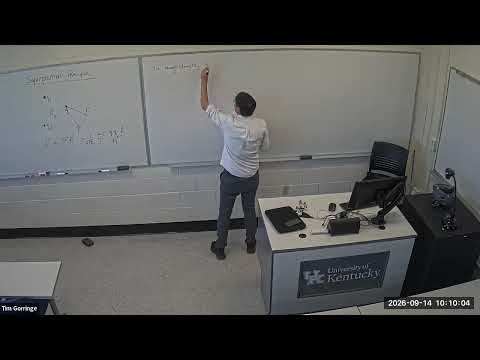 Watch on YouTube →
Overview
The lecture formalizes electrostatic superposition, extending Coulomb’s inverse-square law from point charges to continuous line, surface, and volume charge distributions using integrals. It applies the method to a point charge on the axis of a uniformly charged disk, deriving the axial force and showing that the far-field limit reproduces Coulomb’s law while the near-sheet force becomes independent of distance.
Key takeaways
- Electrostatic superposition calculates the total force by adding Coulomb-force vectors, or integrating their contributions for continuous charge distributions.
- The standard continuous-charge elements are dq = λ dl for a line, dq = σ dA for a surface, and dq = ρ dV for a volume.
- For a uniformly charged disk, rotational symmetry cancels transverse force components, so only the axial components need to be integrated.
- A disk of radius R and surface density σ produces an axial force Fz = Qσ/(2ε₀) [1 − z/√(z² + R²)] for a point charge above it.
- At distances much larger than the disk radius, the disk behaves like a point charge q = πR²σ and the force reduces to Coulomb’s inverse-square law.
- Close to a large charged sheet, the force approaches |Q|σ/(2ε₀), independent of the point charge’s distance from the sheet.
Chapters
- The lecture recaps Coulomb’s law as an inverse-square, central force between point charges.
- The law alone describes interactions between pairs of point charges, so superposition is needed to handle multiple charges and continuous distributions.
- The worked application is the electrostatic force between a point charge and a charged sheet.
- For a test charge Q, the total force from surrounding charges Q₁, Q₂, and others is the vector sum of their individual forces.
- The direction of each contribution matters: the lecture illustrates repulsion from a like charge and attraction to an unlike charge.
- The vector-sum rule extends from two point charges to any number of charges and to continuous charge distributions.
- For point charges, Coulomb’s law supplies each force contribution, which is summed over the surrounding charges.
- A line distribution uses linear charge density λ, with a small charge element dq = λ dl.
- A surface distribution uses surface charge density σ and dq = σ dA; a volume distribution uses volume density ρ and dq = ρ dV.
- For each continuous distribution, integration adds the Coulomb-force contributions from all charge elements.
- Gravity and electrostatic forces obey superposition, as illustrated by the forces of the Sun and Earth acting on the Moon.
- The lecture relates electromagnetic superposition to the photon’s lack of electric charge and its absence of self-interaction.
- It contrasts gluons, which interact with one another, to explain why nuclear forces do not combine by the same simple superposition rule.
- The source is a uniformly charged circular disk of radius R and surface charge density σ, giving total charge q = πR²σ.
- A point charge Q lies on the disk’s central axis at distance z from its center.
- The calculation finds the force of the disk on Q; Newton’s third law gives an equal and opposite force on the disk.
- Cylindrical coordinates suit the disk’s rotational symmetry.
- A disk element at cylindrical coordinates (ρ, φ) has area dA = ρ dρ dφ and charge dq = σρ dρ dφ.
- The element-to-charge distance is r = √(ρ² + z²), and the axial projection of its force contributes a factor z/r.
- Rotational symmetry cancels all horizontal force components in opposite directions, leaving only the force along the disk’s axis.
- Integrating over φ from 0 to 2π and ρ from 0 to R accounts for the entire disk.
- The azimuthal integral contributes a factor of 2π, reducing the disk to a sum of thin charged rings.
- Each ring’s axial force decreases at large radius because its Coulomb distance grows and its force points increasingly sideways.
- Although larger rings contain more charge, their net axial contribution tends to zero as their radius becomes very large.
- The strongest contributions come from charge nearer the point charge and more directly aligned with the axis.
- The remaining radial integral contains ρ dρ divided by (ρ² + z²) to the 3/2 power.
- The substitution u = ρ² + z² gives du = 2ρ dρ and changes the limits from z² to z² + R².
- The resulting axial force for a point charge above the disk is Fz = Qσ/(2ε₀) [1 − z/√(z² + R²)].
- The expression combines the point charge Q, surface density σ, disk radius R, and axial separation z.
- Writing the signed result with z/|z| handles a point charge on either side of the disk and reverses the axial force direction across it.
- When |z| is much greater than R, the disk appears point-like, with total charge q = πR²σ.
- In that far-field limit, the force approaches Coulomb’s law, F ≈ Qq/(4πε₀z²), along the axis.
- When z is much smaller than R, the finite-disk result approaches a force magnitude |Q|σ/(2ε₀) for a point charge above the disk.
- The near-sheet force is independent of the separation z and depends on the surface charge density rather than the disk’s total charge.
- This constant-force limit is presented as a distinctive consequence of the inverse-square law for a large charged sheet.
Transcript excerpt
0:02 I'll get started. Last class we talked about Kulum's law for electrostatics. Specifically we discussed electrical charge. It's a component of Kulum's law. Uh it's a force between electrical charges. We discussed the 1 / R square dependence of Kulum's law and some significance of that. We discussed the central force behavior of Kulum's law and some significance of that and we also talked about Kulum's experimental work with a torsion balance's experimental work with a um hollow conducting shell and uh inner conducting globe. And those were really the
0:51 foundations of this first quantitative law in electromagnetism. Kulum's law of electrostatics. Today's class I want to move on to the principle of superposition. We actually used the principle of superposition at the end of the last class. But today I want to kind of introduce it more formally and we're going to apply it to a problem of the uh electrostatic interaction or electrostatic force between a point charge and a sheet of charge. So puls was a a groundbreaking law in establishing quantitatively the electrostatic interaction between uh
1:40 two twoo point charges but kulum's law on its own is limited to the case of twopoint charges. we need to extend it for it to be more useful to to other problems uh that are beyond just two interaction charges. And the superposition principle allows us to extend it. And the superp position principle is basically about the the um the sum of forces on a test charge due to other surrounding charges multiple other surrounding charges. So I think I'm just going to um uh make a little sketch and write down the superposition principle and then we'll go on from
2:27 there and look at illustrations and examples of the superposition principle. So let's imagine that we have some
This is the start of the transcript. Save this video free for the whole transcript, searchable and time-coded.
Related notes
Summary, takeaways, and chapters were generated by AI from the video's transcript and may contain errors. The video belongs to its creator, tim gorringe.