Electromagnetic fields, Lecture 8 - Coulomb law and Coulomb, Cavendish experiments
 Watch on YouTube →
Overview
Tim Gorringe develops Coulomb’s law as a central, inverse-square force between electric charges, explaining how charge signs determine attraction or repulsion and how charge is conserved and quantized. He describes Charles-Augustin de Coulomb’s torsion-balance measurements and Henry Cavendish’s concentric-sphere experiment, whose null result supports the inverse-square law through cancellation of forces from equal-solid-angle surface patches.
Key takeaways
- Coulomb’s force between point charges is proportional to QQ′ and inversely proportional to r², with direction along the line joining the charges.
- The sign of QQ′ determines whether the force is repulsive or attractive: like charges repel and opposite charges attract.
- A torsion balance converts the tiny electrostatic force between charged spheres into measurable fiber rotation, allowing Coulomb to test both separation and charge dependence.
- Electric charge is conserved and quantized in units of approximately 1.6 × 10⁻¹⁹ C, with electrons negative and protons positive.
- Cavendish tested the inverse-square law by charging a conducting shell around a connected inner globe and checking for charge on the globe; the observed null result supported the law.
- For a 1/r² force, equal-solid-angle patches on a uniformly charged shell exert equal and opposite forces on an interior test charge, explaining why their contributions cancel.
Chapters
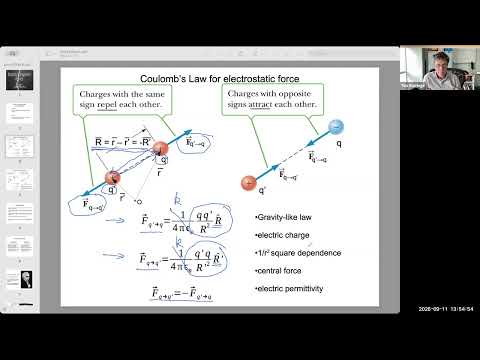
- The lecture introduces electrostatics after differential and integral vector calculus, focusing on Coulomb’s force between two charges.
- For charges Q and Q′, the position vectors are r and r′, and the separation vector R = r − r′ points from Q′ to Q.
- The reverse separation vector R′ points from Q to Q′ and is equal in magnitude but opposite in direction to R.
- The force between charges is proportional to QQ′ and inversely proportional to the square of their separation.
- The constant 1/(4πε₀) expresses the force scale in terms of the permittivity of free space; the same constant can be written as Coulomb’s constant k.
- The unit separation vector sets the force direction, and the forces Q′ exerts on Q and Q exerts on Q′ are equal and opposite.
- Like charges have QQ′ > 0 and repel, while unlike charges have QQ′ < 0 and attract.
- The force is central because its direction lies along the single separation vector between the charges.
- Like Newtonian gravity, Coulomb’s law has inverse-square dependence, but electrostatic force can repel as well as attract.
- The lecture contrasts electrostatics with magnetism, where moving charges and currents introduce additional direction vectors and forces need not be central.
- A 1/r² dependence characterizes sources spreading an influence through three-dimensional space, such as electric fields from charge.
- The light-bulb analogy illustrates the same geometric falloff: light intensity decreases with the square of distance from the source.
- Gravity and electrostatics are both central-force laws, but gravity is only attractive while electrostatics allows both attraction and repulsion.
- Charge is presented as an intrinsic property of matter that gives rise to electromagnetic interactions, analogous to mass as a source of gravity.
- Electromagnetic interactions involving charge help account for atoms, molecules, cells, and the structure of everyday materials.
- Defining charge only as the source of electromagnetic force is circular, so the lecture also describes charge through its measurable properties and deeper origins.
- Electric charge has positive and negative forms, unlike ordinary mass, which is positive; this difference enables the rich structures of atoms and materials.
- Net charge is conserved in a closed system: charge cannot be created or destroyed, although positive and negative charges can coexist.
- Charge is quantized: each electron carries −1.6 × 10⁻¹⁹ C and each proton carries +1.6 × 10⁻¹⁹ C.
- Gorringe points to U(1) symmetry as a deeper quantum-field-theory account of electric charge and contrasts it with the distinct color charges of the nuclear force.
- Charles-Augustin de Coulomb used a torsion balance: a charged sphere on a horizontal rod twists a thin suspended fiber when acted on by another charged sphere.
- The amount of fiber twist and rod rotation provides a measure of the electrostatic force.
- Coulomb varied sphere separation to measure distance dependence and varied charge amounts to measure charge dependence.
- His measurements had to contend with weak forces, difficult charge preparation, and charge leaking through the atmosphere.
- Coulomb could divide charge using conducting spheres: touching a charged sphere to an identical neutral sphere shares the charge equally.
- Repeating the process produces half-charge, quarter-charge, and smaller amounts for force measurements at fixed separation.
- Varying distance with fixed charges isolates the inverse-square behavior, while varying charge at fixed distance tests proportionality to the product QQ′.
- Henry Cavendish investigated the electrostatic 1/r² law before Coulomb’s published work, but did not publish his experiment; Joseph Priestley also argued for inverse-square behavior.
- Cavendish’s apparatus used an inner conducting globe and an outer conducting shell assembled from two hemispheres.
- For an inverse-square force, charge added to the connected outer shell should not appear on the inner globe, providing a test of the law.
- Cavendish connected the initially neutral inner sphere and outer shell as one conductor, charged the shell, then disconnected the two conductors.
- He opened the hemispherical shell and checked whether charge had accumulated on the inner globe.
- A nonzero charge on the inner globe would contradict the inverse-square prediction; Cavendish observed no charge, a null result supporting the 1/r² law.
- For a uniformly charged shell with surface density σ, two surface patches subtending the same solid angle contain charge proportional to their respective distances squared from a test charge.
- Coulomb’s 1/r² factor cancels that distance-squared difference, so the two patches exert equal and opposite forces on the test charge.
- Pairing opposite equal-solid-angle patches across the shell makes their forces cancel; another force exponent would not produce the same cancellation.
- The explanation uses Coulomb’s law and superposition, leading into the next lecture’s treatment of superposition for systems of multiple charges.
Transcript excerpt
0:05 In the last classes, we've been covering differential vector calculus and integral vector calculus. These are the tools. These are the mathematics that we need to discuss quantitatively electromagnetic fields and the sources and the interactions of electromagnetic fields. In this class, we're going to move on from differential vector calculus, integral vector calculus to discuss electrostatics and in particular in this class discuss Kulum's law for the electrostatic force. Um, you've met Kulum's law for the electrostatic force before in general physics. I'm going to be covering Kulum's law for the electrostatic force again. Um, so some of this is a review.
0:56 A lot of this is a review, but I'll probably say a bit more a bit more about how Kulum obtained his law Kulum's law for the electrostatic force and a bit more about the quantities involved in Kulum's law for the electrostatic force. So a bit more about electrical charge, a bit more about the inverse square law, a bit more about the central force uh nature of the electrostatic force that's described by Kulum's law. Anyway, that's the plan for today. This the beginning of our work on
1:43 the electrostatic force and this will continue over the remaining classes of the semester. So on this slide I have depicted Kulum's law. It's a law for the electrostatic force between a pair of charges. I've pictured it on the left hand side for two like charges say two positive charges or two negative charges because in that left hand picture the force is repulsive. uh pictured it on the right hand side between two unlike charges a positive and negative or negative and a positive because the force on the right hand side is attractive. The ingredients in Kulum's law begin
2:36 with uh a series of vectors
This is the start of the transcript. Save this video free for the whole transcript, searchable and time-coded.
Related notes
Summary, takeaways, and chapters were generated by AI from the video's transcript and may contain errors. The video belongs to its creator, tim gorringe.