EM field, lecture 12 - examples of superposition of fields, far-field dipole, solid charged sphere
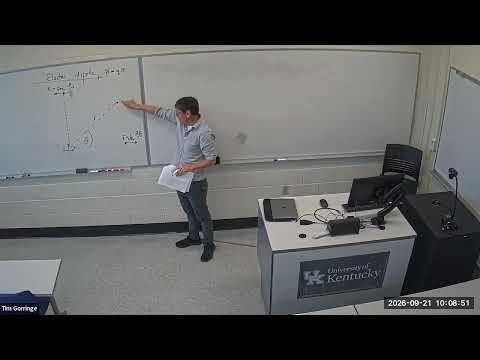 Watch on YouTube →
Overview
The lecture develops two applications of electric-field superposition: the far-field electric dipole and a uniformly charged solid sphere. It derives the dipole’s spherical-coordinate components by decomposing its moment into parallel and perpendicular parts, checks that the field has zero divergence and curl away from charges, then integrates thin spherical shells to obtain the sphere’s inside and outside fields.
Key takeaways
- A far-field electric dipole has Eᵣ = [1/(4πϵ₀)](2p cos θ/r³) and Eθ = [1/(4πϵ₀)](p sin θ/r³), with no azimuthal component.
- The arbitrary-angle dipole result follows by resolving p into p cos θ along the observation direction and p sin θ perpendicular to it, then applying the known axial and bisector fields.
- The dipole field has zero divergence and zero curl in charge-free far-field space, consistent with electrostatics and the absence of local charge there.
- A uniformly charged sphere produces E = Q/(4πϵ₀z²) outside, so its external field is identical to that of a point charge equal to its total charge.
- Inside a uniformly charged sphere, E = ρz/(3ϵ₀), so the field increases linearly with distance from the center and reaches its maximum at the surface.
- The solid-sphere field profile mirrors the stated gravitational-field pattern for a uniform Earth: linear growth inside and inverse-square decay outside.
Chapters
- The lecture applies electric-field superposition to point charges and extended charge distributions.
- The dipole moment vector p points from the negative charge to the positive charge.
- The far-field approximation requires observation distance r to be much larger than the charge separation.
- On the dipole axis, the far-field magnitude is 1/(4πϵ₀) times 2p/r³ and points along the axis.
- On the perpendicular bisector, the field magnitude is 1/(4πϵ₀) times p/r³ and points opposite the dipole moment.
- These two special-direction results provide the basis for finding the field at any angle.
- The general field point is described by spherical coordinates r and θ, with θ measured from the dipole axis.
- The axis result gives the radial component at θ = 0, while the bisector result gives the angular component at θ = 90°.
- Axial symmetry means the dipole has no azimuthal component, Eφ = 0.
- The original dipole moment is resolved into p∥ = p cos θ and p⊥ = p sin θ relative to the line from the dipole center to the field point.
- The parallel component produces an axial field, while the perpendicular component produces a bisector field.
- The decomposition preserves the original charge arrangement because the coincident positive and negative charges at the components’ junction cancel.
- The radial field is Eᵣ = [1/(4πϵ₀)](2p cos θ/r³).
- The angular field is Eθ = [1/(4πϵ₀)](p sin θ/r³), and Eφ remains zero.
- At θ = 0°, the field is purely radial; at θ = 90°, it is purely in the θ direction; intermediate angles have both components.
- Substituting Eᵣ and Eθ into the spherical-coordinate divergence formula gives cancelling radial and angular contributions.
- The dipole field has zero divergence in the far-field region, where there are no charges.
- The electrostatic field’s curl is also zero away from the point charges.
- A sphere of radius A and uniform volume charge density ρ is modeled as concentric shells of radius r and thickness dr.
- Each shell has volume 4πr²dr and charge dq = 4πρr²dr.
- A shell contributes zero field at points inside it and the field of a point charge dq at points outside it.
- For an observation distance z greater than A, every shell contributes, so the integration runs from r = 0 to r = A.
- The resulting outside field is E = Q/(4πϵ₀z²), where Q = (4/3)πA³ρ is the sphere’s total charge.
- The outside field therefore has the same inverse-square form as the field of a point charge Q at the sphere’s center.
- For z < A, shells with radius greater than z contribute no field, so the integral only runs from r = 0 to r = z.
- The interior field is E = ρz/(3ϵ₀), growing linearly from zero at the center to its maximum at the surface.
- At z = A, the surface field is ρA/(3ϵ₀); the linear-inside and inverse-square-outside pattern parallels the gravitational-field behavior described for a uniform Earth.
Transcript excerpt
0:06 Okay, let's get started. Last class we introduced the concept of the electrical field as mediating the electrical force. We started working on an example of the electrical field of a charge arrangement electric dipole. Today's class I want to continue working on the electrical field of charge arrangements. We're going to talk both about the electrical dipole made of two point charges in in the far field region and we're also going to talk about uh an electrical dipole made of two spheres of opposite charge solid spheres of opposite charge in the near field region. In both those cases, we'll discover kind of simple [snorts]
0:56 um simple expressions for the far field electric dipole field of our pair of point charges and maybe surprisingly also a region of the near field uh field of uh electric dipole made of spheres of charge, solid spheres of charge. And so we'll we'll explore those results a little bit. Uh in general, what we're doing is working with examples of superimposing electrical fields and and exploring the different ways that you can superimpose electrical fields. You can superimpose electrical fields of point charges. Uh but you can also superimpose electrical fields of charge distributions. So for example, if we
1:43 knew the electrical field of a sphere of charge, we could superimpose that with the electrical another electrical field from another sphere of charge. open. I'm going to sketch on the whiteboard a summary of where we ended up at the end of the last class where we first were looking at the electric dipole uh constructed from two twoo two point charges and we had computed or figured out uh we figured out the field along the axis of the dipole that's the the line that passes through the two charges
This is the start of the transcript. Save this video free for the whole transcript, searchable and time-coded.
Related notes
Summary, takeaways, and chapters were generated by AI from the video's transcript and may contain errors. The video belongs to its creator, tim gorringe.