ECO 100 - 17 - F2026
Overview
Matthew Baker explains Ronald Coase’s argument that externality problems can often be addressed by clearly defining tradable property rights, allowing affected parties to bargain toward the least-cost outcome. Using a rancher-and-farmer example, sulfur dioxide allowance trading, and fishery catch shares, he shows how markets can coordinate pollution reduction and resource use while reducing the information policymakers need; he also considers how laws and institutions shape whether markets work well.
Key takeaways
- In the rancher-farmer example, crop damages are $100, a rancher’s corral costs $80, and a farmer’s fence costs $60, so the farmer’s fence is the least-cost way to prevent the damage.
- Coasean bargaining can lead to the same efficient mitigation under either initial rights allocation when rights are tradable and parties can bargain, though the allocation changes who receives payment.
- Tradable sulfur dioxide permits can direct pollution reduction toward firms with the lowest abatement costs without requiring regulators to know each firm’s costs in advance.
- In the six-firm permit example, firms A, C, and E abate while higher-cost firms B, D, and F hold permits and pollute, achieving a 50 percent reduction at minimum abatement cost.
- Catch shares replace a race to harvest a fishery’s total allowable catch with tradable individual shares, reducing incentives to fish in dangerous weather.
- Baker’s broader institutional argument is to examine how laws and property-rights rules shape incentives, including in examples such as low-cost lodging, short-term labor, and access to vacant lots.
Chapters
- Matthew Baker reports that the class average on the latest exam rose by about five points.
- Students can inspect exam grading and submit regrade requests through Gradescope.
- The final exam is not cumulative and will cover macroeconomics, beginning with the next class.
- A factory that pollutes air or water imposes external damages on people outside its market transaction.
- A Pigouvian tax, named for economist Arthur Pigou, can make producers face the cost of those damages.
- The Clean Air Act and Clean Water Act era also relied on command-and-control rules, including required technologies.
- Setting policy requires difficult information about pollution damages and firms’ costs of installing technology or changing operations.
- In Sturges v. Bridgman, noise from a confectioner’s machinery interfered with a neighboring doctor’s practice, raising questions about which activity should bear the cost.
- The doctrine of coming to the nuisance matters when a doctor moves next to a confectioner who has operated there for decades.
- In Boomer v. Atlantic Cement, residents sued over dust and noise from a large cement plant, illustrating the trade-off between local harms and a major business’s output and jobs.
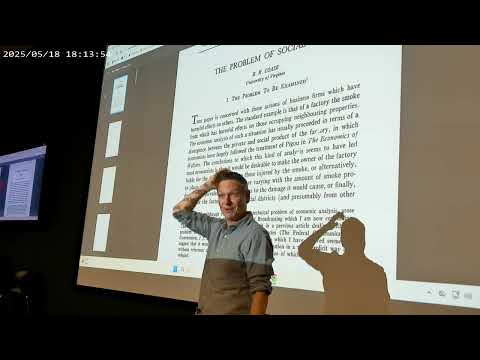
- In The Problem of Social Cost, Ronald Coase challenges the usual prescription to tax or restrain the party causing an externality.
- Coase frames the choice as reciprocal: preventing harm to one party can impose harm on another.
- The social decision should avoid the more serious harm, such as weighing fish losses against the value of production made possible by using a stream.
- The example assigns $100 in crop damages, an $80 cost for the rancher to build a corral, and a $60 cost for the farmer to build a fence.
- Because either prevention option costs less than the $100 damage, society benefits from stopping the damage.
- The farmer’s $60 fence is the least-cost solution, saving $40 compared with leaving the damage unaddressed.
- A court injunction could make the rancher build the $80 corral, while a different ruling could leave the farmer to build the cheaper fence.
- Coase’s proposed framework defines whether the rancher may let cattle roam or the farmer has a right to crops free from damage.
- If the farmer has the right, the rancher can offer $70 for permission to let the cattle roam; the farmer can then build a $60 fence and keep $10.
- If the rancher has the right, the farmer can compare bargaining with the rancher against building the $60 fence directly.
- With tradable rights and bargaining, the parties can reach the least-cost mitigation regardless of who initially receives the right, under the example’s assumptions.
- For Sturges v. Bridgman, the parties could bargain over a right to quiet or a right to make noise, potentially shifting the confectioner’s operating hours.
- For Boomer v. Atlantic Cement, residents and the cement company could bargain over dust-free air, operating schedules, or anti-dust technology.
- The initial rights allocation affects who pays whom, even if bargaining leads to the same efficient activity under the simplified Coasean setup.
- Matthew Baker connects Coase’s argument to research by Elinor Ostrom on complex property rights and negotiated resource management.
- Baker describes research with Jonathan Conning on open-access areas, frontier regions, and customary landholding.
- In the My Little Pony episode “Over a Barrel,” ponies’ apple planting conflicts with buffalo grazing, and an agreement involving trees and apple pies resembles a negotiated property-rights settlement.
- Firms compare the cost of avoiding a penalty with the cost of continuing an activity and paying the fine.
- New York City charged UPS about $23 million in parking fines in 2019; adding a second worker to each truck could cost more than paying tickets.
- For pollution control, Baker argues that firms able to abate emissions cheaply should reduce pollution, while higher-cost firms may continue operating.
- Sulfur dioxide emissions contributed to acid rain, and power plants differed in how costly it was for them to reduce emissions.
- Newer plants could use low-sulfur coal or newer technology, while older plants built near high-sulfur coal supplies faced greater retrofit costs.
- A hypothetical set of six firms has different abatement costs, including $1 million for firm A, $5 million for B, and $7 million for F.
- A pollution price gives each firm an incentive to abate when its own abatement cost is below the price, revealing a supply of pollution control.
- To halve pollution from six firms, the example issues three permits, each granting a right to pollute.
- Permits are initially allocated to firms A, C, and F, but firms can trade them rather than policymakers assigning them to the final users.
- At an illustrative price of $4.5 million, high-abatement-cost firms B and D buy permits from lower-cost abaters A and C.
- After trading, B, D, and F pollute, while A, C, and E abate, producing the target reduction at the lowest total abatement cost in the example.
- Marketable pollution permits have been used in programs addressing lead in gasoline and sulfur dioxide linked to acid rain.
- An environmental organization can buy a pollution permit and retire it to reduce the number of permits available for emissions.
- Matthew Baker notes that permit rules can restrict such purchases and that policies can produce manipulation as well as unanticipated beneficial participation.
- A similar example involves environmentalists buying trapping licenses and leaving them unused, effectively valuing non-use.
- Under a seasonal catch limit, crab fishers race to harvest before the total allowable catch is reached, sometimes working in dangerous Bering Sea weather.
- Catch shares assign fishers a fraction of the allowable harvest, which they can take during the season or sell to another fisher.
- Tradable shares can reduce the incentive to fish in storms and allow harvesting rights to move to more efficient operators.
- Baker notes that catch-share systems can also help protect smaller fishers and Native American fishing rights.
- Baker considers whether clearer rights could improve disputes over renters, eviction, vacant lots, and community gardens, while presenting these as questions rather than settled prescriptions.
- He argues that institutional rules can shape people’s incentives, so policy analysis should examine how the “game” is designed rather than blame individual choices alone.
- Examples include restrictions on short-term work, the loss of low-cost Bowery flop houses after for-profit lodging rules changed, and the tax-stamp requirement for selling loose cigarettes.
- Baker closes by arguing that markets may be poorly designed or constrained rather than inherently incapable of addressing social needs, then previews a shift to macroeconomics and economic growth.
Transcript excerpt
0:00 Okay, I guess I'll get started here with lecture 17 uh which is I guess a little bit expansive on what we were talking about uh right before the exam. More on that in a second. Uh and maybe is my last uh I guess my last chance to say something about uh the economics or markets in general. So I'm going to say a little bit about all that stuff uh and then we'll start doing something different uh next class. So anyways, so I just this very morning about 20 minutes ago released the exam scores. Um and you know once again excellent job uh even better than last time on average. Um the class average was up about five points. I thought some of the questions were difficult and I you know it looked great. Very nicely done. Uh so as before
0:51 uh the same things will happen now as they did after the last exam. Check the grading. I actually just, you know, my phone just binged a couple times. Couple emails already coming in with regrade requests via grade scope. So, you can look at your exam. Please do. I tried to put a complete answer key in there. Uh, so you can check the grading. It might even be that I mclassified your answer. So, check that as well. Uh, and then of course I will do the other stuff. I have the homework to sift through. I have everything. I'm going to try to get all of your grades up onto the system uh once the dust settles with the regrades and all of that stuff. So, oh, and the other thing is if you aren't able to access your exam via Grade Scope, let me know and uh I can help you out with that
This is the start of the transcript. Save this video free for the whole transcript, searchable and time-coded.
In this course
Related notes
Summary, takeaways, and chapters were generated by AI from the video's transcript and may contain errors. The video belongs to its creator, Matthew Baker.