ECO 100 - Lecture 2 - F2026
 Watch on YouTube →
Overview
Matthew Baker introduces the production possibilities frontier (PPF) as a way to model scarcity, efficiency, and opportunity cost, showing how diverse resources make the cost of producing more of one good rise as production expands. Using an island that can produce cattle and wheat, then a Denmark-Iceland example of wheat and wool, he explains comparative advantage and how trade at a 1:1 exchange rate can expand what both countries can consume; the lecture also reviews Top Hat homework and course logistics.
Key takeaways
- A PPF distinguishes feasible, infeasible, and inefficient outcomes: a point inside the frontier, such as 30 wheat and 40 cattle in Baker's example, leaves room to produce more of both goods.
- When resources differ in suitability, opportunity costs rise as production shifts toward one good; the island example moves from sacrificing about 1/6 of a cattle per added wheat to 5 cattle per wheat near all-wheat production.
- Efficiency describes full use of resources, not which output mix society should choose; every point on the frontier can be efficient while representing a different trade-off.
- Comparative advantage depends on relative opportunity cost: Iceland's example costs 2 wool per wheat, while Denmark's costs only 1/4 wool per wheat, making Denmark relatively better at wheat.
- Trade at a rate between countries' opportunity costs can benefit both sides: at one wool per wheat, Iceland gets wheat more cheaply than domestic production and Denmark gets wool more cheaply than domestic production.
- Rising marginal opportunity costs help explain upward-sloping supply: producers need a higher price to make it worthwhile to cover the greater cost of expanding output.
Chapters
- Matthew Baker directs students to the Brightspace syllabus and Top Hat for lecture notes, readings, recordings, and assignments.
- Two early assignments are listed with an October 5 due date, which Baker says is his estimate for the first exam; students can retry them until then.
- Chapter questions also count as homework and can be completed through the end of the semester; Baker says he reviews them when considering students' work.
- Baker lists Tuesday 10:30 to 11:30 and Wednesday 1:00 to 2:30 office hours, and recommends Top Hat support for technical problems.
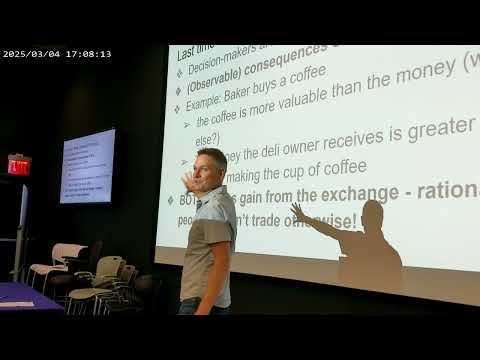
- If Baker buys a $2 coffee, an economist can infer that he values the coffee more than the money he gave up.
- The deli owner must expect to receive more than the cost of producing the coffee, or the owner would not sell it for $2.
- Both buyer and seller gain from a voluntary exchange, although the observed purchase does not reveal the size of either gain.
- Every decision involves a trade-off because limited time and resources prevent people from doing everything they want.
- Opportunity cost includes non-cash costs: walking to get a free coffee still uses time and effort.
- Baker's modeling method is to build a simple example, understand its mechanics, identify general principles, and then add realism.
- He names rent control, minimum wages, and illicit-drug markets as later topics that can be analyzed with this approach.
- The island is a simplified, isolated setting with limited land and two outputs, wheat and cattle.
- Land parcels differ in suitability: flat parcel A is especially good for wheat, while mountainous parcel D is well suited to cattle.
- The example represents a general economic problem: diverse resources can be allocated to produce different goods, but not every combination is possible.
- Baker plots cattle on the vertical axis and wheat on the horizontal axis; devoting the island entirely to cattle yields 100 cattle, while all-wheat production yields zero cattle.
- Moving from 100 cattle and zero wheat to 95 cattle and 30 wheat uses parcel A for wheat, gaining 30 wheat for only 5 cattle.
- Shifting more land to wheat, including parcel B, produces 55 wheat and 80 cattle, showing that later gains in wheat require larger cattle sacrifices.
- The PPF's bowed-out shape reflects the order in which land is reassigned, from the land least suited to cattle toward land with greater cattle value.
- A point inside the PPF, such as 30 wheat and 40 cattle, is inefficient because more of both goods could be produced with the available resources.
- Points on the frontier are efficient in the resource-use sense, but each has a different output mix and involves a trade-off.
- The slope of the PPF measures opportunity cost: in Baker's successive examples, the cattle sacrificed per added wheat rise from about 1/6 to 0.6, then 1.5, and finally 5.
- Increasing opportunity costs arise because resources differ in suitability, so producing more of one good eventually requires moving increasingly useful resources away from the other.
- The same PPF reasoning applies to a factory producing tables and chairs, where workers, wood, and machinery may be better suited to one product than the other.
- A country can use the model to compare capital goods with consumer goods, or healthcare with all other goods.
- A new wheat seed that improves wheat productivity expands wheat possibilities at each cattle output, while a general improvement to the island can expand both outputs.
- Baker connects technology questions, including AI, to whether a productivity change benefits a particular activity or raises productivity more broadly.
- Baker treats a 12-hour Sunday as four three-hour blocks that can be assigned to work or leisure activities.
- His work examples are editing a paper, grading exams, preparing lecture notes, and reviewing theses; leisure examples include football, fishing, movies, and a nap.
- When an extra work task arrives, he first gives up the least-valued leisure activity, then sacrifices increasingly valued activities as work demands rise.
- Baker links rising incremental costs to market supply: producing more of a good generally requires a higher price to cover the higher cost of additional production.
- Baker presents David Ricardo's comparative advantage as the principle that people or countries can gain by specializing according to lower opportunity cost.
- Ricardo's insight challenged mercantilist thinking that treated trade as a zero-sum contest between countries.
- Baker's household example is his physician wife: time spent painting a hallway means not taking a medical case, so she can benefit by paying someone else to paint.
- Comparative advantage is about relative opportunity costs, not simply which party can produce more in absolute terms.
- Baker compares flat Denmark, suited to wheat, with hilly Iceland, suited to wool, and gives each a straight-line PPF for simplicity.
- In the example, Iceland can produce either 10 units of wheat or 20 units of wool; one wheat therefore costs 2 wool, while one wool costs 1/2 wheat.
- Denmark can produce 80 units of wheat or 20 units of wool; one wheat costs 1/4 wool, while one wool costs 4 wheat.
- The different PPF slopes show that Iceland has comparative advantage in wool and Denmark has comparative advantage in wheat.
- At a hypothetical international rate of one wool for one wheat, Iceland can trade wool for wheat at a lower cost than producing wheat itself, which costs 2 wool per wheat.
- Denmark can obtain wool through trade for one wheat per wool instead of giving up 4 wheat to produce wool domestically.
- Specializing and trading can move consumption possibilities beyond each country's own PPF; Baker illustrates Iceland trading 3 wool for 3 wheat and Denmark shipping wheat to obtain wool.
- Trade gains depend on different opportunity costs, so even a country that can produce more of everything may benefit from specializing and exchanging goods.
- The PPF discussion establishes what an economy can produce, but does not decide which efficient output combination it should choose.
- Economies must also determine how goods such as cattle, wheat, and New York City housing are distributed among people.
- Baker contrasts planned decisions with decentralized market choices made by individuals who own different plots of land and have different preferences.
- The next step is to examine how markets interact with production and efficiency, a topic he leaves for the following class.
Transcript excerpt
0:15 It's looking like all systems are go here. So maybe we'll get started at our 1002 start time. Uh today we're going to talk a little bit more about uh some of the things we introduced last time. uh in particular we'll talk about efficiency and what we mean by that when we're when economists talk about efficiency and we'll talk a little bit about economic models the two things at once right um I guess before we dive in I'll well this should actually be chapters three and four um so maybe I'll fix that in a second but let me um just first do a little bookkeeping stuff so I know you have there's a couple people who were here for the first time just because that's you know it's the first week of classes as people come in, uh, they go out, all that stuff. Uh, so if you did, if this is your first class, it's fine. You
1:02 haven't really missed anything. I'm going to show you in a second where you can find everything you need, uh, and remind you, the rest of you, about, uh, where you can find all this stuff. Um, I also brought today some syllabi, right? I put a couple on the chairs in the back uh, of the room, so you can take them as you leave. There's some right here as well. You don't if you don't need a hard copy, that's fine, too. It's online. It's on the Brightpace uh page and if you're just showing up for the first time um almost everything you need to know can be uh unlocked with that with that online syllabus. Um okay so just a a couple of things here. I'm going to get to the bottom of this in a
This is the start of the transcript. Save this video free for the whole transcript, searchable and time-coded.
Related notes
Summary, takeaways, and chapters were generated by AI from the video's transcript and may contain errors. The video belongs to its creator, Matthew Baker.