ECO 100 -16.5 - F2026 - Exam Review
Overview
Matthew Baker reviews the second ECO 100 exam, covering material from competitive markets and monopoly through game theory and externalities, and works through a practice exam plus selected Top Hat questions. The review emphasizes how to read monopoly and competition diagrams, calculate surplus and marginal revenue, find Nash equilibria, and measure external damages, with numerical examples including a $2 per-unit external cost and a 240-unit market quantity.
Key takeaways
- For a monopoly diagram, locate quantity where marginal revenue equals marginal cost, then read price from the demand curve at that quantity; the marginal revenue and marginal cost intersection is not the monopoly price.
- Competitive firms choose output where price equals marginal cost, while long-run entry and exit drive economic profit to zero at the minimum of average cost.
- A Nash equilibrium is an action pair in which each player's choice is a best response to the other player's choice; a dominant strategy remains best regardless of the opponent's action.
- With an external cost of 2 per unit and competitive output of 4, total external damages are 8; reducing output to the socially optimal 3 lowers damages to 6.
- Marginal revenue for a unit is the change in total revenue from selling that unit: the examples yield MR of 7 for unit three and 3 for unit four.
- Market surplus counts consumer and producer surplus, while social surplus subtracts external damages; in the area diagram, market surplus is A + B + E and social surplus is A − D.
Chapters
- The second exam covers material since the previous exam, including competitive market structure, marginal revenue, monopoly, externalities, and environmental economics.
- Students should bring a pencil and a basic four-function calculator; advanced calculators with cameras are not allowed.
- The review uses the practice exam and selected Top Hat questions; the practice exam answer key is available through Top Hat.
- Competitive equilibrium is where demand intersects supply, which represents industry marginal cost.
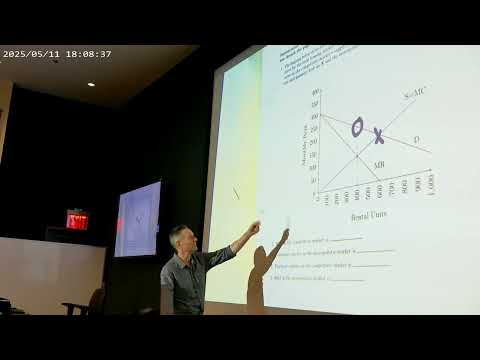
- For a monopolist, find quantity where marginal revenue equals marginal cost, then move vertically to demand to read the monopoly price.
- The graph illustrates that monopoly produces less and charges more than competition.
- Consumer surplus is the area below demand and above price; producer surplus is below price and above supply.
- In the payoff matrix, Pepsi selects columns and Coke selects rows; if Pepsi spends little on R&D, Coke's best response is to spend a lot, earning 400 rather than 300.
- Both firms spending a lot is the Nash equilibrium because each firm's action is a best response to the other's action.
- Spending a lot is dominant for both firms, making the game a version of the prisoners' dilemma.
- A best response is an action, not the payoff number associated with that action.
- The competitive quantity is where demand crosses private marginal cost, which is the market supply curve.
- In the diagram, the competitive quantity is 4 and external damage is 2 per unit, so total external damages equal 4 × 2 = 8.
- The socially optimal quantity is 3, found where demand intersects marginal social cost; damages at that output equal 3 × 2 = 6.
- Total damages can be represented either as quantity multiplied by damage per unit or as the corresponding rectangle on the graph.
- For the generic payoff matrix, if the column player chooses little A, the row player's best response is big A because 4,000 exceeds 1,000.
- Given big A, the column player's best response is little A because its payoff is 2,000 rather than 500.
- The Nash equilibrium is the action pair where both players are responding optimally to each other; the exam questions will have one equilibrium.
- In Hotelling's beach model, two hot-dog stands competing only over location both settle at the center, securing half the customers each.
- The socially preferred arrangement is different: placing stands at B minimizes the total walking distance for beachgoers.
- The Coase theorem, previewed for the post-exam lecture, says efficient outcomes can occur regardless of initial rights allocation when property rights are defined and transaction costs are zero.
- A per-unit tax equal to external damage can address an externality; in the earlier diagram, that tax would be 2.
- A competitive firm chooses output where price equals marginal cost; at a price of $14, the example firm produces 14 units.
- When price is $14 and the firm has average costs below price, it earns short-run economic profit, which attracts entry.
- Entry shifts industry supply outward and lowers market price until economic profit reaches zero.
- Long-run equilibrium occurs where price equals minimum average cost; in the example, the firm produces 8 units at a price of 8.
- When marginal social cost is parallel to and above marginal private cost, the vertical gap measures the external cost per unit; one example has a gap of 9.
- With a competitive quantity of 240 and external damage of 9 per unit, total external costs are 240 × 9 = 2,160.
- In a firm-and-market diagram, a market price of 24 leads the typical firm to produce 66 units where price equals marginal cost.
- A short-run firm producing 78 units at price 28 with average cost 24 earns profit of 78 × (28 − 24) = 312; long-run market quantity in the example is 700,000.
- In the Jacob and Elsa output game, collusion means producing a small amount, while defection means producing a large amount.
- If Jacob colludes, Elsa's best response is to defect, earning 300 rather than 200.
- Defection is Jacob's best response whether Elsa colludes or defects, so defect is Jacob's dominant strategy.
- The best-response pattern shows why firms may abandon an agreement to collude even when cooperation could raise their joint profits.
- Marginal revenue for the third unit is the change in total revenue from selling two units to selling three.
- At two units and price 13, total revenue is 26; at three units and price 11, revenue is 33, so third-unit marginal revenue is 7.
- At four units and price 9, total revenue is 36; compared with 33 at three units, fourth-unit marginal revenue is 3.
- A monopolist produces the fourth unit when its marginal cost is below that unit's marginal revenue of 3.
- In the Jacob and Elsa advertising game, each firm's dominant strategy is to advertise.
- Both advertising is the Nash equilibrium, producing payoffs of 200 for Jacob and 100 for Elsa.
- Both firms could earn more by not advertising, but each has an incentive to advertise if the other refrains.
- The incentive to undercut cooperation explains why the outcome resembles a prisoners' dilemma.
- At the competitive equilibrium, market surplus is consumer surplus plus producer surplus; the diagram represents it as areas A + B + E.
- Social surplus subtracts external damages from market surplus, with the damage area represented by B + E + D.
- After subtracting damages, areas B and E cancel, leaving social surplus of A − D.
- The distinction is whether external costs are counted: market surplus excludes them, while social surplus includes them.
Transcript excerpt
0:00 Here we go. I think we're all set to go. We're at lecture 16 and a half, which puts us right on the cusp of our second exam. Right? It's going to be exciting. We've done we've worked pretty hard here. So now's your your chance to show us how show me how much how much we've learned over this time. So as before, we know how it works. Just show up in class, take the exam. You can leave when you're done. Bring a four-function calculator and a pencil. If you What the heck is that? Bring a four-function calculator that's, you know, the I guess it could have a square root function, too, or a log function. Just not one of the fancy ones you can take pictures with and all that stuff. In terms of the material, it's really I'll stress it once again.
0:48 It's everything we've done since the last exam up until now. So this I guess started with market structure where we talked about how a competitive market worked in the short run and in the long run. Then we talked about marginal revenue and market power. Then we talked about monopoly and comparing monopoly and competition. Talked a little bit about externalities, environmental economics, if you want to think about it that way. We're going to talk There's one more lecture I want to do. Since I just learned I won't be doing Eco 100 for the foreseeable future, I I have to get this one lecture in. So we'll do that after the exam. Anyways, five chapters to read, six homeworks which you don't have to have completed until Friday this week.
1:37 And then we have the slide decks here or these are the lectures anyways on the course matrix as I
This is the start of the transcript. Save this video free for the whole transcript, searchable and time-coded.
In this course
Related notes
Summary, takeaways, and chapters were generated by AI from the video's transcript and may contain errors. The video belongs to its creator, Matthew Baker.