ECO 100 - 16 - F2026
Overview
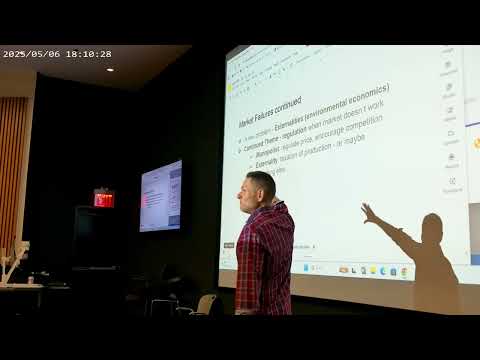
Matthew Baker explains negative externalities as costs imposed on third parties when firms use resources such as clean air, water, or silence without paying for them. In a numerical example, marginal external cost is $2 per unit, so a Pigouvian tax of $2 reduces output from 100 to the socially optimal 80 units; Baker then contrasts command-and-control rules with tradable emissions permits, citing the phaseout of leaded gasoline and sulfur dioxide permits that helped curb acid rain.
Key takeaways
- A negative externality occurs when a market transaction imposes costs on third parties, as with car exhaust, fertilizer runoff, or cement-plant noise.
- Marginal social cost equals marginal private cost plus marginal external cost; when firms ignore the external cost, competitive markets produce more than the socially optimal quantity.
- In Baker’s example, a $2 marginal external cost makes output of 100 units excessive; a $2 Pigouvian tax reduces output to 80 units and raises $160 in revenue.
- At 100 units, the example’s $500 in consumer and producer surplus minus $200 in damages gives $300 in social welfare; at 80 units, $480 in surplus minus $160 in damages gives $320.
- Command-and-control policies under the Clean Air Act and Clean Water Act helped reduce pollution, while tradable permits offered a market-based approach through programs targeting lead in gasoline and SO2 emissions.
- Tradable emissions permits limit total pollution through a government-set cap while allowing firms to buy and sell rights, creating a market for the use of air or other shared resources.
Chapters
- Matthew Baker announces a practice exam available in class, Top Hat, and Gradescope, plus 54 additional review questions.
- The class will review for the exam on Monday, with the exam scheduled for the following Wednesday.
- Practice exam question 14 covers the Coase theorem, which Baker says the class will discuss after the exam.
- Competitive markets typically maximize social gains, while interventions such as taxes and price controls can create deadweight loss.
- Monopoly creates a market failure because firms set output where marginal revenue equals marginal cost, producing less and charging more than in competition.
- Externalities add another rationale for policy, with regulation or taxation potentially improving on the market outcome.
- A negative externality occurs when a buyer-seller transaction imposes costs on someone outside the transaction.
- Examples include noisy, dusty all-terrain vehicle tours affecting Caribbean residents, car exhaust degrading air quality, and fertilizer runoff contaminating water.
- Baker cites Boomer v. Atlantic Cement, where cement-plant dust and truck noise affected neighbors, and Sturges v. Bridgman, where a candy maker’s noise disrupted a doctor’s practice.
- The policy question is not simply whether harm occurs, but how much production should continue and how affected parties should be compensated.
- Positive externalities arise when benefits spill over to people outside the original transaction.
- Weather forecasts provide shared information, while beekeepers’ bees pollinate orchards and nearby plants.
- Baker’s examples include holiday decorations and children’s lost jackets or soccer balls that other people can enjoy.
- Baker reframes pollution as a resource-use problem: firms consume resources without paying for them.
- A factory uses clean air during production and releases dirty air, while farms can use river water without bearing the full cost of fertilizer runoff.
- Noise pollution can be understood as using up silence, as in the trucks near the Atlantic Cement plant.
- Market supply reflects marginal private cost, the labor, materials, and other expenses paid by the firm.
- Marginal social cost adds third-party external costs to private costs, shifting the supply curve upward.
- When marginal social cost exceeds private cost, the competitive market produces too much and the market price fails to reflect the full cost to society.
- In Baker’s example, marginal external cost is $2 per unit; producing 100 units creates $200 in total damages.
- At the market outcome, consumer and producer surplus total $500, so social welfare after damages is $300.
- Reducing production to 80 units yields $480 in consumer and producer surplus and $160 in damages, for social welfare of $320.
- At 100 units, the last unit creates $5 of benefit but costs society $7; at 80 units, marginal benefit and marginal social cost both equal $6.
- A per-unit tax equal to the $2 marginal external cost shifts firms’ effective costs upward and reduces output from 100 to the socially optimal 80 units.
- The tax makes firms account for the cost of using a resource such as clean air, rather than treating it as a free input.
- Baker identifies this corrective charge as a Pigouvian tax, named for economist Arthur Cecil Pigou.
- At 80 units, a $2 tax raises $160 in revenue, equal to total external damages at that output.
- A government could directly cap production at 80 units or require firms to use specified technologies instead of applying a tax.
- Baker distinguishes the $2 per-unit external cost from total damages, which equal the per-unit cost multiplied by output.
- The damage rectangle on the graph represents aggregate harm, while the $2 vertical distance represents marginal damage per unit.
- Baker describes the Clean Air Act and Clean Water Act as responses to severe pollution during U.S. industrialization.
- The Cuyahoga River near Cleveland caught fire after floating waste ignited, and Lake Erie and New York waterways were also heavily polluted.
- Baker says the laws produced substantially cleaner air and water, but largely used command-and-control rules such as required pollution-control technologies rather than taxes.
- Assessing environmental policy requires information about production processes and the damages caused by emissions.
- Baker notes that even technically informed agencies face value judgments about whose costs matter, illustrated by the doctor and confectioner in Sturges v. Bridgman.
- He argues that economists sought less costly ways to meet environmental goals than uniform technology mandates.
- Marketable emissions permits create a limited right to pollute that firms can buy and sell, establishing a market for an otherwise unpriced resource.
- The government limits total pollution by issuing a fixed number of permits and can reduce the cap over time.
- Baker presents permits as a way to make firms pay for resource use while letting market exchange help allocate pollution rights.
- A tradable-permit program gradually reduced firms’ rights to put lead in gasoline until leaded gasoline disappeared.
- The 1990 Clean Air Act amendments established sulfur dioxide permits, with one permit authorizing emissions of roughly one ton of SO2 per year.
- The SO2 program targeted a major cause of acid rain by allowing permits to trade while the government reduced the number available.
- Baker closes by framing tradable permits as a way to create a missing market, then returns to the Coase theorem as a topic for after the exam.
Transcript excerpt
0:00 Okay, here we are. I think it's a Is it actually lecture 16? I Yeah, okay. I The The thing is the slide deck is the same for this lecture as for last one. Um just because we fell a little bit behind and it took us two classes to get through uh game theory, so here we are. Uh we get to talk about uh We'll talk a little bit about externalities today, which is a strange word, but I'll get into what that means uh shortly. It's a pretty exciting thing to talk about. Um anyways uh Okay, so uh we are now Let's see. It is the fourth here today, and as I as promised, I do have review materials for the exam for you. Uh so I placed some uh copies of my practice exam in the
0:48 back of the classroom, and there's also some here. I also released it on Top Hat, and it's also on GradeScope. So you should be able to get this uh exam in multiple locations uh this practice exam. And we are one week out from our next exam, which is, you know, uh next Wednesday. So the materials are handed out. More on that in a second. Uh we will spend all day Monday, all class Monday reviewing, and then we'll just have our exam as last time. Uh and hopefully you'll be ready for the material and the length and all of the stuff that goes along with uh uh exam taking. So one thing on Top Hat um if I Let's see. Second exam here
1:37 uh I actually assigned you this thing called It's called second exam template. That's not a great uh name for this, but it is a set of questions. There's 54 of them. It's
This is the start of the transcript. Save this video free for the whole transcript, searchable and time-coded.
In this course
Related notes
Summary, takeaways, and chapters were generated by AI from the video's transcript and may contain errors. The video belongs to its creator, Matthew Baker.